Introduction to the Nicolaus Copernicus Heliocentric Theory
The development of modern astronomy can be traced back to one revolutionary idea: the nicolaus copernicus heliocentric theory. Before Copernicus, scientists believed that Earth stood at the center of the universe. This belief, known as the geocentric model, had dominated scientific thinking for more than a thousand years.
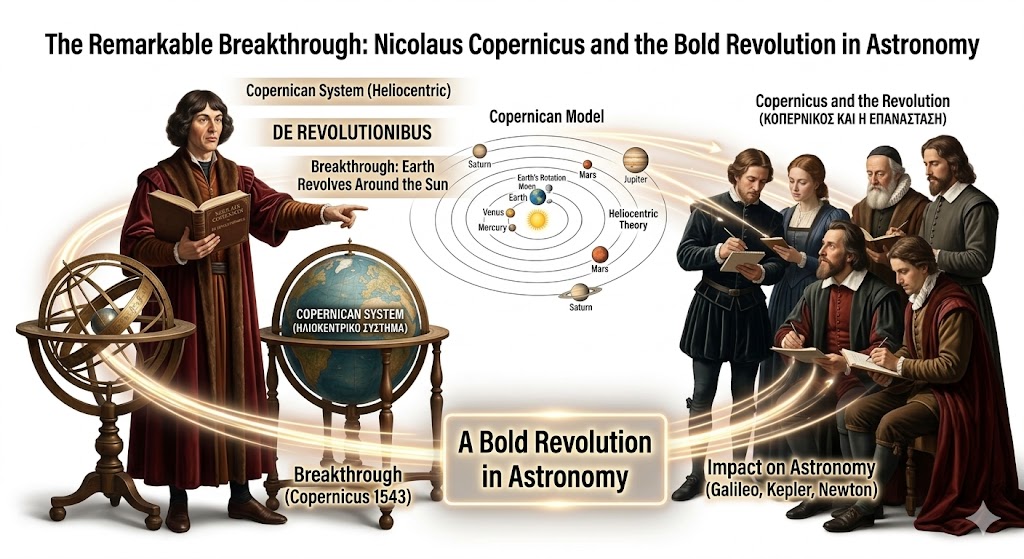
Nicolaus Copernicus changed this perspective by proposing that the Sun, not Earth, lies at the center of the planetary system. According to the nicolaus copernicus heliocentric theory, Earth rotates on its axis and revolves around the Sun along with other planets. This idea was revolutionary because it challenged centuries of tradition and transformed the way humans understood the cosmos.
The importance of the nicolaus copernicus heliocentric theory goes beyond astronomy. It marked the beginning of the scientific revolution and encouraged scientists to question established beliefs using observation and mathematics.
To fully appreciate Copernicus’ achievement, it is also important to understand how ancient greek scientists changed modern science, since many earlier discoveries laid the foundation for the work of Copernicus.
Early Life of Nicolaus Copernicus
Nicolaus Copernicus was born in 1473 in Toruń, a city in modern-day Poland. From an early age, he showed great interest in mathematics, astronomy, and philosophy. His education played a crucial role in shaping the ideas that eventually led to the nicolaus copernicus heliocentric theory.
Copernicus studied at the University of Kraków, where he learned about astronomy and mathematics. Later, he traveled to Italy to continue his education in law, medicine, and astronomy. During this time, he studied classical works by Greek scientists such as Aristotle, Ptolemy, and Hipparchus.
These scholars had created the foundations of ancient astronomy. Their studies demonstrate how ancient greek scientists changed modern science, since their observations and mathematical ideas inspired later thinkers like Copernicus.
While studying these earlier works, Copernicus began to notice weaknesses in the traditional geocentric explanation of planetary motion.
The Universe Before the Nicolaus Copernicus Heliocentric Theory
Before the nicolaus copernicus heliocentric theory, the dominant explanation of the universe was the geocentric model. According to this theory, Earth remained fixed at the center while the Sun, Moon, planets, and stars revolved around it.
This system was refined by the Greek astronomer Claudius Ptolemy. His model used epicycles and deferents to explain planetary motion. Although the model could predict celestial movements, it required increasingly complicated adjustments to match observations.
Over time, astronomers realized that the geocentric model had become extremely complex. These difficulties encouraged Copernicus to search for a simpler explanation of the cosmos.
His search eventually led to the development of copernicus’ heliocentric model, which placed the Sun at the center of the solar system.
Copernicus’ Heliocentric Model and Its Revolutionary Idea
The core concept of the nicolaus copernicus heliocentric theory was simple but revolutionary. Instead of Earth standing at the center of the universe, Copernicus proposed that the Sun occupies the central position.
In copernicus’ heliocentric model, Earth rotates once every day and revolves around the Sun once every year. The other planets also orbit the Sun, each following its own path.
This explanation made planetary motion much easier to understand. For example, the strange backward movement of planets known as retrograde motion could now be explained naturally through the motion of Earth and other planets.
Because of its simplicity and logical structure, copernicus’ heliocentric model became one of the most important ideas in the history of astronomy.
Astronomical Observations Supporting the Theory
Although Copernicus did not have access to telescopes, he relied heavily on careful astronomical observations to develop his ideas. Using basic instruments available in the Renaissance period, he tracked the positions of stars and planets.
These astronomical observations allowed Copernicus to identify patterns in planetary motion. By comparing these patterns with predictions from different models, he realized that the heliocentric system offered a more consistent explanation.
The nicolaus copernicus heliocentric theory therefore combined observation with logical reasoning. Even though his observational tools were limited, his interpretation of celestial motion was remarkably insightful.
Repeated astronomical observations helped Copernicus strengthen his argument for a Sun-centered universe.
Mathematical Methods of Copernicus
Another important aspect of the nicolaus copernicus heliocentric theory was the use of mathematical calculations. The mathematical methods of copernicus helped explain planetary motion in a more organized way than earlier models.
Copernicus used geometry and arithmetic to calculate planetary orbits and determine the relative distances of planets from the Sun. Although he still assumed circular orbits, his calculations demonstrated that the heliocentric model could explain celestial movements more clearly.
The mathematical methods of copernicus were crucial in transforming astronomy into a more precise science. By combining observation with mathematics, Copernicus helped create a scientific approach that influenced later astronomers.
These methods eventually inspired scientists such as Johannes Kepler to develop more accurate mathematical descriptions of planetary motion.
Books of Copernicus (De Revolutionibus)
The ideas behind the nicolaus copernicus heliocentric theory were formally presented in the famous books of copernicus (de revolutionibus). The full title of this work was De Revolutionibus Orbium Coelestium, which means “On the Revolutions of the Heavenly Spheres.”
Published in 1543, the books of copernicus (de revolutionibus) explained the heliocentric structure of the solar system in detail. The book included mathematical calculations, diagrams, and explanations of planetary motion.
Although the books of copernicus (de revolutionibus) were initially controversial, they gradually gained acceptance among scholars. Many scientists began to study the heliocentric theory and explore its implications.
This book later became one of the most influential scientific works in history.
Influence on Renaissance Astronomy
The publication of the nicolaus copernicus heliocentric theory had a profound influence on renaissance astronomy. After Copernicus introduced his new model, astronomers began to reexamine traditional beliefs about the universe.
Scientists such as Tycho Brahe collected more accurate astronomical data, while Johannes Kepler used mathematical analysis to develop the laws of planetary motion. Galileo Galilei later used telescopes to observe celestial bodies and support the heliocentric model.
The influence on renaissance astronomy created a scientific transformation that reshaped humanity’s understanding of the universe.
Without the revolutionary nicolaus copernicus heliocentric theory, these later discoveries might not have occurred.
Copernicus’ Legacy in Modern Science
Today, the impact of the nicolaus copernicus heliocentric theory is recognized as one of the most significant turning points in scientific history.
The long-term importance of copernicus’ legacy in modern science lies in the way it changed scientific thinking. Copernicus demonstrated that long-held beliefs could be questioned and replaced through observation and reasoning.
The copernicus’ legacy in modern science can be seen in modern astronomy, space exploration, and physics. His ideas inspired generations of scientists who continued to study the universe using scientific methods.
Because of this lasting influence, the nicolaus copernicus heliocentric theory remains a central concept in the history of science.
Frequently Asked Questions (FAQs)
What is the Nicolaus Copernicus heliocentric theory?
The nicolaus copernicus heliocentric theory states that the Sun is at the center of the solar system and that Earth and other planets revolve around it.
Why was Copernicus’ theory important?
It challenged the geocentric model and helped start the scientific revolution.
What book explained Copernicus’ theory?
Copernicus explained his ideas in De Revolutionibus Orbium Coelestium.
How did Copernicus influence later scientists?
His theory inspired astronomers like Kepler and Galileo to study planetary motion and develop modern astronomy.
Conclusion
The story of Nicolaus Copernicus is one of courage, curiosity, and intellectual revolution. By proposing the nicolaus copernicus heliocentric theory, Copernicus transformed humanity’s understanding of the cosmos.
His work challenged centuries of tradition and inspired a new era of scientific discovery. The ideas he introduced influenced generations of scientists and played a key role in the development of modern astronomy.
Even today, the nicolaus copernicus heliocentric theory remains one of the most important milestones in the history of science, reminding us that new discoveries often begin with the courage to question established beliefs.