The history of human thought is punctuated by moments of profound clarity that forever alter our perspective on existence. Perhaps no shift was more destabilizing or more brilliant than the nicolaus copernicus heliocentric theory. For over a thousand years, humanity had lived with the absolute certainty that the Earth was the immobile center of all creation. In 1543, with the publication of his life’s work, a Polish cleric challenged this “obvious” truth, proposing instead a Sun-centered universe that would spark the Scientific Revolution.
Introduction to Copernicus’ Heliocentric Model
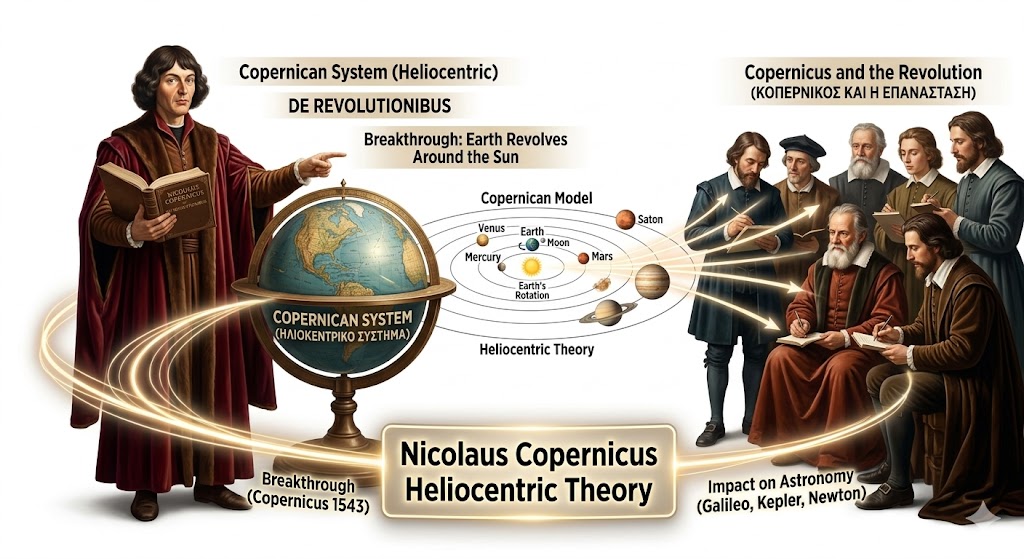
The nicolaus copernicus heliocentric theory was more than a mere astronomical update; it was a fundamental reorganization of the cosmos. By shifting the Earth from its central position and placing it among the planets orbiting the Sun, Copernicus dismantled the rigid hierarchy of medieval science. This Copernican solar system model simplified the complex celestial dance that had baffled scholars for centuries. While Copernicus himself was a cautious man, the implications of his heliocentric theory explained a universe that was far more vast and dynamic than previously imagined, ultimately leading to the Copernicus’ legacy in modern science.
The Geocentric Universe Before Copernicus
To appreciate the nicolaus copernicus heliocentric theory, one must understand the model it replaced. The Ptolemaic, or geocentric, system had been the gold standard for over 1,400 years. It suggested that the Earth sat perfectly still while the Sun, Moon, and planets revolved around it in perfect circular paths.
This early heliocentric astronomy was preceded by a world of “epicycles” and “deferents”—complex mathematical loops designed to explain why planets occasionally seemed to move backward. While this system was highly developed, it was becoming increasingly “messy” as astronomical observations became more precise. Scholars were forced to add more and more circles-within-circles to keep the math working, leading Copernicus to seek a more elegant solution.
The Core Principles of the Heliocentric Model
The nicolaus copernicus heliocentric theory was built upon a few radical, yet simple, axioms. In his landmark text, often referred to among the books of copernicus (de revolutionibus), he outlined these core principles:
- The Earth is not the center of the universe, but only the center of the Moon’s orbit.
- All the spheres (planets) revolve around the Sun, which is near the center of the universe.
- The perceived motion of the Sun is actually caused by the Earth’s own rotation on its axis and its yearly revolution around the Sun.
- The apparent retrograde motion of the planets is an optical illusion caused by the Earth’s movement relative to the other planets.
How the Sun Became the Center of the System
In the nicolaus copernicus heliocentric theory, the Sun became the “lamp of the universe.” Copernicus argued that the Sun’s central position was not just mathematically convenient but aesthetically and physically logical. He believed that the source of light and heat should naturally sit at the heart of the system. This Sun centered universe provided a fixed point from which all other distances could be measured. By using the mathematical methods of copernicus, he was able to calculate the relative distances of the planets from the Sun for the first time, revealing a solar system structure that was far larger than the Greeks had estimated.
Explaining Planetary Motion in the Heliocentric Model
The beauty of the nicolaus copernicus heliocentric theory lay in its ability to explain the varied speeds of the planets. In a geocentric system, it was difficult to explain why Mars, Jupiter, and Saturn took so much longer to orbit than Mercury or Venus. Copernicus realized that the further a planet was from the Sun, the slower its planetary motion around the sun would be.
This Copernican system astronomy created a cohesive link between a planet’s distance and its orbital period. It was a rigorous Copernicus planetary model that replaced the chaotic individual motions of the old system with a single, unified law of motion.
Retrograde Motion and the Copernican Solution
One of the most annoying problems in ancient astronomy was “retrograde motion,” where planets like Mars appear to stop and move backward in the sky. The nicolaus copernicus heliocentric theory solved this elegantly without the need for complex epicycles.
Copernicus explained that this is merely a perspective effect. Because Earth is on an inner, faster track, it periodically “laps” the outer planets. As we pass Mars, it appears to move backward against the distant stars, much like a slower car appears to move backward when you pass it on the highway. This “Copernican revolution astronomy” proved that a moving Earth could explain celestial phenomena better than a stationary one.
Comparison Between Geocentric and Heliocentric Models
When comparing the heliocentric vs geocentric model, the primary difference is simplicity and predictive power.
| Feature | Geocentric (Ptolemy) | Heliocentric (Copernicus) |
| Center | Earth | Sun |
| Earth’s Motion | Stationary | Rotating and Revolving |
| Retrograde Motion | Real (Epicycles) | Optical Illusion (Perspective) |
| Order of Planets | Moon, Mercury, Venus, Sun… | Mercury, Venus, Earth, Mars… |
| Mathematical Complexity | High (many circles) | Lower (unified system) |
While the nicolaus copernicus heliocentric theory still used some small circles (as he wrongly believed orbits were perfect circles), it reduced the total number of moving parts needed to explain the heavens. This efficiency had a massive influence on renaissance astronomy, as it appealed to the period’s desire for mathematical harmony.
Scientific Impact of the Heliocentric Model
The nicolaus copernicus heliocentric theory did not become the standard overnight. Because it contradicted the literal interpretation of certain religious texts and the “common sense” of the era, it faced significant resistance. However, it provided the essential framework for those who followed.
Galileo’s telescope discoveries, Kepler’s elliptical laws, and Newton’s gravity were all built directly upon the foundation of the nicolaus copernicus heliocentric theory. Without this initial “breakthrough,” the path to modern physics would have been blocked by the immovable Earth.
Frequently Asked Questions (FAQs)
What is the main idea of the nicolaus copernicus heliocentric theory?
The main idea is that the Sun, not the Earth, is the center of the solar system, and that the Earth revolves around the Sun once a year and rotates on its axis once a day.
Why was Copernicus’s model revolutionary?
It was revolutionary because it challenged 1,400 years of scientific and religious dogma, fundamentally changing humanity’s place in the universe from the “center of everything” to just one of many planets.
Did Copernicus prove the Earth moves?
He provided a mathematical model that was much simpler and more logical than the geocentric model, but he didn’t have the physical “proof” (like stellar parallax), which came centuries later.
Why did Copernicus wait so long to publish his work?
He was a perfectionist and feared the controversy it would cause. His book, De revolutionibus orbium coelestium, was only published as he was on his deathbed in 1543.
What is the difference between heliocentric and geocentric?
Heliocentric means “Sun-centered,” while geocentric means “Earth-centered.”
Conclusion
The nicolaus copernicus heliocentric theory remains one of the greatest achievements of the human mind. By having the courage to look past the “obvious” and trust in the power of mathematics, Copernicus opened the door to the modern world. His model taught us that we live on a “pale blue dot” in a vast, spinning universe—a realization that is both humbling and exhilarating. By refining the mathematical rigour of his predecessors, he demonstrated how ancient greek scientists changed modern science through their foundational logic, even as he moved the world beyond their geocentric errors. As we look at the stars today, we do so through the eyes of a revolution that began five hundred years ago with a single, brilliant idea: that we are in motion, orbiting the light of the Sun.