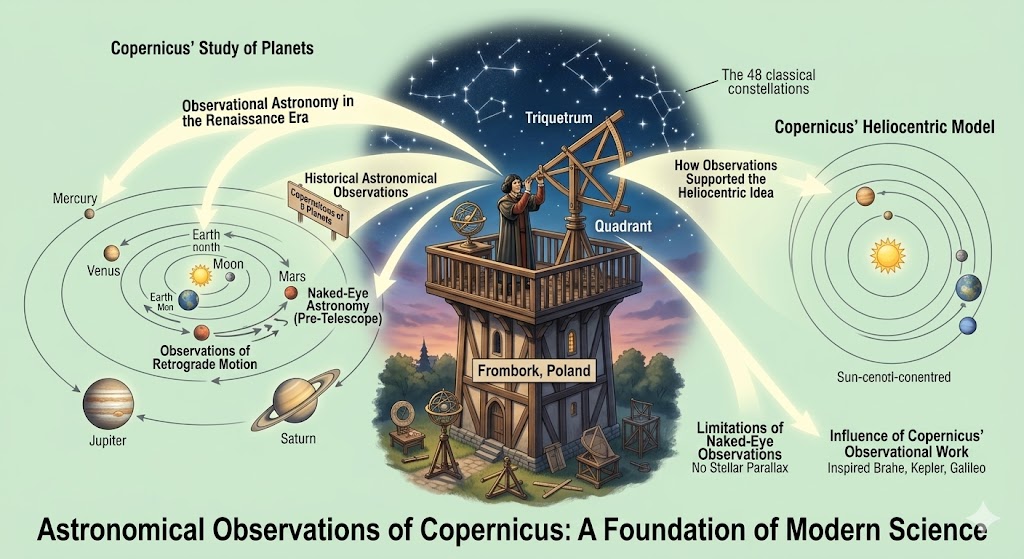
The transition from a world-centered view to a sun-centered one was not merely a lucky guess; it was the result of the meticulous astronomical observations of copernicus. Working in an era before the invention of the telescope, Nicolaus Copernicus had to rely on his own eyes and primitive wooden instruments to challenge a thousand years of established dogma. By carefully documenting the night sky from his tower in Frombork, he gathered the data necessary to propose the nicolaus copernicus heliocentric theory, a shift that would eventually move the Earth itself in the minds of all humanity.
Introduction to Copernicus’ Astronomical Observations
The astronomical observations of copernicus represent a bridge between the medieval obsession with philosophy and the modern obsession with empirical data. While Copernicus is often remembered as a theoretical mathematician, he was also a dedicated practitioner of naked eye astronomy. He spent decades recording the positions of the moon, the sun, and the five known planets. These astronomical observations of copernicus were designed to find inconsistencies in the prevailing geocentric model. He realized that if the math didn’t match the sky, it was the model—not the sky—that was wrong. This commitment to observation is what eventually led to the development of copernicus’ heliocentric model.
Observational Astronomy in the Renaissance Era
During the 15th and 16th centuries, Renaissance astronomy observations were undergoing a slow but steady transformation. Scholars were no longer content with just reading ancient Greek texts; they wanted to verify the heavens for themselves. However, early sky observation techniques were limited. Without magnifying lenses, astronomers had to be incredibly precise with their measurements of angles and degrees. The astronomical observations of copernicus were influenced by this burgeoning spirit of inquiry, which sought to harmonize the beauty of the cosmos with the emerging rigor of the scientific method.
Tools Used by Copernicus for Observations
It is a common misconception that Copernicus had access to advanced technology. In reality, he used ancient astronomical instruments that would seem crude today. His tools were largely made of wood and lacked the precision of the brass instruments that would follow. Key tools included:
- The Triquetrum: Used for measuring the altitudes of celestial bodies.
- The Quadrant: A tool used to measure the height of the sun and stars above the horizon.
- The Armillary Sphere: A model of objects in the sky, used to determine coordinates.
Despite these limitations, the astronomical observations of copernicus were remarkably accurate. He utilized these tools to perform his Copernicus study of planets, carefully noting the degrees of separation between celestial bodies over long periods.
Tracking the Motion of Planets
A central part of the astronomical observations of copernicus involved planetary tracking methods. He was particularly interested in the “wandering stars”—the planets—and how they moved relative to the background of fixed stars. By comparing his own historical astronomical observations with those recorded by the ancients, he noticed that the timing of planetary appearances was slightly off.
He applied the mathematical methods of copernicus to these data points, realizing that the erratic speeds of the planets could be explained much more simply if the observer (the Earth) was also in motion. This realization was a turning point in his life’s work, which he would eventually document in the famous books of copernicus (de revolutionibus).
Observations of Retrograde Motion
Perhaps the most confusing phenomenon for early sky watchers was retrograde motion—the moments when planets like Mars appear to stop and move backward. Through his astronomical observations of copernicus, he realized that this was not a physical loop in space, as the Greeks believed, but a perspective effect.
His early planetary observations of Mars and Jupiter showed that this “looping” always happened when the planet was opposite the sun in the sky. In copernicus’ heliocentric model, this was easily explained: Earth, being on an inner and faster orbit, was simply passing the outer planet. This observational proof was the “smoking gun” that undermined the geocentric model.
How Observations Supported the Heliocentric Idea
The astronomical observations of copernicus acted as the evidence for his revolutionary theory. He observed that Mercury and Venus never wandered far from the sun. In a geocentric system, this was a mystery that required complicated “linking” of their orbits. In the nicolaus copernicus heliocentric theory, it was the natural result of those planets being closer to the sun than Earth is.
These findings had a massive influence on renaissance astronomy, as they provided a logical, visual reason to accept a sun-centered universe. By documenting these patterns, the astronomical observations of copernicus turned a radical philosophical idea into a verifiable scientific hypothesis.
Limitations of Naked-Eye Observations
While his work was brilliant, the astronomical observations of copernicus suffered from the limitations of pre-telescope astronomy. One major problem was the lack of “stellar parallax.” Copernicus correctly predicted that if the Earth moved, the stars should appear to shift positions slightly. However, because the stars are so incredibly far away, this shift is invisible to the naked eye.
This lack of visible parallax was a major argument used against him by critics. Because his astronomical observations of copernicus could not prove the Earth’s motion directly, he had to rely on the “elegance” of his math to win over his peers. It would take centuries and the invention of powerful telescopes to finally see the shift he predicted.
Influence of Copernicus’ Observational Work
The true power of the astronomical observations of copernicus lies in what they inspired. By proving that the old system was flawed, he paved the way for Tycho Brahe, who would take even more precise observations, and Johannes Kepler, who would use that data to discover elliptical orbits.
This lineage of thought is the core of copernicus’ legacy in modern science. His insistence that we must look at the sky with fresh eyes and trust the data over tradition changed the world forever. The astronomical observations of copernicus were the spark that ignited the Scientific Revolution, moving us from a world of myth to a world of measurable reality.
Frequently Asked Questions (FAQs)
Did Copernicus use a telescope for his observations?
No, the telescope was not invented until more than 50 years after Copernicus died. He used his naked eyes and wooden instruments like the triquetrum.
How accurate were the astronomical observations of copernicus?
For his time, they were quite accurate. He was able to determine the relative distances of the planets from the sun with surprising precision, though he still believed orbits were perfect circles.
Where did Copernicus conduct his observations?
Most of his work was done in Frombork, Poland, where he had an observatory in one of the towers of the cathedral wall.
What was the most important thing Copernicus observed?
His observations of the positions of the planets—especially their retrograde motion—were vital because they showed that a sun-centered system was much simpler and more logical than an Earth-centered one.
Why did Copernicus need to study the planets for so long?
Planetary cycles take years to complete (for example, Saturn takes 29 years to orbit the sun). To gather enough data to build a new model, he had to track these movements over decades.
Conclusion
The astronomical observations of copernicus remind us that great revolutions often begin with quiet, patient work. By spending his nights tracking the faint lights of the planets, Copernicus was able to dismantle a universe and build a new one. His data provided the skeleton for the nicolaus copernicus heliocentric theory, proving that the Sun—not the Earth—was the heart of our system. This intellectual shift illustrates how ancient greek scientists changed modern science, as Copernicus utilized their foundational geometric logic even while correcting their observational errors. While he lacked the tools of modern technology, his dedication to empirical truth remains a pillar of copernicus’ legacy in modern science. As we peer into the deepest reaches of space today, we are still following the path first cleared by the humble, wooden instruments of a Renaissance priest.