At the heart of the Scientific Revolution lay a silent, numerical transformation. While we often focus on the dramatic shift from Earth to Sun, the mathematical methods of copernicus were the true engine of change. Nicolaus Copernicus was not just a dreamer staring at the stars; he was a rigorous mathematician who believed that the universe was written in the language of geometry. By applying complex orbital calculations to the heavens, he provided the proof needed to support the nicolaus copernicus heliocentric theory, proving that numbers could reveal truths that our senses might miss.
Introduction to Mathematical Astronomy
In the 16th century, astronomy was considered a branch of mathematics rather than physics. The mathematical methods of copernicus emerged from a tradition where the “saving of appearances”—predicting the positions of planets—was the ultimate goal. However, Copernicus went further. He sought a mathematical harmony that the previous system lacked. By studying how ancient greek scientists changed modern science, Copernicus adopted their love for perfect circles and ratios but rearranged the pieces of the celestial puzzle to create a more logical and simplified model of the universe.
Mathematics in Copernicus’ Heliocentric Theory
The mathematical methods of copernicus were designed to solve the growing complexity of the medieval universe. In the old system, the math had become so cluttered with “equants” and “epicycles” that it resembled a broken machine. Copernicus used his skills in Copernicus mathematical astronomy to demonstrate that by placing the Sun at the center, the math became more “elegant.”
The mathematical methods of copernicus allowed him to assign relative sizes to the orbits of the planets for the first time in history. He didn’t just say the Earth moved; he used scientific mathematics in astronomy to prove exactly how fast and how far it moved in relation to its neighbors.
Geometry and Planetary Motion
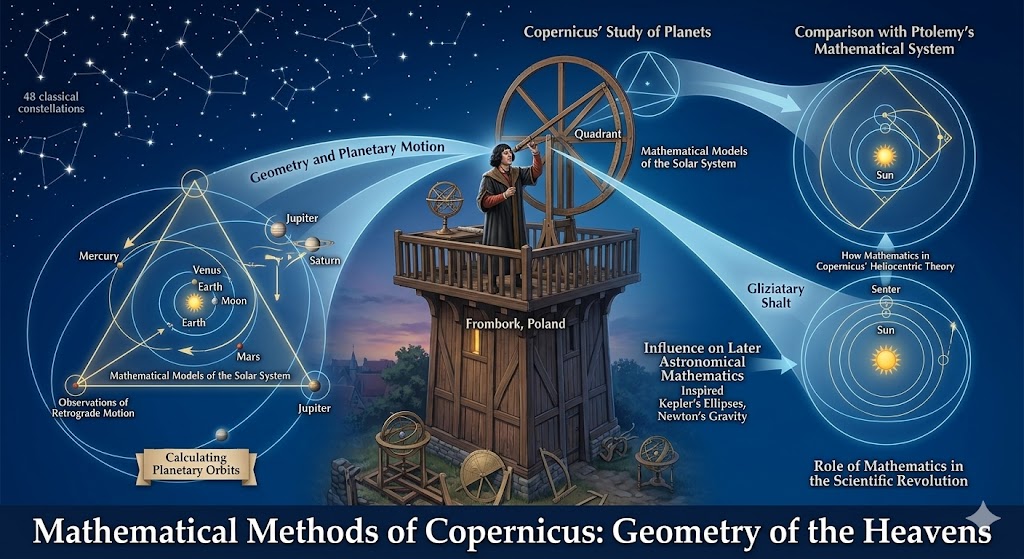
Geometry in astronomy was the primary tool of the Renaissance scholar. Copernicus relied heavily on plane and spherical trigonometry to map the movements of the planets. Through the mathematical methods of copernicus, he treated the solar system as a series of nested spheres.
By observing the angles of the planets from a moving Earth, he utilized astronomical observations to triangulate the positions of Mars, Jupiter, and Saturn. These planetary motion calculations were revolutionary because they treated the Earth’s orbit as a baseline for measuring the rest of the cosmos, a technique that remains a staple of modern astrophysics.
Calculating Planetary Orbits
The most difficult part of the mathematical methods of copernicus was accounting for the varying speeds of the planets. Because he still believed that orbits must be perfect circles, he had to use a device called a “small epicycle” to account for the slight irregularities in speed.
Despite this, his mathematical methods of copernicus were far more accurate than those of his predecessors. He successfully calculated the “period” of each planet—the time it takes to circle the Sun—to within a few minutes of modern values. This early astronomy calculations paved the way for the influence on renaissance astronomy, as scholars realized that a sun-centered system was not just a philosophical idea, but a superior calculator.
Mathematical Models of the Solar System
In his landmark books of copernicus (de revolutionibus), Nicolaus provided a complete mathematical modeling of planets. His model was the first to correctly order the planets based on their orbital speed:
- Mercury (fastest)
- Venus
- Earth (with the Moon)
- Mars
- Jupiter
- Saturn (slowest)
The mathematical methods of copernicus showed a direct correlation between distance from the Sun and orbital time. This was a massive leap in mathematical astronomy history, as it provided a physical reason for the layout of our solar system that the Earth-centered model simply could not explain.
Comparison with Ptolemy’s Mathematical System
The mathematical methods of copernicus are best understood when compared to the Ptolemaic system. While Ptolemy used an “equant” (an imaginary point to explain speed changes), Copernicus found this mathematically “ugly” and inconsistent with the laws of physics.
| Feature | Ptolemaic Math | Mathematical Methods of Copernicus |
| Foundation | Geocentric Geometry | Heliocentric Trigonometry |
| Speed Control | Equant Point (Complex) | Small Epicycles (Consistent) |
| Planetary Order | Arbitrary | Based on Orbital Math |
| Predictive Power | Good, but messy | High and Harmonious |
By removing the equant, the mathematical methods of copernicus returned astronomy to the “pure” geometry of the ancients while simultaneously moving the field toward the copernicus’ heliocentric model.
Influence on Later Astronomical Mathematics
The mathematical methods of copernicus did not end with his death. His numbers were used to create the “Prutenic Tables,” which were the most accurate astronomical tables of the 16th century. This data was the raw material used by later geniuses.
Without the mathematical methods of copernicus, Johannes Kepler would never have had the foundation to discover that orbits are actually ellipses, not circles. This direct link between Renaissance mathematical astronomy and modern physics is a key part of copernicus’ legacy in modern science, showing that a change in math can lead to a change in our entire reality.
Role of Mathematics in the Scientific Revolution
The mathematical methods of copernicus signaled a shift in how humans interact with the world. He taught us that the truth is often hidden beneath the surface and can only be reached through calculation. This reliance on mathematical modeling of planets became the blueprint for the Scientific Revolution.
By prioritizing “mathematical truth” over “sensory truth,” the mathematical methods of copernicus empowered future scientists like Galileo and Newton to describe the universe as a vast machine governed by laws. This is perhaps the greatest influence on renaissance astronomy—the realization that the universe is a solvable equation.
Frequently Asked Questions (FAQs)
What were the primary mathematical methods of copernicus?
Copernicus used plane and spherical trigonometry combined with geometric projections to calculate the positions and orbital periods of the planets.
Why did Copernicus prefer a sun-centered model mathematically?
He found it more “elegant” and harmonious. It allowed him to explain retrograde motion as a perspective shift and linked a planet’s orbital speed directly to its distance from the sun.
Was Copernicus’s math more accurate than Ptolemy’s?
Initially, it was roughly the same because Copernicus still used circular orbits. However, his model was much simpler and provided the correct structure for later scientists to improve upon.
What mathematical mistake did Copernicus make?
His biggest mistake was the assumption that planetary orbits must be “perfect circles.” This forced him to keep using small epicycles, which were later replaced by Kepler’s ellipses.
How did the mathematical methods of copernicus impact the calendar?
His precise calculations of the length of the year and the motion of the sun were used by the Church to help reform the Gregorian calendar in 1582.
Conclusion
The mathematical methods of copernicus were the quiet revolution that changed everything. While the image of the Sun at the center is what we remember, it was the geometry, the trigonometry, and the tireless orbital calculations that made the nicolaus copernicus heliocentric theory undeniable. By proving that the universe follows a mathematical order, Copernicus did more than move the Earth; he launched the age of modern science. The mathematical methods of copernicus remain a testament to the idea that with a few circles, some triangles, and a lot of courage, a human mind can map the very heart of the heavens, ensuring copernicus’ legacy in modern science for generations to come.