The history of human progress is often defined by “before” and “after” moments. In the realm of physics and astronomy, that dividing line is the life and work of Nicolaus Copernicus. The copernicus’ legacy in modern science is not merely a collection of old star charts; it is the very foundation of the modern secular and scientific worldview. By displacing the Earth from its supposed throne at the center of the universe, Copernicus did more than move a planet—he moved the human mind. Every satellite orbiting our globe today and every rover traversing the Martian soil is a direct descendant of the nicolaus copernicus heliocentric theory.
Introduction to Copernicus’ Scientific Legacy
To discuss copernicus’ legacy in modern science is to discuss the birth of objectivity. Before the 16th century, science was often a slave to theology and “common sense.” Copernicus’ scientific legacy taught us that what we see with our eyes—the Sun rising and setting—is not always the literal truth of the universe. By providing the first predictive copernicus’ heliocentric model, he established a new standard for truth: if the mathematics and observations suggest a reality that contradicts tradition, the tradition must be discarded. This shift in the history of modern astronomy redefined our species as observers rather than the center of the drama.
The Copernican Revolution in Science
The Copernican revolution impact was seismic. It wasn’t just an “update” to the solar system; it was a total restructuring of human knowledge. In the centuries following the publication of the books of copernicus (de revolutionibus), the Western world underwent a transition from medieval mysticism to the Enlightenment.
This revolution forced humanity to reconcile with the “Copernican Principle,” which suggests that we do not occupy a privileged position in the cosmos. This humility is a core component of copernicus’ legacy in modern science, guiding how we approach everything from biology to the search for extraterrestrial life.
Influence on Modern Astronomy
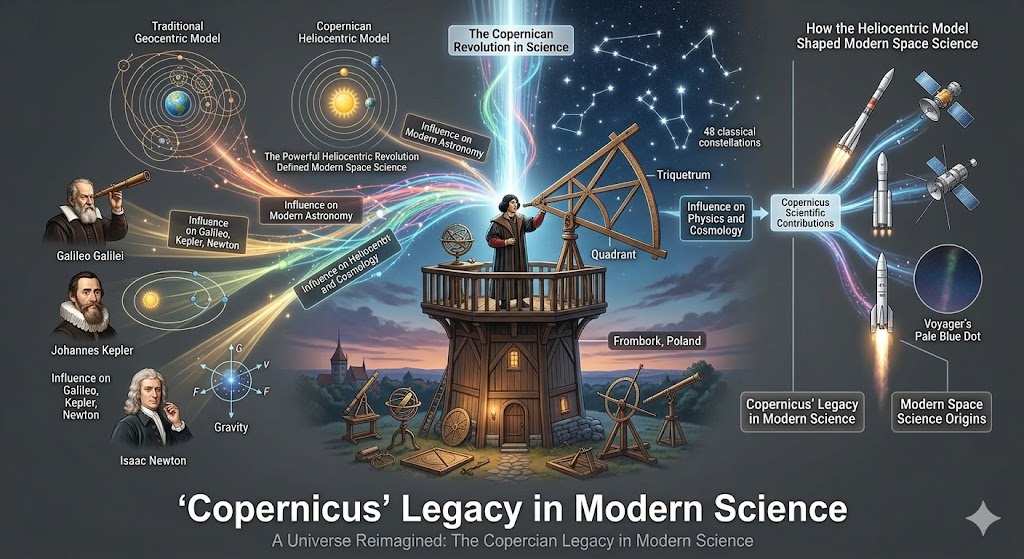
The development of modern astronomy is a direct line from the tower in Frombork to the James Webb Space Telescope. Copernicus’ scientific contributions provided the necessary framework for those who followed. Without his initial breakthrough, the influence on renaissance astronomy would have been stunted, leaving geniuses like Tycho Brahe and Johannes Kepler without a target for their research.
By identifying the correct solar system structure, Copernicus allowed astronomers to move past “where” the planets were and start asking “why” they moved. This evolution of astronomy theories shifted the focus from simple mapping to deep physical understanding, a hallmark of the copernicus’ legacy in modern science.
Influence on Physics and Cosmology
The copernicus’ legacy in modern science extends far beyond the stars and into the very laws of motion. By asserting that the Earth was in motion, Copernicus created a new problem for physics: if the Earth is spinning at incredible speeds, why don’t we feel it? This question led directly to the work of Galileo on inertia and eventually to Newton’s law of universal gravitation.
Furthermore, in modern cosmology, the “Copernican Principle” remains a foundational assumption. We assume that the laws of physics we observe here are the same everywhere in the universe. This consistency is perhaps the most “powerful” part of copernicus’ legacy in modern science, allowing us to map distant galaxies using the same logic we use to study our own backyard.
Copernicus and the Scientific Method
While we often focus on how ancient greek scientists changed modern science through their initial logic, Copernicus refined that logic into a more empirical form. He demonstrated that a scientific theory must be both mathematically elegant and observationally consistent.
The mathematical methods of copernicus proved that data must drive the model, not the other way around. This is the heart of the modern scientific method. By utilizing his own astronomical observations to challenge a 1,400-year-old error, he emboldened future generations to question authority and trust in the power of evidence.
How the Heliocentric Model Shaped Modern Space Science
The origins of modern space science are found in the transition from geocentrism to heliocentrism. The heliocentric model impact was not just theoretical; it was practical. To launch a rocket today, we must calculate its trajectory based on the Earth’s rotation and its orbit around the Sun—concepts that originated with Copernicus.
Our understanding of the “habitable zone” around other stars also stems from copernicus’ legacy in modern science. Because he correctly identified the Earth’s relationship with the Sun, we can now look at distant solar systems and predict which planets might have liquid water based on their orbital distance.
Copernicus’ Place in the History of Science
In the grand history of scientific revolution, Copernicus is the “prime mover.” He is often grouped with Darwin and Einstein as the three thinkers who most radically altered the human self-image. Before Copernicus, we were the focus of the Creator; after him, we were inhabitants of a “pale blue dot.”
His place in the history of science is unique because he didn’t have a telescope or a computer; he had only a few wooden tools and the courage to think. This human element is a vital part of copernicus’ legacy in modern science, proving that a single individual can change the world through the power of reason.
Lasting Impact of Copernicus’ Ideas
The lasting impact of Copernicus’ ideas can be seen in our cultural and philosophical landscape. The “Copernican Turn” is a term used even in philosophy to describe a total shift in perspective. As we move further into the 21st century, the copernicus’ legacy in modern science continues to grow as we discover thousands of exoplanets, confirming that our Sun is just one of billions in a vast, decentralized universe.
Frequently Asked Questions (FAQs)
What is the core of copernicus’ legacy in modern science?
The core of his legacy is the “Copernican Principle,” which states that Earth is not the center of the universe and that the laws of physics are universal.
How did Copernicus influence the Scientific Revolution?
He provided the first mathematically sound alternative to ancient geocentrism, which inspired later scientists like Galileo, Kepler, and Newton to develop modern physics.
Why is the nicolaus copernicus heliocentric theory still important today?
It remains the fundamental model for understanding our solar system and is the basis for all modern space navigation and planetary science.
What is the “Copernican Turn”?
It is a term used to describe a paradigm shift—a moment when an entire way of thinking is replaced by a new, more accurate perspective.
Did Copernicus prove the universe is infinite?
No, but by removing the Earth from the center, he opened the door for later astronomers to realize that the universe was much, much larger than previously imagined.
Conclusion
The copernicus’ legacy in modern science is the story of humanity’s intellectual awakening. By daring to move the Earth, Copernicus set the stage for every discovery that followed. He taught us that the universe does not revolve around us, yet our minds are capable of understanding its vast, hidden laws. This realization is both humbling and empowering. As we continue to explore the final frontiers of space, we do so as “Copernicans,” forever grateful to the man who gave us the map to the stars. The copernicus’ legacy in modern science is not a finished chapter; it is an ongoing journey that leads us deeper into the heart of the cosmos.