Introduction
The transistor history is one of the most revolutionary stories in modern technology. Transistors are tiny semiconductor devices that control electrical signals, making them the fundamental building blocks of all modern electronics. From smartphones and computers to satellites and artificial intelligence systems, nearly every digital device depends on transistor technology.
The invention of the transistor completely transformed the semiconductor technology, replacing bulky vacuum tubes and enabling smaller, faster, and more reliable electronics. Over the decades, engineers improved transistor designs, leading to the rapid transistor scaling that allowed billions of transistors to fit inside modern processors.
Today, the transistor remains at the heart of computing systems described in the history of computer hardware and the history of computer processors. Understanding transistor history helps explain how modern computing power became possible and why the semiconductor industry continues to push technological boundaries.
A. 1947 – 1954: The Breakthrough at Bell Labs
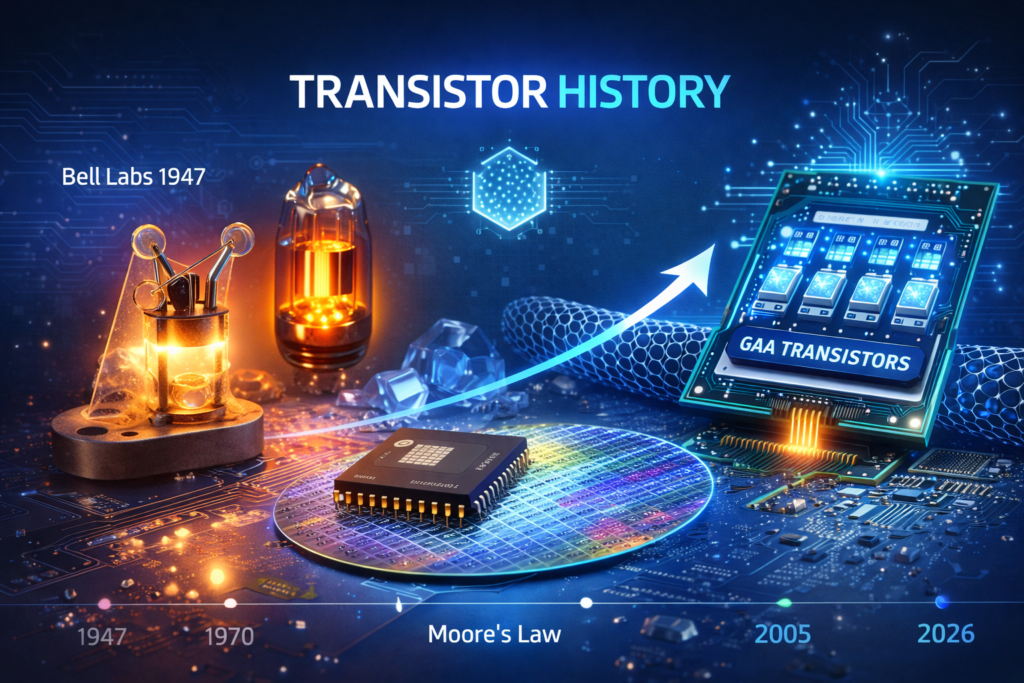
The earliest chapter of transistor history began in 1947 at Bell Laboratories in the United States. Scientists were searching for a better alternative to vacuum tubes, which were large, fragile, and consumed significant power.
Their groundbreaking discovery would completely reshape the electronics industry.
Shockley, Bardeen, and Brattain: The Point-Contact Discovery
In December 1947, physicists John Bardeen and Walter Brattain successfully demonstrated the first working transistor. Their colleague William Shockley later helped refine the design.
This early device, known as the point-contact transistor, relied on the behavior of P-type and N-type semiconductors to control electron flow.
This historic moment marked the beginning of transistor history, as the invention of the transistor proved that semiconductor devices could amplify and switch electrical signals more efficiently than vacuum tubes.
Replacing the Vacuum Tube: Why the Transistor Changed Everything
Before transistors, electronic circuits relied on vacuum tubes, which were large, fragile, and generated significant heat.
Transistors quickly replaced these components because they were:
- Smaller
- More energy efficient
- More reliable
- Faster at switching signals
The transition away from vacuum tubes played a major role in the early development of computers, which is also explored in the history of computers.
B. 1954 – 1960: Silicon Takes Over the Industry
The next milestone in transistor history occurred when engineers discovered that silicon was a better semiconductor material than germanium.
Silicon offered better thermal stability and improved manufacturing potential, which allowed transistor technology to expand rapidly.
From Germanium to Silicon: The Texas Instruments Milestone
In 1954, Texas Instruments developed the first commercial silicon transistor. This breakthrough helped launch the modern semiconductor industry.
Using carefully controlled dopants during wafer fabrication, engineers could create precise semiconductor structures that controlled electron movement.
This innovation significantly advanced the semiconductor industry timeline, enabling faster and more reliable electronic components.
The First Transistor Radios and Consumer Electronics
Transistor technology quickly entered consumer markets during the 1950s. One of the most famous products was the portable transistor radio.
These devices were smaller, cheaper, and more energy efficient than previous vacuum tube radios.
The rapid adoption of transistor electronics laid the foundation for modern computing and communication systems, including technologies explored in history of computer networking.
C. 1960 – 1970: The Invention of the MOSFET
One of the most important innovations in transistor history occurred in 1959 when engineers invented the MOSFET.
The Metal-Oxide-Semiconductor Field-Effect Transistor became the most widely used transistor design in the world.
Creating the Metal-Oxide-Semiconductor Field-Effect Transistor
The MOSFET introduced a new way to control electrical signals using an insulated gate structure.
This design allowed transistors to be smaller, more efficient, and easier to manufacture.
As a result, the evolution of mosfet technology became the foundation for nearly all modern microchips.
The Integrated Circuit (IC): Putting Multiple Transistors on One Chip
During the 1960s, engineers began combining multiple transistors onto a single silicon chip.
This breakthrough created the integrated circuit (IC), which dramatically increased computing power.
Integrated circuits made possible many technologies that later shaped the history of programming languages and advanced software development.
D. 1970 – 2000: Miniaturization and the Transistor History Milestone
Between the 1970s and early 2000s, the semiconductor industry achieved remarkable progress in transistor scaling.
Engineers developed new manufacturing techniques that allowed millions—and eventually billions—of transistors to fit on a single chip.
This era represents a critical milestone in transistor history.
VLSI: Fitting Millions of Transistors on a Single Die
Very Large Scale Integration (VLSI) technology allowed engineers to integrate millions of transistors onto a single silicon die.
This innovation dramatically increased computing power while reducing size and cost.
The growth of VLSI helped fuel developments in history of data centers and large-scale computing infrastructure.
CMOS Technology: Solving the Power Consumption Problem
As transistor density increased, engineers needed a way to reduce energy consumption.
Complementary Metal-Oxide-Semiconductor (CMOS) technology solved this challenge by using paired transistors to minimize power usage.
CMOS became the dominant technology used in nearly all modern processors.
E. 2000 – 2011: Overcoming the Limits of Physics
By the early 2000s, semiconductor engineers began encountering the physical limits predicted by Moore’s Law.
Shrinking transistors too much caused new problems such as heat generation and quantum tunneling.
High-K Dielectrics: Preventing Current Leakage
As transistor gates became extremely small, electrical leakage became a major problem.
Engineers introduced high-K dielectric materials to improve insulation and reduce leakage currents.
This innovation allowed transistors to continue shrinking while maintaining performance.
The Transition to 3D: Intel’s FinFET Revolution
In 2011, Intel introduced a revolutionary 3D transistor structure called FinFET.
Unlike traditional flat transistors, FinFET devices used a vertical fin-shaped structure that improved control of electron flow.
This design helped extend Moore’s Law and improved processor performance.
F. 2011 – 2026: Nanosheets and the Future of Atomic Logic
In recent years, transistor designs have continued evolving as engineers explore new ways to overcome physical limitations.
Modern semiconductor research focuses on structures measured in only a few nanometers.
Gate-All-Around (GAA) Transistors: Scaling Below 3nm
One promising technology is the Gate-All-Around transistor.
In this design, the gate completely surrounds the channel, providing better control over electron flow.
Gate-All-Around structures are considered the next step in transistor scaling beyond FinFET technology.
The End of Silicon? Exploring Carbon Nanotubes and 2D Materials
Researchers are also investigating alternatives to silicon, including carbon nanotubes and 2D materials like graphene.
These materials could potentially allow transistors to operate beyond the physical limits of traditional silicon.
Such innovations may support future computing systems powering Modern Artificial Intelligence Applications and next-generation electronics.
Frequently Asked Questions (FAQs)
What is a transistor?
A transistor is a semiconductor device that controls electrical signals and acts as a switch or amplifier in electronic circuits.
Who invented the transistor?
The transistor was invented in 1947 by John Bardeen and Walter Brattain at Bell Laboratories, with important contributions from William Shockley.
Why are transistors important in computers?
Transistors form the foundation of integrated circuits and processors, enabling modern computing devices to function.
What is MOSFET technology?
MOSFET stands for Metal-Oxide-Semiconductor Field-Effect Transistor. It is the most widely used transistor design in modern electronics.
Are transistors reaching their physical limits?
Yes, engineers are approaching the physical limits predicted by Moore’s Law, which is why researchers are exploring new materials and transistor architectures.
Conclusion
The transistor history illustrates how a single scientific breakthrough transformed the world of technology. From the first point-contact transistor at Bell Labs to today’s nanoscale semiconductor devices, transistors have enabled the exponential growth of computing power.
Advancements in semiconductor manufacturing, transistor scaling, and materials science continue pushing the limits of physics.
As engineers explore new transistor architectures and materials, the future of computing will likely bring even more revolutionary innovations.