Introduction
A fascinating question in computing history is how much storage did the first computer have. Today we measure storage in terabytes and even petabytes, but early computers had extremely limited memory capacity. In fact, many of the earliest machines had no permanent storage at all.
Understanding how much storage did the first computer have requires exploring early computing technologies such as vacuum tube memory, magnetic drums, delay-line memory, and punched tape systems. These early solutions helped engineers solve the problem of storing digital data before modern hard drives existed.
The evolution of digital storage is closely tied to the history of computers, the history of computer hardware, and the history of computer storage. Without breakthroughs in memory technologies, modern computing, cloud platforms, and Modern Artificial Intelligence Applications would not be possible.
To answer the question how much storage did the first computer have, we must explore the early machines that shaped the foundation of digital storage.
A. 1943 – 1946: ENIAC and the Era of Vacuum Tube Memory
The first major step in answering how much storage did the first computer have begins with ENIAC, one of the earliest electronic computers ever built.
Developed during World War II, ENIAC used thousands of vacuum tubes and consumed enormous electrical power. However, it had almost no traditional storage system.
Instead, the machine relied on accumulators and registers to temporarily store numbers during calculations.
Why Early Computers Had No “Hard Drive”
One reason how much storage did the first computer have is difficult to answer is because early machines did not include hard drives or disks.
Instead, data was entered manually using punched cards or punched tape. These systems acted as early forms of external storage.
Because these machines lacked secondary storage, engineers relied on delay-line memory and other temporary memory systems to hold data briefly during processing.
Accumulators and Registers: Processing Data Without Storage
ENIAC contained twenty accumulators that functioned as temporary storage units for numbers during calculations.
These accumulators stored decimal digits electronically using vacuum tubes.
Although this system allowed calculations to be performed, the overall memory capacity was extremely small by modern standards. The design highlighted the early limitations of vacuum tube memory and the challenges engineers faced in the early history of computer memory.
B. 1947 – 1950: The Manchester Baby and Electronic Memory
The next important milestone in understanding how much storage did the first computer have came with the Manchester Baby in 1948.
This experimental computer demonstrated the first practical electronic stored-program memory.
The Williams Tube: Using CRT Screens as RAM
The Manchester Baby used the Williams tube, an innovative memory technology that stored data using patterns on a cathode ray tube screen.
Each spot on the CRT represented a bit of data, allowing the computer to store small amounts of memory electronically.
Although the storage capacity was tiny—only a few dozen bytes—it represented a revolutionary step in the first digital storage devices.
The First Stored-Program Computer Milestone
The Manchester Baby is often considered the first computer capable of running a stored program from memory.
This innovation solved a major limitation of earlier machines and marked an important moment in answering how much storage did the first computer have.
It also influenced the development of early programming systems described in history of programming languages.
C. 1951 – 1956: Magnetic Drums and Early Data Persistence
By the early 1950s, engineers began developing new ways to store data permanently.
Magnetic storage technologies dramatically increased capacity compared with earlier memory systems.
These innovations helped answer the question how much storage did the first computer have by introducing the first practical persistent storage devices.
EDVAC and Univac: Moving Toward Magnetic Tape
Computers such as EDVAC and UNIVAC began using magnetic tape systems for data storage.
Magnetic tape allowed large amounts of information to be stored sequentially, though read/write speeds were relatively slow.
Despite these limitations, magnetic tape played a crucial role in the early history of data centers and enterprise computing systems.
Magnetic Drum Memory: The Precursor to the Hard Disk
Magnetic drum memory was one of the earliest forms of rotating storage devices.
A magnetic drum stored data on the surface of a rotating metal cylinder coated with magnetic material.
This technology allowed computers to store thousands of bits, which was a major improvement compared to earlier systems.
Magnetic drums eventually influenced the development of modern disk drives used in history of computer processors and computing systems.
D. 1956 – 1960: How Much Storage Did the First Computer Have vs. Today?
By the mid-1950s, engineers finally created the first true hard disk drive.
This breakthrough dramatically increased storage capacity compared with earlier memory technologies.
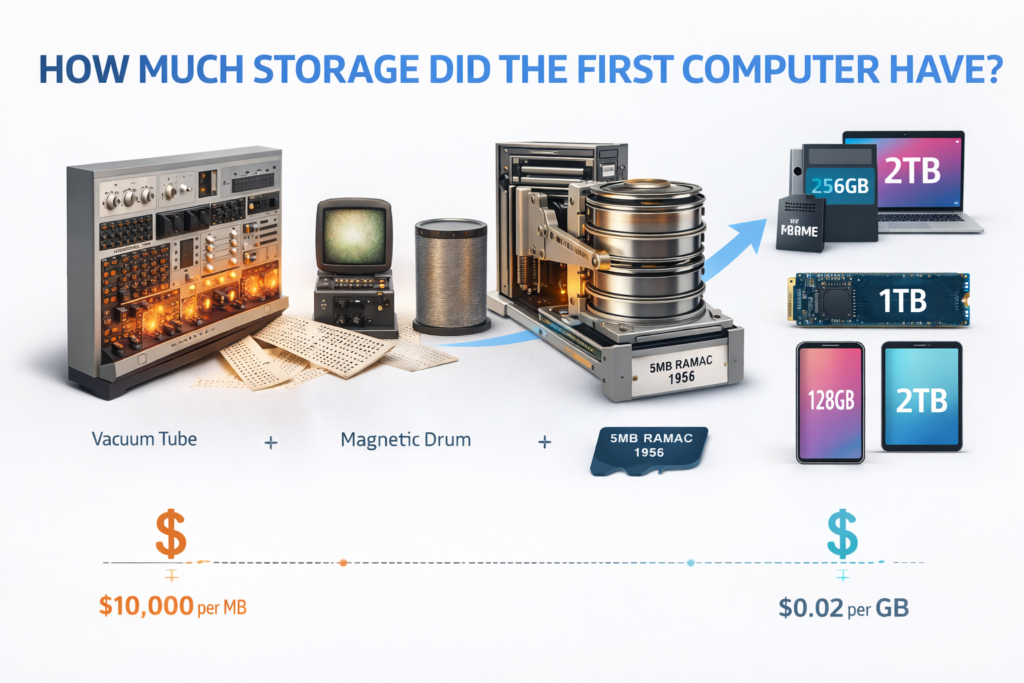
Analyzing the 5MB Capacity of the IBM RAMAC 305
In 1956, IBM introduced the RAMAC 305 system, which contained the first commercial hard disk drive.
The disk system stored approximately 5 megabytes of data.
While this seems extremely small today, it represented a massive breakthrough in computing history.
To better understand how much storage did the first computer have, consider that modern smartphones store millions of times more data.
Cost Comparison: The Millions Spent on Megabytes
The IBM RAMAC system was extremely expensive.
The cost of storing a single megabyte was thousands of dollars. In contrast, modern storage devices provide gigabytes or terabytes for only a few dollars.
This dramatic difference highlights the rapid progress of computing technology over time.
E. 1960 – 1970: The Era of Magnetic Core Memory
The next major development in how much storage did the first computer have involved magnetic core memory.
This technology became the dominant form of computer memory throughout the 1960s.
Hand-Woven Memory: How Ferrite Cores Stored Bits
Magnetic core memory used tiny ferrite rings that were threaded together by hand.
Each ferrite core stored a single bit of information.
Although the manufacturing process was labor-intensive, this technology offered fast read/write speeds and reliable storage.
NASA and Apollo: The Importance of Non-Volatile Storage
Magnetic core memory played a crucial role in the Apollo Guidance Computer used during NASA’s moon missions.
Because this memory was non-volatile, it retained data even when power was lost.
These systems demonstrated the importance of reliable memory in mission-critical applications and influenced later developments in transistor history.
Frequently Asked Questions (FAQs)
How much storage did the first computer have?
The earliest computers had extremely limited storage. Some systems had only a few bytes of memory, while early hard disks stored around 5MB.
Did ENIAC have a hard drive?
No, ENIAC did not have a hard drive. It used accumulators and registers to temporarily store numbers during calculations.
What was the first computer with electronic memory?
The Manchester Baby in 1948 was one of the first computers to use electronic memory through the Williams tube.
What was the first hard disk drive?
IBM introduced the first hard disk drive in 1956 with the RAMAC 305 system, which stored about 5MB of data.
Why was early computer storage so small?
Early storage technologies were limited by the materials and electronic components available at the time. Advances in semiconductor technology allowed storage capacity to grow dramatically.
Conclusion
The story behind how much storage did the first computer have reveals how dramatically computing technology has evolved.
Early computers like ENIAC had almost no permanent storage, relying on accumulators and temporary memory systems. Later innovations such as magnetic drums, magnetic tape, and core memory gradually increased storage capacity.
The first commercial hard disk introduced in 1956 stored only 5MB, yet it paved the way for the massive storage technologies we use today.
As computing continues to evolve, modern storage systems power everything from cloud platforms to Modern Artificial Intelligence Applications, demonstrating how far digital storage has progressed since the earliest computers.