When we look back at the rapid advancements in artificial intelligence over the past decade, few innovations stand out quite like the invention of GANs. The history of generative adversarial networks is a fascinating journey that shifted AI from merely analyzing existing data to creating entirely new, hyper-realistic content. This breakthrough idea sparked a creative AI revolution, paving the way for the sophisticated image and video generators we use today.
Understanding the history of generative adversarial networks is crucial for anyone interested in the evolution of modern artificial intelligence. By tracing the GAN timeline and the origins of generative adversarial networks, we can appreciate how these systems fundamentally changed how machines learn. This article will explore the deep learning generative models history, examining the major milestones, the brilliant minds behind the technology, and the enduring legacy of these famous GAN models.
What Are Generative Adversarial Networks?
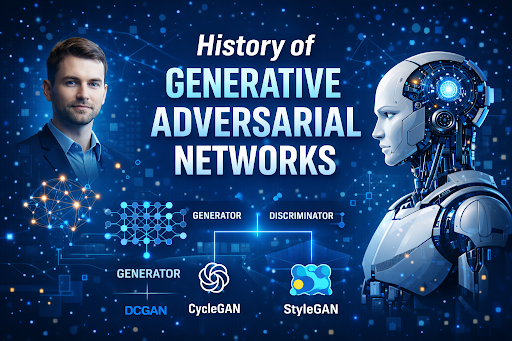
Before diving into the timeline, it is important to understand what these networks actually are. At its core, a Generative Adversarial Network (GAN) consists of two separate neural networks locked in a continuous competition. One network is the “generator,” tasked with creating fake data (such as images) that looks as realistic as possible. The other network is the “discriminator,” whose job is to distinguish between real data from a training set and the fake data produced by the generator.
As they compete, both networks get better. The generator learns to create increasingly convincing forgeries, while the discriminator becomes a sharper detective. This zero-sum game, or minimax game, is the foundation of adversarial learning history. The realization that two networks could teach each other without constant human supervision was a monumental shift in the history of generative adversarial networks.
Early Roots Before GANs
The path to GANs did not happen overnight. In the days of Early Machine Learning, AI systems were largely focused on classification and simple predictions. However, researchers always harbored the ambition of building machines that could create. The Evolution of Machine Learning Algorithms saw the development of earlier generative models like Restricted Boltzmann Machines and Autoencoders, which attempted to learn the underlying distribution of data to generate new samples.
While these early models laid important groundwork, they often produced blurry or low-resolution results. They lacked the mathematical friction needed to force the AI to produce crisp, high-fidelity outputs. The industry needed a structural paradigm shift, setting the stage perfectly for the next big leap in GAN development.
2014: The Original GAN Paper
The true starting point in the history of generative adversarial networks occurred in 2014. A researcher named Ian Goodfellow, along with his colleagues at the University of Montreal, published a landmark paper simply titled “Generative Adversarial Nets.” According to AI lore, the Ian Goodfellow GAN concept was born during an argument at a pub, where Goodfellow suddenly realized that pitting two neural networks against each other could solve the blurry image problem plaguing existing models.
This 2014 paper proved that the adversarial framework worked mathematically. Though the initial images generated by the first GAN were incredibly small and grainy (mostly simple digits and blurry faces), the proof of concept was undeniable. It was the most important of all early GAN milestones, proving that machines could generate sharp data by competing against themselves.
2014: Conditional GANs Expanded the Idea
Almost immediately after the original paper was published, researchers began tweaking the formula. Later in 2014, the conditional GAN (cGAN) was introduced. In a standard GAN, the generator creates random images from random noise. You couldn’t tell it what to generate. The conditional GAN changed this by feeding “conditions” or labels into both the generator and discriminator.
For example, you could now condition the network to generate an image specifically of a “cat” or a “number 7.” This gave humans control over the output, making image generation with GANs significantly more useful for targeted tasks.
2015: DCGAN Made GANs More Practical
While the theory was sound, early GANs were notoriously unstable and difficult to train. In 2015, the introduction of the Deep Convolutional Generative Adversarial Network (DCGAN) revolutionized GAN architecture history. By integrating convolutional neural networks—which are specifically designed for processing pixel data—DCGANs dramatically improved the quality of generated images.
This era coincided beautifully with The Rise of Neural Networks across the broader tech industry. DCGANs provided a stable set of architectural guidelines that allowed researchers everywhere to experiment with GANs on their own computers. They could finally generate recognizable, coherent images of bedrooms, faces, and objects, solidifying a practical way forward in the history of generative adversarial networks.
2016: GANs Enter Real Image Enhancement
By 2016, the generative adversarial network’s history moved from academic curiosity to practical utility. Researchers began discovering new GAN applications, particularly in image enhancement and super-resolution (SRGAN). GANs were used to take low-resolution, pixelated images and upscale them, hallucinating the missing details with incredible accuracy.
This capability had massive implications for medical imaging, satellite photography, and digital art restoration. It proved that GANs weren’t just for making up fake data; they could be actively used to repair and enhance real-world information.
2017: CycleGAN and Image-to-Image Translation
The year 2017 was a blockbuster year in the history of generative adversarial networks. One of the most visually stunning breakthroughs was CycleGAN. This model mastered “image-to-image translation” without needing perfectly paired training data.
With CycleGAN, you could feed the AI a video of a horse running in a field, and it could seamlessly transform the horse into a zebra in real-time. It could change a photo of a summer landscape into a winter wonderland, or turn a regular photograph into a painting in the style of Monet. This was a massive leap for the History of Computer Vision in Artificial Intelligence, proving that GANs could deeply understand and manipulate the stylistic properties of visual data.
2017: WGAN Improved Training Stability
Despite the visual successes, GAN training instability remained a massive headache for developers. Models would often suffer from “mode collapse,” where the generator found a single flaw in the discriminator and just outputted the exact same image over and over again to win the game.
To solve this, the Wasserstein GAN (WGAN) was introduced in 2017. By changing the mathematical loss function to the Wasserstein distance (also known as Earth Mover’s distance), WGANs provided a smooth, meaningful gradient for the generator to learn from, even when the discriminator was performing flawlessly. This solved many of the most frustrating bottlenecks in the history of generative adversarial networks.
2018 to 2019: StyleGAN Raised the Quality Bar
If you have ever visited the website “This Person Does Not Exist,” you have seen StyleGAN in action. Released by NVIDIA researchers between 2018 and 2019, StyleGAN allowed for unprecedented, hyper-realistic image generation with GANs.
StyleGAN introduced a novel architecture that allowed developers to control different aspects of the image synthesis at various scales. They could adjust high-level features like a person’s pose or face shape, down to fine details like hair color and freckles. The faces produced by StyleGAN were so photorealistic that humans could no longer tell they were generated by a machine.
Why GANs Became So Important
The evolution of GANs was crucial because it taught machines how to model the complex, high-dimensional distribution of real-world data. Before GANs, AI was largely discriminative (learning the boundary between a cat and a dog). GANs made AI truly generative (learning the fundamental essence of what makes a cat look like a cat, and then creating a new one). This conceptual leap accelerated the entire field of unsupervised learning, pushing the boundaries of what computers were capable of imagining.
Main Challenges in the history of generative adversarial networks
Despite their fame, the history of generative adversarial networks is also a history of immense technical frustration. Even with WGANs, training these models required a delicate, almost magical balance of hyperparameters. If the discriminator learned too fast, the generator got no useful feedback. If the generator learned too fast, it exploited the discriminator and mode collapsed.
Furthermore, as GANs became better at generating realistic human faces and voices, they birthed the era of “deepfakes.” This introduced severe ethical and security challenges, forcing the tech industry to scramble to develop new AI detection tools to combat digital misinformation.
GANs and the Rise of Generative AI
Today, the landscape has shifted. When looking at GAN vs diffusion models (like those powering Midjourney and DALL-E), diffusion models have largely taken the spotlight for text-to-image generation due to their superior stability and diversity.
However, GANs are far from obsolete. They are still heavily utilized in Modern Artificial Intelligence Applications that require real-time generation, such as video game rendering, video upscaling, and certain types of medical drug discovery. The history of generative adversarial networks laid the absolute foundation that made today’s diffusion models and large language models possible.
The Legacy of GANs in the history of generative adversarial networks
The legacy of the history of generative adversarial networks is one of profound innovation. Ian Goodfellow’s brilliant idea to pit algorithms against each other essentially hacked the machine learning process, creating a self-sustaining loop of improvement. The famous GAN models developed between 2014 and 2020 will forever be remembered as the pioneers that gave artificial intelligence its digital imagination.
Frequently Asked Questions (FAQs)
Who invented Generative Adversarial Networks?
GANs were invented by Ian Goodfellow and his colleagues at the University of Montreal in 2014. The concept arose from the idea of using two competing neural networks to generate new, synthetic data.
What is the difference between a GAN and a Diffusion Model?
GANs use a generator and a discriminator competing against each other to create images quickly. Diffusion models, on the other hand, work by slowly adding random noise to an image and then learning to reverse that process to recover the image. While diffusion models are currently better at complex text-to-image tasks, GANs are often much faster at generating outputs.
What are some common GAN applications today?
Today, GANs are used for image super-resolution, repairing old or damaged photographs, creating realistic video game textures, synthesizing medical training data, and real-time video manipulation.
Conclusion
In conclusion, the history of generative adversarial networks is a testament to the power of creative problem-solving in computer science. From the initial 2014 paper that proposed a simple adversarial game, to the breathtaking photorealism of StyleGAN, the evolution of these networks changed the trajectory of technology forever. While new architectures continue to emerge, the fundamental principles established in the history of generative adversarial networks will remain a cornerstone of the creative AI revolution for decades to come.