In the modern digital age, we are constantly surrounded by an invisible hand that guides our choices. Whether it is the next movie we watch, the product we buy, or the song that plays next, personalization algorithms are at work. The history of AI recommendation systems is a fascinating journey of how data-driven recommendations evolved from simple email filters to the hyper-intelligent engines that power the global economy.
Understanding the history of AI recommendation systems allows us to see how artificial intelligence transitioned from laboratory experiments to the very core of consumer culture. This technology has solved the problem of “information overload,” helping users navigate millions of choices with ease. Today, we dive deep into the evolution of AI recommendation systems to understand how we reached this level of sophisticated personalization.
Early Development of Recommendation Systems
The origins of recommendation systems can be traced back to the early 1990s, a period often associated with the Revival of Artificial Intelligence in the 1990s. Before the internet became a household staple, researchers were already looking for ways to manage the growing amount of digital information. The first recognized system, Tapestry, was developed at the Xerox Palo Alto Research Center (PARC).
Tapestry was designed to handle the increasing volume of emails in office environments. However, it wasn’t “automated” in the way we think of AI recommendation engines today. It required users to manually record their reactions to documents. While primitive, this was the first significant step in the history of ai recommendation systems. It introduced the concept that a computer could assist in selecting content based on user feedback. During this era, the foundations of Early Machine Learning began to merge with information retrieval, setting the stage for more complex automated systems.
Collaborative Filtering and Content-Based Methods
As the internet expanded, the need for better filters grew. This led to the formal development of two primary strategies: collaborative filtering and content-based filtering. These two methodologies are the twin pillars of recommendation systems in artificial intelligence.
Collaborative Filtering
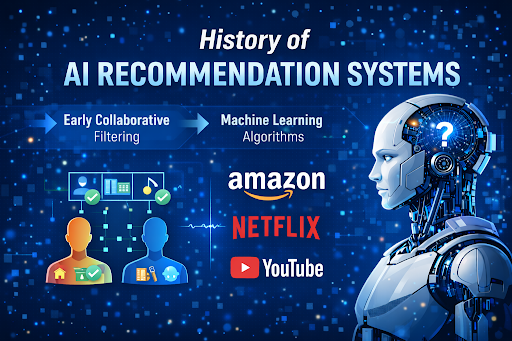
Collaborative filtering history began with the “GroupLens” project, which applied automated algorithms to Usenet news articles. The core idea was simple yet revolutionary: if User A and User B both liked the same five books in the past, and User A likes a new sixth book, User B will probably like it too. This “people-to-people” matching became the gold standard for personalized recommendation technology. It didn’t require the computer to understand the item itself; it only needed to understand user behavior analysis.
Content-Based Filtering
Content-based filtering took a different approach. Instead of looking at what other people liked, it looked at the properties of the item itself. If you watch a sci-fi movie with space battles, the system recommends other sci-fi movies with space battles. This method relied on detailed metadata and was a crucial part of the early development of recommender systems. By combining these methods, researchers began to overcome the “cold start” problem—where a system cannot make recommendations for a new user because it has no history of their preferences.
The Rise of Machine Learning in Recommendation Systems
By the mid-2000s, the history of AI recommendation systems entered a new phase. Simple filtering was no longer enough for the massive datasets being generated by global e-commerce. This period saw the integration of more advanced machine learning recommendations.
The Evolution of Machine Learning Algorithms allowed developers to use matrix factorization and latent factor models. These algorithms could uncover “hidden” patterns in data that weren’t obvious to human observers. For example, a system might discover that people who buy organic gardening tools also tend to listen to specific genres of folk music. This shift toward machine learning recommendation systems allowed for much higher accuracy and helped businesses move away from generic “top ten” lists toward truly individual experiences.
Industry Adoption of AI Recommendation Systems
The history of AI recommendation systems is best viewed through the lens of the companies that turned them into multibillion-dollar assets. Industry leaders took the theoretical models from academia and applied them at an unprecedented scale.
Amazon
The Amazon recommendation engine is perhaps the most famous early success story. By using “item-to-item” collaborative filtering, Amazon was able to suggest products in real-time. This didn’t just improve the user experience; it fundamentally changed the business model of retail by driving a significant percentage of total sales through the “Customers who bought this also bought” feature.
Netflix
The Netflix recommendation system gained worldwide fame through the Netflix Prize in 2006. The company offered $1 million to anyone who could improve their movie recommendation algorithm by 10%. This contest was a watershed moment in the history of AI recommendation systems, as it brought the world’s best data scientists together to solve the problem of personalization.
YouTube and Spotify
YouTube and Spotify took the development of recommender systems into the realm of streaming media. Spotify’s “Discover Weekly” uses a mix of collaborative filtering and natural language processing to analyze what people are saying about songs online. Meanwhile, YouTube’s AI recommendation engines process billions of hours of video to keep users engaged for as long as possible.
Deep Learning and Modern Recommendation Systems
In the last decade, The Rise of Neural Networks has transformed the history of AI recommendation systems once again. Modern systems no longer rely on simple tables of data. They use deep learning to process images, text, and even the “sequence” of a user’s clicks.
Modern Artificial Intelligence Applications in recommendation utilize Recurrent Neural Networks (RNNs) and Transformers to understand the temporal nature of interest. For example, a system now understands that your interest in “baby strollers” is temporary, whereas your interest in “jazz music” might be lifelong. This level of AI personalization technology allows for a fluid, evolving relationship between the user and the platform.
Challenges in AI Recommendation Systems
Despite the success, the history of AI recommendation systems is fraught with challenges. One of the most significant is the “Filter Bubble.” If an algorithm only shows you what it thinks you like, you may never be exposed to new ideas or opposing viewpoints. This has led to concerns about social polarization and the narrowing of human experience.
Another challenge is data privacy. To provide high-quality machine learning recommendations, these systems require vast amounts of personal data. As regulations like GDPR and CCPA emerge, developers must find ways to provide personalization without infringing on user rights. Furthermore, there is the issue of algorithmic bias, where the history of ai recommendation systems shows that if the training data is biased, the recommendations will be too.
The Future of AI Recommendation Systems
The future looks toward “Explainable AI” and “Context-Aware” systems. We are moving toward a time in the history of AI recommendation systems where the AI can tell you why it is recommending a certain item. Instead of a black box, it becomes a transparent assistant.
We will also see the integration of Reinforcement Learning History into these engines. This will allow systems to optimize for long-term user satisfaction rather than just a quick click. As we move toward more immersive technologies like the Metaverse or AR, AI recommendation engines will likely guide our physical movements and social interactions in real-time, making the history of recommendation systems an ongoing, epic saga of human-machine collaboration.
Frequently Asked Questions (FAQs)
What was the first AI recommendation system?
The first system is generally considered to be Tapestry, developed at Xerox PARC in the early 1990s. It was followed quickly by the GroupLens project, which pioneered automated collaborative filtering.
How does Netflix know what I want to watch?
Netflix uses a hybrid model of collaborative filtering (what others like) and content-based filtering (what characteristics your favorite shows have). It also uses deep learning to analyze the exact moment you pause, rewind, or stop watching a show.
Why is the history of AI recommendation systems important for businesses?
It is vital because personalization is the primary driver of customer retention. Systems like Amazon’s are responsible for up to 35% of their total revenue, proving that recommendation algorithms history is directly tied to economic success.
Conclusion
The history of AI recommendation systems is a journey from simple lists to complex, predictive brains. What started as a way to filter junk email has evolved into a powerful AI personalization technology that influences almost every digital interaction we have. As we have seen through the development of recommender systems at Amazon and Netflix, the ability to predict human desire is one of the most valuable tools in the world. While we must remain cautious of challenges like filter bubbles and privacy, the future of AI recommendation systems promises a more intuitive, helpful, and personalized world for everyone.