Introduction
The evolution of computer memory is one of the most critical developments in modern computing. While processors often receive most of the attention, memory systems determine how quickly a computer can access and process data. From early delay line storage to modern High Bandwidth Memory (HBM), each generation of memory technology has significantly improved performance, efficiency, and scalability.
In the early days of computing, memory systems were slow, bulky, and unreliable. Engineers experimented with several technologies, including cathode-ray tubes, magnetic cores, and delay lines. Over time, semiconductor innovations revolutionized memory design, enabling faster data access and higher storage density.
Today, modern memory systems operate at incredible speeds measured in gigabytes per second of bandwidth, powering everything from cloud computing platforms to artificial intelligence systems. Understanding the evolution of computer memory also helps explain broader technological advancements discussed in history of computers and improvements driven by the evolution of transistors.
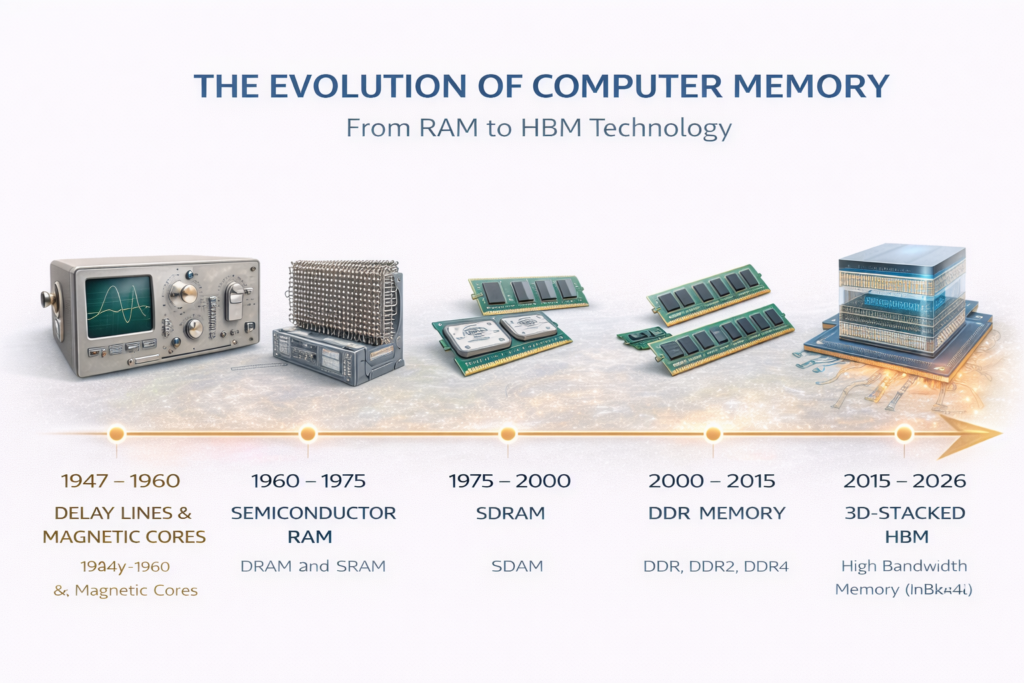
A. Delay Lines and Magnetic Cores (1947 – 1960)
The Williams Tube and Early CRT Memory
One of the earliest technologies in the evolution of computer memory was the Williams Tube, developed in the late 1940s. This system used cathode ray tube (CRT) technology to store binary data as electrically charged spots on a screen.
The Williams Tube allowed computers to store data electronically rather than mechanically. However, the system had significant limitations. The stored charges faded quickly, requiring constant refreshing to maintain data integrity. Despite its shortcomings, CRT memory was an important milestone in the volatile memory history.
The development of early electronic memory also coincided with rapid progress in computing hardware and systems described in history of computer hardware.
Hand-Woven Core Memory: The Reliable Standard of the 50s
By the 1950s, magnetic core memory replaced many early experimental designs. Tiny ferrite rings were woven into grids, and each ring stored one bit of information by magnetizing in different directions.
Core memory proved far more reliable than earlier technologies and became the dominant memory system for many computers during the 1950s and 1960s. Engineers literally wove memory modules by hand, threading wires through thousands of magnetic cores.
This era represents a crucial stage in the evolution of computer memory, laying the foundation for modern memory architecture and reliable data access.
B. The Transition to Semiconductor RAM (1960 – 1975)
Robert Dennard and the Invention of DRAM at IBM
The next major breakthrough in the evolution of computer memory came with the invention of Dynamic Random Access Memory (DRAM). In 1967, IBM engineer Robert Dennard proposed a memory cell that stored data using a single transistor and capacitor.
DRAM dramatically improved memory density compared to magnetic cores. However, the stored charge slowly leaked away, requiring periodic refresh cycles to maintain the stored data. This process became known as the refresh rate.
DRAM’s compact design allowed manufacturers to pack thousands and later millions of memory cells onto silicon chips. These advances were made possible by semiconductor breakthroughs discussed in transistor history.
SRAM vs. DRAM: Speed vs. Density in Early Silicon
Two main types of semiconductor RAM emerged during this period:
- Static RAM (SRAM)
- Dynamic RAM (DRAM)
SRAM uses flip-flops to store data and offers extremely fast access speeds with very low latency. However, it requires more transistors per bit, making it expensive and less dense.
DRAM, on the other hand, uses a simpler capacitor-based design. While slightly slower, it provides much higher density and lower cost.
This tradeoff between speed and density continues to shape the evolution of computer memory even today.
C. Scaling Density and the SDRAM Standard (1975 – 2000)
The Rise of SIMM and DIMM Modules
As semiconductor manufacturing improved, memory capacity increased dramatically. During the 1980s and 1990s, memory modules such as SIMM (Single Inline Memory Module) and DIMM (Dual Inline Memory Module) became standard components in personal computers.
These modules simplified memory upgrades and enabled dual-channel memory configurations for improved bandwidth.
This stage in the evolution of computer memory saw computers move from kilobytes of memory to megabytes and eventually gigabytes. It also aligned with broader technological developments such as the rise of storage technology, which expanded overall data handling capabilities.
Syncing with the CPU: The Fascinating Evolution of Computer Memory Synchronicity
Synchronous Dynamic Random Access Memory (SDRAM) represented a major improvement in memory performance. Unlike earlier memory systems, SDRAM synchronized its operations with the system clock.
This synchronization allowed memory to communicate more efficiently with the CPU and memory controller, improving throughput and reducing latency.
By the late 1990s, SDRAM had become the standard memory architecture used in most personal computers and servers.
D. The DDR Revolution and Power Efficiency (2000 – 2015)
Double Data Rate (DDR) to DDR4: Doubling Throughput
The early 2000s introduced Double Data Rate (DDR) memory, which dramatically increased memory performance by transferring data on both rising and falling clock signals.
Each new generation of DDR technology improved performance:
- DDR
- DDR2
- DDR3
- DDR4
These improvements increased bandwidth measured in gigabytes per second while reducing power consumption.
This stage in the evolution of computer memory also saw advancements in CAS latency, dual-channel configurations, and more efficient memory controllers.
High-performance memory became essential for tasks such as gaming, scientific computing, and large-scale data processing systems related to history of data science.
LPDDR: Solving the Battery Crisis for Mobile Devices
Mobile computing created new challenges for memory technology. Smartphones and tablets required memory solutions that consumed far less power than traditional desktop RAM.
Low Power DDR (LPDDR) memory solved this issue by reducing voltage and improving power management.
LPDDR allowed mobile devices to run powerful applications while preserving battery life. This innovation played a key role in the evolution of computer memory and enabled the growth of modern mobile computing platforms connected to technologies described in history of mobile technology.
E. HBM and the Future of Unified Memory (2015 – 2026)
High Bandwidth Memory (HBM): Stacking DRAM in 3D
Modern computing workloads such as artificial intelligence and machine learning require enormous memory bandwidth.
High Bandwidth Memory (HBM) addresses this challenge by stacking multiple DRAM layers vertically using advanced packaging techniques.
HBM significantly increases bandwidth while reducing latency and energy consumption. This technology is commonly used in high-performance GPUs and AI accelerators.
HBM represents the latest step in the evolution of computer memory, enabling extremely high throughput for modern computing tasks.
CAMM2 and the Next Generation of Laptop Memory Scaling
Another recent innovation is CAMM2 (Compression Attached Memory Module), designed to improve memory performance in laptops and compact systems.
CAMM2 allows higher memory capacity and improved bandwidth while reducing space requirements.
This design represents a new direction in memory architecture, enabling faster systems and supporting future workloads related to artificial intelligence, cloud computing, and big data.
The future of the evolution of computer memory will likely involve unified memory systems where CPUs and GPUs share memory resources seamlessly.
Frequently Asked Questions (FAQs)
What is computer memory?
Computer memory is the hardware used to temporarily store data and instructions that the CPU needs to process tasks quickly.
What is the difference between SRAM and DRAM?
SRAM is faster and more expensive, using flip-flops for storage, while DRAM is slower but more dense and cost-effective.
Why does DRAM need refreshing?
DRAM stores data as electrical charges in capacitors that gradually leak, so refresh cycles are required to maintain stored data.
What is HBM memory used for?
HBM is used in high-performance computing systems such as GPUs, AI accelerators, and supercomputers due to its extremely high bandwidth.
How has memory speed improved over time?
Advances in semiconductor technology, improved memory controllers, and innovations like DDR and HBM have dramatically increased memory throughput.
Conclusion
The evolution of computer memory reflects the continuous pursuit of faster, denser, and more efficient data access systems. From the fragile CRT memory of the 1940s to the advanced stacked DRAM technologies used today, each generation has dramatically improved computing capabilities.
Magnetic cores provided reliability during the early years of computing, while semiconductor RAM introduced scalability and higher density. Later innovations such as DDR memory and LPDDR optimized performance and power efficiency for both desktop and mobile devices.
Today, advanced technologies like High Bandwidth Memory and unified memory architectures are pushing the limits of computing performance. As new applications such as artificial intelligence and big data demand even greater speeds, the evolution of computer memory will continue to shape the future of computing technology.