The Dawn of AI Ethics: From Sci-Fi to Early Computers
Long before computers could beat grandmasters at chess or generate breathtaking art, humans worried about the morality of intelligent machines. This remarkably fascinating journey into ai ethics history begins not in a laboratory, but in the pages of science fiction. Writers and philosophers imagined worlds where thinking machines could help humanity or destroy it. These early thought experiments laid the groundwork for serious ethical discussions that would follow decades later.
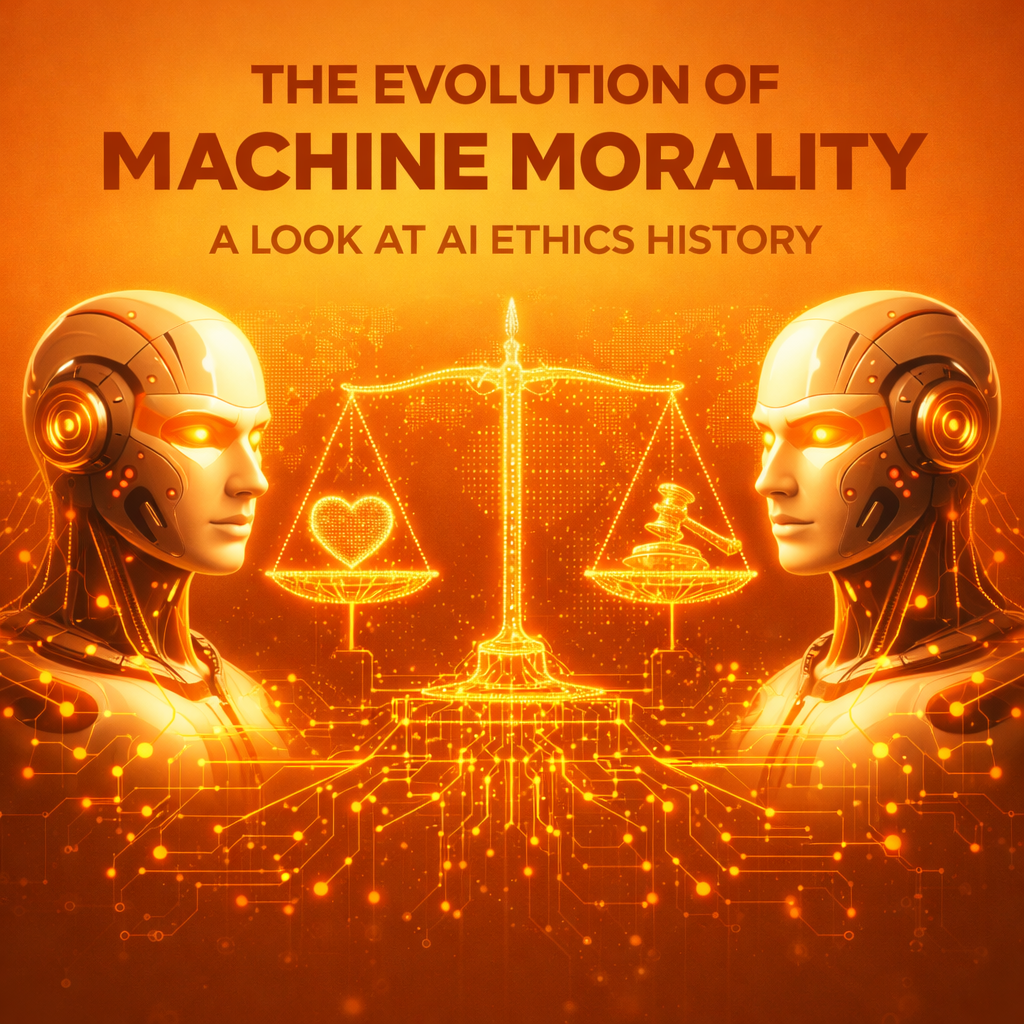
Ai ethics history is the story of how humans have grappled with moral questions raised by artificial intelligence. Should a machine be allowed to make life or death decisions? Who is responsible when an AI causes harm? How do we ensure that intelligent systems align with human values? These questions have evolved alongside the technology itself, from simple calculators to the sophisticated large language models of today.
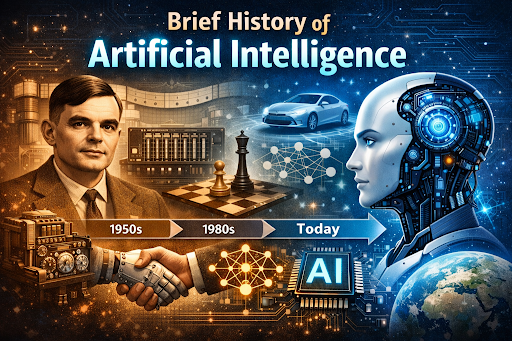
Understanding ai ethics history is essential for anyone building or deploying AI systems. The mistakes of the past inform the safeguards of the present. The philosophical debates of the 1940s resonate in the regulatory battles of the 2020s. By tracing this evolution of machine morality, we gain wisdom that helps us navigate the ethical challenges of our AI driven world. A look back at the brief history of artificial intelligence reveals how ethical concerns grew alongside each new technological breakthrough.
Isaac Asimov and the Three Laws of Robotics
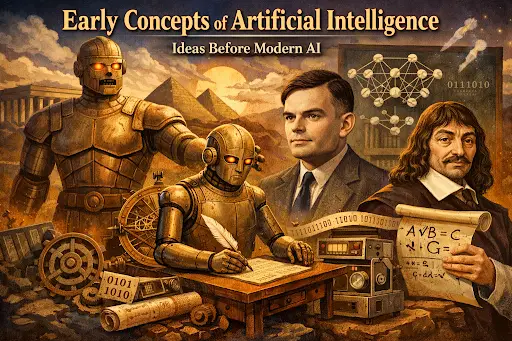
No discussion of ai ethics history is complete without honoring Isaac Asimov. In 1942, this brilliant science fiction writer introduced the Three Laws of Robotics in a short story. These laws were designed to ensure that robots would serve humanity safely and ethically.
The First Law stated that a robot may not injure a human being or, through inaction, allow a human being to come to harm. The Second Law commanded that a robot must obey orders given by humans except where such orders conflicted with the First Law. The Third Law directed that a robot must protect its own existence as long as such protection did not conflict with the First or Second Laws.
Asimov’s Three Laws were fictional, but they sparked real philosophical debates about the machine ethics timeline. Could such rules be programmed? What happened when laws conflicted? How would a robot interpret abstract concepts like harm? These questions anticipated real challenges that AI developers face today. The fascinating history of the turing test shows similar foresight from early AI pioneers who understood that intelligence and morality were deeply connected.
The Dartmouth Workshop and Initial Moral Questions (1950s)
The Dartmouth Workshop of 1956 is widely considered the birth of artificial intelligence as a field. But buried within the excitement of creating thinking machines were the seeds of AI ethics history. The researchers gathered at Dartmouth were not blind to the implications of their work.
Early AI pioneers like John McCarthy, Marvin Minsky, and Claude Shannon discussed not just how to build intelligent machines, but whether they should. They worried about job displacement, autonomous weapons, and the potential loss of human control. These concerns were largely speculative at the time, as AI could barely solve simple math problems. Yet the fact that these discussions happened at all shows that early AI controversies and philosophical debates began almost immediately.
The Dartmouth Workshop also highlighted a tension that would define ai ethics history for decades. Some researchers believed that AI should be designed to augment human intelligence, working alongside people as tools. Others dreamed of autonomous systems that could operate independently. This tension between human control and machine autonomy remains central to ethical discussions today.
The Rise of the Algorithm: When Bias Became Apparent
As AI systems moved from theory to practice, abstract ethical concerns became concrete problems. Ai ethics history entered a new phase when researchers and users realized that algorithms could be biased, unfair, and harmful.
Expert Systems and the “Responsibility Gap” (1980s-1990s)
The 1980s saw the rise of expert systems, AI programs designed to replicate human decision making in specialized domains. These systems were used for medical diagnosis, financial analysis, and industrial control. They worked reasonably well, but they introduced a troubling question: who is responsible when an expert system makes a mistake?
If a doctor relies on an AI diagnosis that turns out to be wrong, who is liable? The doctor who trusted the system? The programmers who wrote the code? The hospital that purchased the software? This “responsibility gap” became a defining challenge in ai ethics history. The development of expert systems in artificial intelligence during this era revealed that accountability could not be easily assigned when humans and machines collaborated.
The 1990s brought the internet and the first large scale data collection. Companies began using algorithms to make decisions about credit, employment, and advertising. These systems were often black boxes, producing outcomes without explanation. Regulators and civil rights advocates grew concerned that algorithms might discriminate against protected groups. The revival of artificial intelligence in the 1990s brought renewed energy to AI development, but also renewed urgency to ethical questions.
Big Data and the Emergence of Algorithmic Bias (2010s)
The 2010s were a turning point in AI ethics history. The rise of big data and machine learning meant that algorithms were making decisions at unprecedented scale. And with scale came evidence of systematic bias.
Researchers discovered that commercial face recognition systems were less accurate for women and people with darker skin tones. Hiring algorithms trained on historical data learned to discriminate against women because past hiring practices had favored men. Predictive policing systems sent more officers to minority neighborhoods, creating a feedback loop that increased arrests in those areas.
These discoveries shocked the public and galvanized the AI ethics community. Evolution of algorithmic bias in tech became a mainstream concern. Companies that had rushed to deploy AI without ethical safeguards faced public backlash. Governments began investigating whether algorithmic discrimination violated civil rights laws. The incredible rise of multimodal artificial intelligence brought new capabilities, but also new risks of bias across different types of data.
Modern AI Ethics: Regulation, Safety, and the Future
Today, ai ethics history is being written in real time. Governments, companies, and researchers are racing to develop guidelines, regulations, and technical solutions for ethical AI.
The Push for Global AI Guidelines and Frameworks
The past decade has seen an explosion of history of AI regulation and governance efforts. The European Union has been particularly active, developing the AI Act, which categorizes AI applications by risk level and imposes strict requirements on high risk systems.
The OECD developed AI Principles that emphasize transparency, accountability, and human centered values. UNESCO adopted the first global agreement on AI ethics, signed by 193 countries. Companies like Google, Microsoft, and IBM have published their own AI ethics guidelines, promising not to develop autonomous weapons or surveillance systems that violate human rights.
Despite these efforts, ai ethics history shows that voluntary guidelines are not enough. Companies have faced scandals when their ethical commitments conflicted with business incentives. Researchers have documented cases where AI systems violated stated ethical principles. The push for enforceable regulation continues, with advocates calling for independent oversight, mandatory impact assessments, and legal liability for AI harms.
The Ongoing Challenge: Achieving Value Alignment in AGI
The ultimate challenge in ai ethics history is value alignment. As AI systems become more capable, the risk increases that they will pursue goals that conflict with human welfare. This problem is especially acute for Artificial General Intelligence, or AGI, systems that could match or exceed human intelligence across many domains.
Value alignment means ensuring that AI systems understand and pursue human values, even in novel situations. This is one of the key historical milestones in AI safety research. Researchers have explored technical approaches like inverse reinforcement learning, where AI infers human preferences from behavior, and debate, where AI systems critique each other’s reasoning.
But value alignment is not just a technical problem. It is also a philosophical and political one. Whose values should AI systems align with? Different cultures, communities, and individuals have different moral priorities. How do we resolve conflicts between values? These questions have no easy answers. The fascinating journey of artificial general intelligence research continues, but ethical challenges remain unresolved.
Frequently Asked Questions
1. What are Asimov’s three laws of robotics meaning?
The Three Laws are fictional rules designed to ensure robots protect humans, obey orders, and preserve themselves, with the First Law being most important. They sparked real ethical discussions in AI.
2. When did AI ethics become a serious field of study?
AI ethics emerged in the 1970s and 1980s alongside expert systems, but became a mainstream concern in the 2010s when algorithmic bias was widely documented.
3. What is the responsibility gap in AI ethics?
The responsibility gap is the difficulty of assigning legal and moral responsibility when AI systems cause harm, especially when multiple humans and organizations are involved.
4. How does algorithmic bias occur?
Algorithmic bias occurs when training data reflects historical discrimination, when features correlate with protected attributes, or when models optimize for proxy measures that encode bias.
5. What is value alignment in AI?
Value alignment is the challenge of ensuring that AI systems pursue goals and values that are consistent with human welfare, even in situations not anticipated by their creators.
6. Are there international laws governing AI ethics?
Several international frameworks exist, including the EU AI Act, OECD AI Principles, and UNESCO AI Ethics Recommendation, but binding global law remains limited.
Conclusion
Ai ethics history is a story of growing awareness and urgent action. From Asimov’s fictional laws to the real world regulations being drafted today, humanity has gradually recognized that intelligent machines require moral guidance. The journey has not been smooth. There have been missteps, scandals, and ongoing disagreements about the right path forward.
But there is also reason for hope. The history of artificial intelligence ethics shows that each generation has contributed to our collective understanding. Early science fiction writers imagined the problems. Pioneering researchers raised the alarms. Activists and scholars documented the harms. Regulators and companies are now responding with concrete policies and technical solutions.
The work is far from finished. As AI systems become more powerful and pervasive, ethical challenges will multiply. Autonomous weapons, surveillance capitalism, and AGI alignment will test our moral frameworks. But AI ethics history teaches us that awareness is the first step toward solutions. By understanding where we have been, we can make better choices about where we are going.
For those interested in how modern AI continues to push ethical boundaries, exploring self supervised learning in artificial intelligence reveals new challenges around data privacy and consent.
Additionally, understanding deep blue vs kasparov artificial intelligence helps us appreciate how far AI has come and why ethical oversight matters more than ever.
The shocking AlphaGo breakthrough showed what AI can achieve. Ai ethics history shows us how to ensure that such achievements benefit humanity rather than harm it. The future of machine morality is still being written, and we all have a role to play.