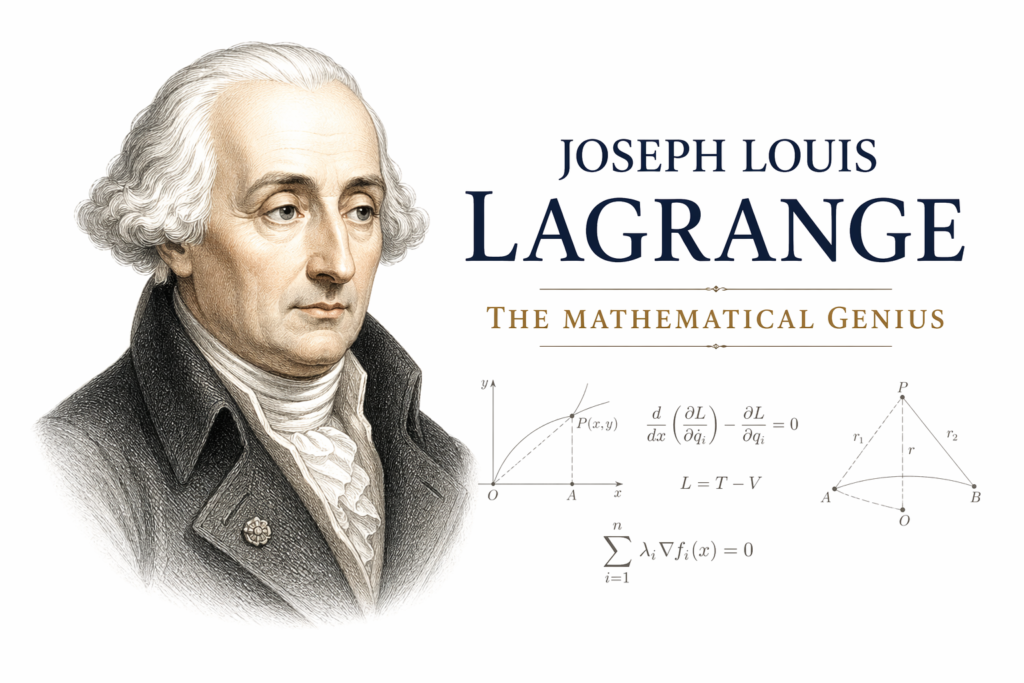
When we talk about the architects of modern science, the name joseph louis lagrange stands among the greatest. He did not just solve math problems; he reinvented the very tools we use to describe the universe. From the motion of planets to the stability of space telescopes, his fingerprints are everywhere. This article introduces you to his remarkable life, his education, and a simple overview of his discoveries. Later articles will dive deeper into each invention.
Early Life and Humble Beginnings
Born in Turin, Italy, in 1736, joseph louis lagrange showed an early flair for mathematics. Interestingly, his original interest was in classics. But after reading a memoir by the astronomer Halley, he was completely hooked on geometry and analysis. His education was largely self driven. He began teaching himself advanced mathematics at the Royal Artillery School in Turin. By the age of 19, he was already a professor. This rapid rise showed the world that a new mathematical star had arrived.
A Career Across Europe
Lagrange’s reputation spread quickly. He wrote letters to great mathematicians like Euler, who recognized his brilliance. Soon, he moved to Berlin to lead the mathematics division at the Prussian Academy of Sciences. Later, he relocated to Paris. Despite the chaos of the French Revolution, joseph louis lagrange was protected and respected. He taught at the École Polytechnique, where he influenced a new generation of engineers and scientists. His life was one of pure thought, dedication, and relentless curiosity.
Key Discoveries and Inventions
Instead of getting lost in complex formulas, here is a simple list of his major contributions. We will explain each one in detail in future articles. For now, know that joseph louis lagrange gave us:
- lagrange multipliers: A powerful method to find maximum and minimum values with restrictions.
- lagrange points: Special positions in space where gravity and motion balance perfectly.
- lagrangian mechanics: A complete reformulation of physics using energy instead of forces.
- euler–lagrange equation: The essential equation that forms the backbone of modern physics.
- lagrange interpolation: A technique to find new data points from existing ones.
- calculus of variations: A field dedicated to finding curves and paths that optimize specific quantities.
These are not just abstract ideas. They are the hidden language of engineering, economics, and even space exploration.
The Legacy of a Quiet Revolutionary
Unlike some of his peers, joseph louis lagrange was modest. He once said that Newton was the luckiest man because the system of the world could be discovered only once. Yet, it was joseph louis lagrange who provided the elegant mathematical framework that still supports physics today. His work directly influenced Einstein, Hamilton, and many others. He died in 1813, but his formulas remain alive in every satellite navigation signal and every engineering simulation.
Frequently Asked Questions (FAQs)
1. What is joseph louis lagrange best known for?
He is best known for his work in analytical mechanics, especially the lagrangian mechanics and the lagrange multipliers.
2. Where did joseph louis lagrange receive his education?
He was mostly self taught. He studied at the Royal Artillery School Joseph Louis Lagrangein Turin and learned mathematics by reading original papers from Euler and others.
3. Did joseph louis lagrange work with Euler?
Yes, he corresponded extensively with Leonhard Euler. Their collaboration on the euler–lagrange equation laid the groundwork for the calculus of variations.
4. What are lagrange points used for today?
lagrange points are used to position space telescopes like James Webb and solar observatories. They offer stable orbits with minimal fuel use.
5. Is joseph louis lagrange related to any other famous scientists?
No, but he worked closely with great minds like Lavoisier, Laplace, and Euler. He was also a friend and mentor to many French scientists.
Conclusion
In summary, joseph louis lagrange transformed abstract mathematics into a practical tool for understanding motion, force, and optimization. From the elegant lagrange interpolation to the game changing lagrange multipliers, his ideas are eternal. His story reminds us that deep focus and pure logic can unlock the secrets of the cosmos. Just like how ancient greek scientists changed modern science, Lagrange changed how we mathematically model reality. In our next articles, we will open each concept fully. Stay tuned.