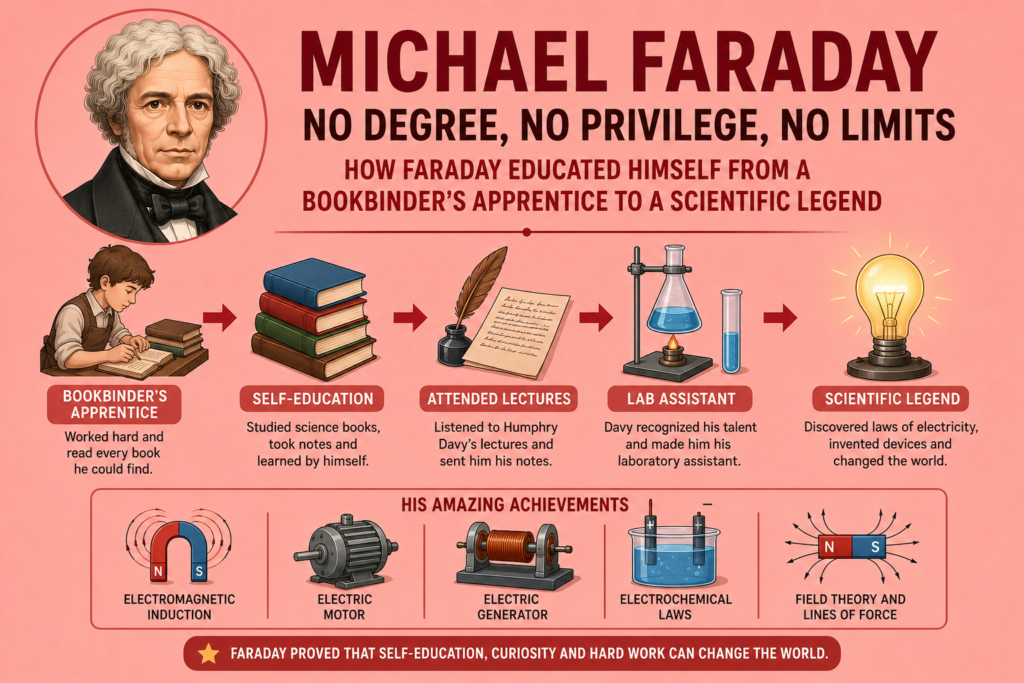
The story of michael faraday self education is one of the most inspiring journeys in the history of science. Michael Faraday was born into poverty, received very little formal schooling, and worked as a bookbinder’s apprentice during his teenage years. Yet despite these challenges, he transformed himself into one of the greatest scientists the world has ever known.
Faraday’s life proves that intellectual curiosity, determination, and self-learning can overcome social class barriers and lack of privilege. Without a university degree or wealthy background, Faraday made revolutionary discoveries in electricity, chemistry, magnetism, optics, and physics.
His work later led to inventions and theories such as:
- Electromagnetic induction
- Electric motors
- Generators
- Electrochemical laws
- Magnetic field theory
Today, Faraday is remembered not only for scientific genius but also for extraordinary academic perseverance and lifelong curiosity.
This article explores the history, struggles, books, mentors, habits, scientific growth, and educational journey behind Michael Faraday’s self education success story.
Childhood Poverty and Early Life (1791 – 1805)
Michael Faraday was born in 1791 in Newington Butts, England.
His family belonged to the working class and struggled financially throughout his childhood.
Faraday’s father worked as a blacksmith but suffered from poor health.
Because of poverty, Faraday received only basic elementary education.
He learned:
- Reading
- Writing
- Simple arithmetic
The mathematical skills Faraday learned were limited.
For example, basic arithmetic operations included:
and
Faraday never received advanced university mathematics during childhood.
Yet his curiosity about the natural world became enormous.
Victorian Social Classes and Limited Opportunity
During the Victorian era, social mobility in science was extremely rare.
Most scientists came from wealthy or aristocratic families.
Universities were generally inaccessible to poor working class children.
Scientific careers often depended on:
- Wealth
- Connections
- Formal education
- Social status
Faraday possessed none of these advantages.
However, his intellectual curiosity became stronger than his circumstances.
This became the foundation of michael faraday self education.
The Bookbinder Apprentice Years (1805 – 1812)
At age 14, Faraday became a bookbinder apprentice in London.
This job changed his life completely.
While binding books, Faraday gained access to scientific journals and educational texts.
Instead of treating books merely as work objects, he read them passionately.
He studied topics including:
- Electricity
- Chemistry
- Physics
- Philosophy
- Mathematics
Faraday educated himself during lunch breaks and late nights.
The bookbinding shop became his unofficial university.
Jane Marcet and Conversations on Chemistry
One of the most important books in Faraday’s education was Jane Marcet’s Conversations on Chemistry.
This book explained chemistry in simple language for beginners.
Faraday studied it repeatedly and carefully copied scientific ideas into notebooks.
Marcet’s work taught Faraday:
- Chemical reactions
- Experimental thinking
- Scientific terminology
Her book became one of the most important influences on Faraday’s self education journey.
Isaac Watts and The Improvement of the Mind
Another major influence was Isaac Watts’ book The Improvement of the Mind.
This book encouraged disciplined learning habits and critical thinking.
Watts emphasized:
- Observation
- Reflection
- Mental discipline
- Intellectual growth
Faraday followed these principles throughout life.
His learning methods became highly organized and systematic.
He proved self education requires structure and consistency.
Scientific Journals and Independent Learning
Faraday spent countless hours studying scientific journals.
He copied diagrams, equations, and lecture notes carefully.
Although he lacked advanced mathematical training, he learned basic scientific formulas gradually.
One simple electrical relationship he encountered was Ohm’s Law:
Where:
- = Voltage
- = Current
- = Resistance
Faraday trained himself to understand scientific reasoning through observation and experimentation.
The Power of Intellectual Curiosity
Faraday’s greatest strength was intellectual curiosity.
He constantly asked questions such as:
- Why do magnets work?
- How does electricity move?
- Why do chemicals react?
This curiosity drove lifelong learning.
Faraday did not wait for formal classrooms or professors.
Instead, he built his own education through reading, note taking, and experimentation.
This autodidacticism became central to his success.
The Royal Institution Lectures
Faraday eventually attended lectures by famous chemist Humphry Davy at the Royal Institution.
Faraday carefully took detailed notes during the lectures.
He later organized these notes into a beautifully bound volume and sent them to Davy.
This simple act changed Faraday’s life forever.
Davy noticed Faraday’s intelligence and dedication.
Soon afterward, Faraday received an opportunity to work as Davy’s laboratory assistant.
Humphry Davy and Scientific Mentorship
Scientific mentorship played an important role in Faraday’s growth.
Humphry Davy became Faraday’s early mentor.
Working alongside Davy exposed Faraday to:
- Laboratory techniques
- Scientific research
- Experimental equipment
- Leading scientists
Although Faraday still lacked university education, practical laboratory experience accelerated his development rapidly.
Davy once famously stated:
“Faraday was my greatest discovery.”
Faraday’s Early Scientific Work (1813 – 1825)
Faraday worked tirelessly inside laboratories.
He conducted experiments involving:
- Electricity
- Magnetism
- Chemical reactions
- Gases
Faraday learned through direct experimentation rather than abstract theory alone.
One important concept he studied was electric current:
Where:
- = Current
- = Electric charge
- = Time
Faraday’s practical approach became one of his greatest strengths.
Academic Perseverance and Failure
Faraday’s journey was not easy.
Many elite scientists looked down on him because of his working class background.
He faced:
- Social prejudice
- Academic elitism
- Limited formal training
Yet Faraday never allowed rejection to stop him.
His academic perseverance became legendary.
He continued reading, experimenting, and learning every day.
Self Education Through Experimentation
Faraday believed experiments were the best teachers.
Rather than memorizing facts alone, he learned by testing ideas physically.
This hands-on learning style helped him develop extraordinary intuition.
For example, Faraday later discovered faraday’s law of induction through repeated magnetic experiments.
His discoveries emerged from observation combined with relentless curiosity.
The Discovery of Electromagnetic Induction (1831)
Faraday’s self education eventually led to one of history’s greatest discoveries.
In 1831, he discovered electromagnetic induction.
The law is written mathematically as:
Where:
- = Induced electromotive force
- = Magnetic flux
This discovery became the foundation of electric generators and modern power systems.
A poor bookbinder apprentice had transformed civilization.
From Apprentice to Scientific Legend
Faraday later achieved worldwide fame.
His discoveries influenced:
- Electricity
- Engineering
- Chemistry
- Physics
- Modern industry
He became one of the greatest scientific lecturers in history.
His famous chemical history of a candle lectures inspired generations of students.
Faraday proved brilliance does not require privilege.
Scientific Method and Lifelong Learning
Faraday followed disciplined scientific methods throughout life.
His process included:
- Observation
- Experimentation
- Repetition
- Careful recording
- Independent thinking
These habits allowed Faraday to continue learning constantly.
His success demonstrates that self education works best with discipline and consistency.
Social Mobility in Science
Faraday’s life became one of history’s greatest examples of social mobility in science.
He rose from poverty into global scientific leadership through knowledge and determination.
Faraday inspired millions because his story showed education could transform lives completely.
His achievements challenged rigid Victorian social classes directly.
Faraday’s Influence on Modern Education
Faraday’s educational journey continues inspiring students today.
Modern educators often emphasize:
- Curiosity based learning
- Hands-on experiments
- Independent research
- Lifelong education
Faraday demonstrated that passion for learning can overcome enormous obstacles.
Scientific Achievements Beyond Education
Faraday’s self education produced discoveries including:
- Faraday effect
- Electric motors
- Electrochemical laws
- Magnetic field theory
- Gas liquefaction
Few scientists in history contributed so broadly across multiple disciplines.
Why Faraday’s Story Still Matters
Faraday’s story remains important because it proves:
- Education is not limited to universities
- Curiosity can overcome poverty
- Self learning can transform lives
- Discipline creates expertise
His life continues inspiring students, researchers, and innovators worldwide.
Modern Learning and Autodidacticism
Today, autodidacticism has become even more accessible through:
- Books
- Online courses
- Digital libraries
- Educational videos
Faraday’s self education journey remains highly relevant in the modern information age.
Faraday’s Scientific Philosophy
Faraday believed truth could be discovered through observation and experimentation.
He valued:
- Humility
- Curiosity
- Persistence
- Integrity
These values helped shape his extraordinary scientific career.
The Lasting Legacy of Self Education
Faraday’s life demonstrates that self education can create revolutionary thinkers.
His journey from bookbinder apprentice to scientific legend became one of humanity’s greatest educational success stories.
Few individuals have proven the power of learning as powerfully as Michael Faraday
FAQs About Michael Faraday Self Education
Did Michael Faraday attend university?
No. Faraday received very little formal education and never earned a university degree.
How did Faraday educate himself?
He learned by reading books, scientific journals, attending lectures, and performing experiments.
What books influenced Faraday most?
Jane Marcet’s Conversations on Chemistry and Isaac Watts’ The Improvement of the Mind strongly influenced him.
What was Faraday’s first job?
Faraday worked as a bookbinder apprentice during his teenage years.
Who mentored Michael Faraday?
Humphry Davy became Faraday’s scientific mentor at the Royal Institution.
Why is Faraday’s story inspiring?
His journey proves that curiosity, hard work, and self education can overcome poverty and lack of privilege.
Conclusion
The story of michael faraday self education remains one of the most inspiring journeys in scientific history. Born into poverty without privilege or university education, Faraday transformed himself into one of humanity’s greatest scientific minds through relentless curiosity, discipline, and lifelong learning.
From reading books in a bookbinding shop to discovering electromagnetic induction and revolutionary scientific laws, Faraday proved that true education comes from passion, observation, and determination. His achievements transformed electricity, chemistry, magnetism, engineering, and modern technology forever.
Faraday’s life continues inspiring students and dreamers worldwide because it demonstrates that intellectual greatness is not limited by wealth, class, or formal degrees.
The impact of Michael Faraday’s self education journey on humanity is as revolutionary as how ancient greek scientists changed modern science, proving once again that knowledge and curiosity can completely reshape human history forever.