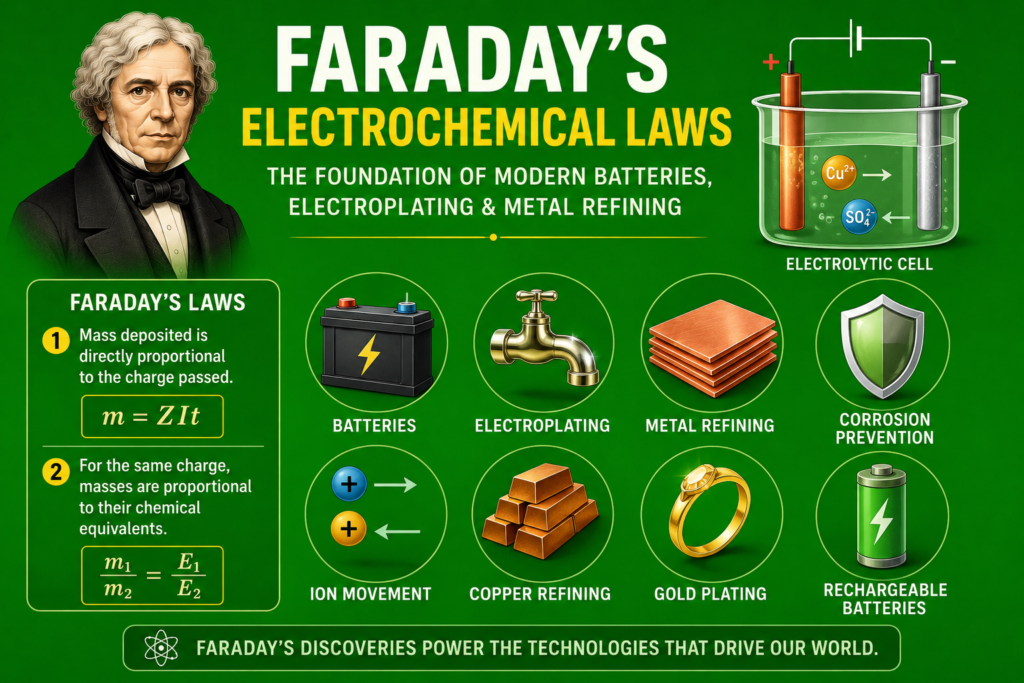
The faraday’s electrochemical laws became one of the most important scientific discoveries in the history of chemistry and industrial technology. Michael Faraday proved that electricity and chemical reactions are directly connected through precise mathematical relationships. His discoveries transformed electrochemistry forever and created the scientific foundation behind modern batteries, electroplating, metal refining, corrosion prevention, and rechargeable energy systems.
Before Faraday’s work, scientists understood that electricity could trigger chemical reactions, but nobody fully understood the quantitative relationship between electrical charge and chemical change. Faraday solved this mystery through brilliant experiments involving electrolytic cells, metals, and electric currents.
Today, faraday’s electrochemical laws remain essential in battery technology, lithium-ion systems, aluminum production, electroplating industries, and industrial electrochemistry worldwide.
This article explores the history, equations, experiments, chemistry, and modern applications behind Faraday’s revolutionary electrochemical laws.
Electrochemistry Before Faraday (1800 – 1830)
In the early 19th century, electricity was still poorly understood.
Scientists knew electric currents could produce:
- Sparks
- Magnetism
- Chemical decomposition
However, they lacked mathematical understanding of how electricity interacted with matter chemically.
Early researchers observed that electric currents passing through solutions caused substances to separate into elements.
This process became known as electrolysis.
Yet nobody understood the exact relationship between:
- Electric charge
- Chemical mass
- Atomic reactions
Michael Faraday decided to investigate these mysteries systematically.
Michael Faraday and Experimental Chemistry
Faraday was one of history’s greatest experimental scientists.
His work combined:
- Physics
- Chemistry
- Electricity
- Magnetism
Much of his scientific success came through michael faraday self education, which encouraged independent experimentation and careful observation.
Faraday believed science should rely on measurable experimental evidence.
This approach helped him develop precise electrochemical laws.
What Is Electrolysis?
Electrolysis is the process where electric current causes chemical decomposition inside an electrolyte solution.
An electrolytic cell usually contains:
- Electrolyte solution
- Cathode
- Anode
- Power source
Electric current forces ions to move through the solution.
Positive ions move toward the cathode.
Negative ions move toward the anode.
Faraday carefully measured these reactions to discover exact mathematical patterns.
Faraday’s First Law of Electrolysis (1834)
Faraday’s First Law states:
The mass of a substance deposited during electrolysis is directly proportional to the electric charge passing through the electrolyte.
Mathematically:
Or:
Where:
- = Mass deposited
- = Electric charge
- = Electrochemical equivalent
Since electric charge equals current multiplied by time:
The equation becomes:
Where:
- = Electric current
- = Time
This discovery transformed electrochemistry into a precise science.
Understanding Electrochemical Equivalent
The electrochemical equivalent represents the mass deposited per unit charge.
Different materials have different electrochemical equivalents because atomic masses and ion charges differ.
Faraday realized electrolysis depended on atomic behavior.
This insight later became important in atomic theory and chemistry.
Faraday’s Second Law of Electrolysis
Faraday’s Second Law states:
When the same quantity of electricity passes through different electrolytes, the masses deposited are proportional to their chemical equivalents.
Mathematically:
Where:
- = Deposited masses
- = Chemical equivalents
This law connected chemistry directly with electricity mathematically.
Faraday proved electrochemical reactions follow universal quantitative principles.
The Faraday Constant
Faraday’s experiments eventually led to the Faraday constant.
The Faraday constant represents electric charge carried by one mole of electrons.
Its value is:
Where:
- = Faraday constant
- = Coulombs
This became one of the most important constants in electrochemistry.
Modern battery science still depends heavily on it.
Electrolytic Cells and Ion Movement
Faraday carefully studied electrolytic cells.
Inside electrolyte solutions:
- Ions carry electric current
- Chemical reactions occur at electrodes
- Matter transfers between surfaces
At the cathode:
Copper ions gain electrons and deposit as solid copper.
At the anode:
Chloride ions lose electrons and form chlorine gas.
Faraday’s measurements revealed the mathematical consistency behind these reactions.
Standard Electrode Potential and Electrochemistry
Modern electrochemistry uses standard electrode potential to predict reactions.
Electrode potential measures a substance’s tendency to gain or lose electrons.
Cell voltage is calculated as:
Where:
- = Standard electrode potential
Faraday’s laws helped establish the scientific framework for modern electrochemical calculations.
Batteries and Faraday’s Laws
Modern battery technology depends directly on faraday’s electrochemical laws.
Batteries convert chemical energy into electrical energy through redox reactions.
Rechargeable batteries reverse these reactions during charging.
Applications include:
- Smartphones
- Electric vehicles
- Solar storage systems
- Portable electronics
Faraday’s discoveries became foundational for modern energy technology.
Rechargeable Batteries and Lithium Ion Systems
Rechargeable cells operate through reversible electrochemical reactions.
Lithium-ion batteries use lithium ions moving between electrodes.
The charge capacity equation is:
Where:
- = Total charge
- = Number of moles of electrons
- = Faraday constant
Modern battery engineering relies heavily on Faraday’s electrochemical principles.
Electroplating and Surface Coating
Electroplating became one of the most important industrial applications of Faraday’s laws.
Electroplating deposits thin metal layers onto surfaces using electricity.
Examples include:
- Gold plating
- Silver plating
- Chromium coating
- Nickel coating
Electroplating improves:
- Appearance
- Corrosion resistance
- Electrical conductivity
- Durability
The deposited mass follows Faraday’s equations precisely.
Gold Plating and Decorative Industry
Gold plating uses electrolysis to coat cheaper metals with thin gold layers.
The process provides:
- Luxury appearance
- Corrosion protection
- Electrical performance
Faraday’s laws allow industries to calculate exact plating thicknesses and costs.
Modern jewelry and electronics manufacturing depend heavily on electroplating.
Metal Refining and Copper Purification
Faraday’s laws transformed metal refining industries.
Copper refining uses electrolysis to purify copper efficiently.
Impure copper acts as the anode.
Pure copper deposits at the cathode.
The purification reaction is:
Electrolytic refining produces extremely pure metals used in electrical systems.
Aluminum Smelting and the Hall Héroult Process
Modern aluminum smelting relies on electrochemistry.
The Hall-Héroult process extracts aluminum from aluminum oxide using electrolysis.
The simplified cathode reaction is:
This industrial process transformed transportation, construction, and aerospace industries.
Faraday’s laws made large scale metal extraction scientifically predictable.
Galvanization and Corrosion Prevention
Galvanization protects metals from corrosion using zinc coatings.
Electrochemical protection reduces oxidation damage.
Cathodic protection systems also use electrochemical principles.
Pipelines, ships, and bridges rely on these technologies for long term durability.
Faraday’s discoveries became essential in industrial engineering.
Industrial Electrochemistry (1900 – Present)
Today, industrial electrochemistry influences nearly every major industry.
Applications include:
- Battery manufacturing
- Water purification
- Metal refining
- Fuel cells
- Chemical synthesis
- Corrosion control
Faraday’s electrochemical laws remain central to industrial production worldwide.
Electrochemistry and Renewable Energy
Modern renewable energy systems rely heavily on electrochemical storage.
Solar and wind power require rechargeable battery systems for stable energy supply.
Faraday’s laws continue guiding:
- Battery capacity calculations
- Energy efficiency
- Electrochemical design
Modern sustainable energy technology depends deeply on Faraday’s discoveries.
Electrochemistry and Modern Science
Faraday’s work influenced many scientific fields beyond chemistry.
His discoveries connected electricity, matter, and energy in profound ways.
This scientific philosophy also shaped discoveries involving:
- Electromagnetic induction
- Electrical engineering
- Modern physics
- Material science
Few scientists transformed industrial civilization as deeply as Faraday.
Faraday’s Broader Scientific Contributions
Faraday’s achievements extended far beyond electrochemistry.
He also contributed to:
- Faraday’s law of electrolysis
- Magnetism
- Optics
- Gas liquefaction
- Electrical generators
His discoveries created the foundation for modern technological civilization.
Why Faraday’s Electrochemical Laws Still Matter
Without faraday’s electrochemical laws:
- Rechargeable batteries would not function efficiently
- Electroplating industries would struggle
- Metal refining would become far less precise
- Renewable energy storage would suffer
Modern civilization depends heavily on Faraday’s electrochemical principles.
Faraday’s Scientific Legacy
Faraday’s electrochemical discoveries transformed chemistry and engineering permanently.
His laws influenced:
- Battery technology
- Industrial chemistry
- Renewable energy
- Electroplating industries
- Modern electronics
Faraday proved mathematics and experimentation together could reveal universal laws of nature.
FAQs About Faraday’s Electrochemical Laws
What are Faraday’s electrochemical laws?
They are laws describing the relationship between electric charge and chemical reactions during electrolysis.
What is electrolysis?
Electrolysis is the chemical decomposition caused by electric current passing through an electrolyte.
What is the Faraday constant?
The Faraday constant represents the electric charge carried by one mole of electrons.
How are Faraday’s laws used in batteries?
They help calculate charge transfer, energy storage, and electrochemical reactions.
What industries use electroplating?
Electroplating is used in electronics, jewelry, automotive manufacturing, and corrosion protection.
Why is electrochemical refining important?
It produces highly pure metals essential for electrical and industrial applications.
Conclusion
The faraday’s electrochemical laws completely transformed chemistry, industry, and modern technology. Michael Faraday proved that electricity and chemical reactions follow precise mathematical relationships, creating the scientific foundation for batteries, electroplating, metal refining, and industrial electrochemistry.
Today, Faraday’s discoveries continue powering rechargeable batteries, renewable energy systems, electronics manufacturing, corrosion prevention, and modern industrial production worldwide. His work connected chemistry and electricity in ways that reshaped civilization permanently.
Faraday’s scientific vision and experimental precision continue influencing technology nearly two centuries later. The impact of faraday’s electrochemical laws on human progress is as revolutionary as how ancient greek scientists changed modern science, proving once again that fundamental scientific discoveries can transform the modern world forever.