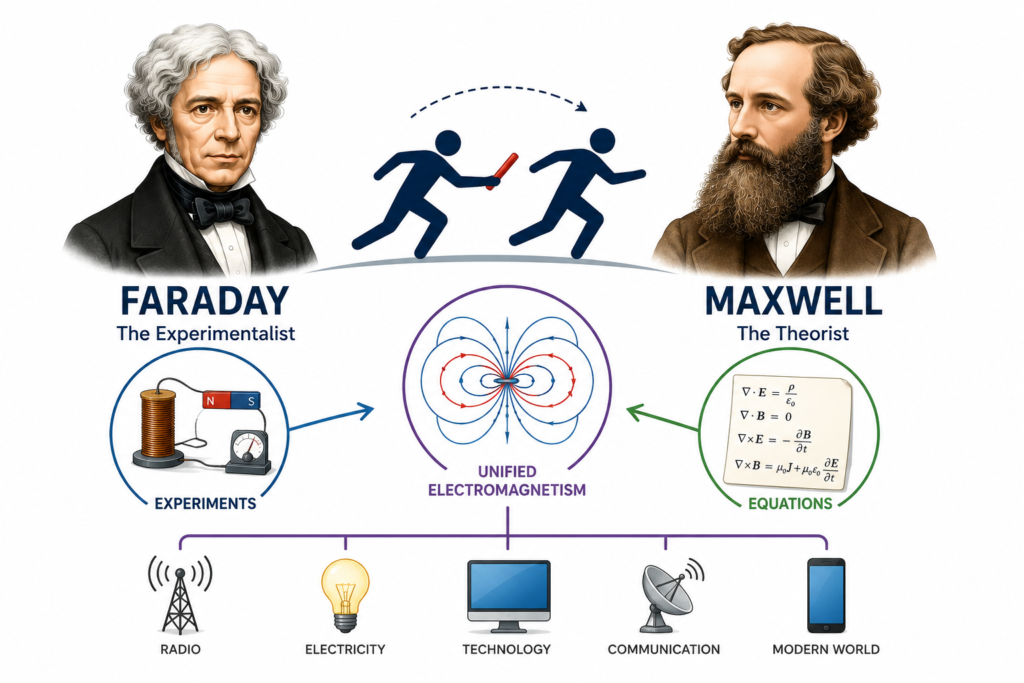
The faraday and maxwell connection is one of the greatest intellectual partnerships in the history of science. Michael Faraday and James Clerk Maxwell never worked side by side in a laboratory, yet together they transformed humanity’s understanding of electricity, magnetism, light, and the universe itself.
Faraday was the master experimentalist. He relied on observation, intuition, and physical demonstrations. Maxwell was the brilliant mathematician who transformed Faraday’s ideas into elegant equations that unified electromagnetism forever.
Their combined work created the foundation for:
- Modern physics
- Electrical engineering
- Radio communication
- Wireless technology
- Fiber optics
- Quantum theory
- Relativity
Without the faraday and maxwell connection, modern civilization would look completely different today.
This article explores the history, experiments, mathematics, equations, scientific philosophy, and global impact behind one of the greatest relay races in scientific history.
The Scientific World Before Electromagnetism (1800 – 1830)
In the early 19th century, electricity and magnetism were mostly studied as separate subjects.
Scientists knew about:
- Static electricity
- Magnets
- Electric currents
- Chemical batteries
However, nobody fully understood how these forces related to each other.
The scientific world lacked a unified theory connecting:
- Electricity
- Magnetism
- Light
This changed dramatically because of Michael Faraday’s experiments.
Michael Faraday and Experimental Genius
Michael Faraday became famous for extraordinary experimental skill.
Although he lacked advanced mathematics education, Faraday possessed remarkable physical intuition.
Much of his success came through michael faraday self education, which helped him develop independent scientific thinking.
Faraday believed scientific truth should emerge from experiments and observation.
His work focused heavily on:
- Electricity
- Magnetism
- Motion
- Force fields
Faraday constantly searched for hidden relationships in nature.
Electromagnetic Induction Changes Science (1831)
In 1831, Faraday made one of the greatest discoveries in scientific history.
He discovered electromagnetic induction, proving changing magnetic fields can generate electric currents.
Faraday’s law of induction is written as:
Where:
- = Induced electromotive force
- = Magnetic flux
This discovery became the scientific foundation for:
- Power stations
- Generators
- Transformers
- Modern electricity
Faraday’s experiments transformed civilization.
The Birth of Field Theory
Faraday introduced revolutionary ideas involving invisible force fields.
Instead of believing forces acted mysteriously across empty space, Faraday proposed that space itself contains fields.
This became the foundation of field theory and lines of force.
Faraday visualized magnetic field lines spreading through space continuously.
Although many scientists initially doubted him, these ideas later became central to physics.
Faraday’s Scientific Philosophy
Faraday emphasized physical intuition over complex mathematics.
He believed nature should be understood through:
- Observation
- Experiments
- Visualization
- Repetition
Faraday often used iron filings around magnets to visualize magnetic field lines.
This simple experimental method inspired entirely new scientific thinking.
James Clerk Maxwell Enters Science (1850 – 1860)
James Clerk Maxwell was born in Scotland in 1831, the same year Faraday discovered electromagnetic induction.
Unlike Faraday, Maxwell received elite mathematical education.
He became one of history’s greatest mathematical physicists.
Maxwell admired Faraday deeply.
He recognized that Faraday’s experimental discoveries contained profound physical truths hidden beneath visual concepts.
Maxwell decided to transform Faraday’s ideas into mathematics.
Experimental vs Theoretical Science
The faraday and maxwell connection perfectly illustrates experimental vs theoretical science.
Faraday provided:
- Experiments
- Physical concepts
- Field intuition
Maxwell provided:
- Mathematical structure
- Equations
- Predictive theory
Together, they created one of the greatest scientific collaborations in history even without direct partnership.
On Physical Lines of Force (1861 – 1862)
Maxwell published an important paper called On Physical Lines of Force.
This work translated Faraday’s field ideas into mathematical form.
Maxwell used partial differential equations to describe how electric and magnetic fields interact.
One important equation became:∇⋅E=ϵ0ρ
Where:
- = Electric field
- = Charge density
- = Permittivity of free space
This equation mathematically described electric fields throughout space.
Maxwell’s Equations and Electromagnetism
Maxwell eventually developed four famous equations describing electromagnetism completely.
These equations unified:
- Electricity
- Magnetism
- Light
One important Maxwell equation is:
This equation directly reflects Faraday’s induction experiments.
Another equation introduced displacement current:
This revolutionary idea allowed electromagnetic waves to exist mathematically.
The Discovery of Electromagnetic Waves
Maxwell realized his equations predicted waves traveling through space.
The wave speed equation became:
Where:
- = Speed of light
- = Magnetic permeability
- = Electric permittivity
The calculated speed matched the known speed of light exactly.
Maxwell concluded:
Light itself is an electromagnetic wave.
This became one of the greatest discoveries in scientific history.
Faraday’s Intuition About Light and Magnetism
Faraday had already hinted at this connection earlier through the faraday effect.
He experimentally showed magnetic fields could rotate polarized light.
Although Faraday lacked the mathematics to explain it fully, Maxwell later proved Faraday’s intuition correct.
This extraordinary scientific relay race changed physics forever.
Vector Calculus and Field Equations
Maxwell’s work helped develop vector calculus in physics.
Fields became represented mathematically as vectors spread through space.
For example:
Where:
- = Force
- = Charge
- = Electric field
- = Magnetic field
- = Velocity
This equation describes electromagnetic force behavior precisely.
Faraday’s visual ideas became rigorous mathematics.
Treatise on Electricity and Magnetism (1873)
Maxwell later published Treatise on Electricity and Magnetism.
This massive work organized electromagnetic theory comprehensively.
The treatise became one of the most important books in scientific history.
It transformed Faraday’s experiments into a unified theoretical framework.
Modern electrical engineering emerged directly from this work.
The Unification of Physics
The faraday and maxwell connection helped create the unification of physics.
For the first time, scientists realized:
- Electricity
- Magnetism
- Light
are manifestations of one unified phenomenon.
This revolutionary insight influenced every major branch of modern physics.
Electromagnetic Technology and Civilization
Faraday and Maxwell’s discoveries eventually enabled:
- Radio communication
- Television
- Wireless networks
- Electric motors
- Power grids
- Radar systems
- Internet communication
Modern technological civilization depends deeply on their work.
Einstein and Electromagnetic Theory
Albert Einstein later described Maxwell’s equations as one of the greatest achievements in human thought.
Einstein’s theory of relativity grew partly from Maxwell’s electromagnetic theory.
The relationship between space, time, and light emerged from Maxwell’s equations.
Faraday’s experiments indirectly influenced modern relativity itself.
Scientific Collaboration Across Generations
The faraday and maxwell connection demonstrates how science evolves across generations.
Faraday passed the intellectual baton through experiments.
Maxwell carried it forward using mathematics.
Together, they proved scientific progress often requires both:
- Experimental intuition
- Mathematical theory
This partnership became a model for modern scientific collaboration.
Why Faraday Needed Maxwell
Faraday’s ideas were brilliant but difficult for some scientists to accept without mathematical proof.
Maxwell provided:
- Mathematical rigor
- Predictive equations
- Theoretical consistency
His equations validated Faraday’s physical intuition scientifically.
Why Maxwell Needed Faraday
Maxwell repeatedly acknowledged Faraday’s importance.
Without Faraday:
- Maxwell would lack experimental foundations
- Electromagnetic theory might never emerge
- Field concepts would remain undeveloped
Faraday’s physical intuition guided Maxwell’s mathematics.
Modern Physics and Electromagnetism (1900 – Present)
Today, modern physics relies heavily on electromagnetic field theory.
Applications include:
- Quantum electrodynamics
- Particle physics
- Telecommunications
- Fiber optics
- Medical imaging
Faraday and Maxwell’s ideas continue shaping scientific research worldwide.
Faraday and Maxwell’s Scientific Legacy
Together, Faraday and Maxwell transformed humanity’s understanding of nature.
Their discoveries unified:
- Electricity
- Magnetism
- Light
- Energy fields
Few scientific partnerships have changed civilization so deeply.
FAQs About Faraday and Maxwell Connection
What is the Faraday and Maxwell connection?
It describes how Maxwell transformed Faraday’s experimental discoveries into mathematical electromagnetic theory.
Did Faraday and Maxwell work together directly?
No. Maxwell studied and mathematically expanded Faraday’s earlier discoveries.
What did Faraday discover?
Faraday discovered electromagnetic induction and introduced field theory concepts.
What did Maxwell contribute?
Maxwell created mathematical equations describing electromagnetism completely.
Why are Maxwell’s equations important?
They unified electricity, magnetism, and light into one theory.
How did Faraday influence modern physics?
Faraday’s field concepts became foundational for electromagnetism, relativity, and quantum physics.
Conclusion
The faraday and maxwell connection remains one of the greatest scientific partnerships in human history. Michael Faraday’s extraordinary experiments revealed hidden electromagnetic forces throughout nature, while James Clerk Maxwell transformed those ideas into elegant mathematical equations that unified electricity, magnetism, and light forever.
Together, they reshaped humanity’s understanding of the universe and laid the foundations for modern physics, engineering, communication, and technology. Their discoveries power nearly every aspect of modern civilization from electric grids and wireless communication to computers and fiber optic networks.
Faraday and Maxwell proved that science advances most powerfully when experimental imagination and mathematical brilliance work together. Their relay race across generations became one of the greatest achievements in intellectual history.
The impact of the faraday and maxwell connection on civilization is as revolutionary as how ancient greek scientists changed modern science, proving once again that great scientific ideas can transform the entire future of humanity forever.