The story of michael faraday is one of the most inspiring journeys in the history of science. Born into poverty with very little formal education, he became one of the most influential scientists the world has ever seen. His discoveries changed electricity, chemistry, magnetism, and modern technology forever. Today, almost every home, industry, and electronic device depends in some way on the work of Michael Faraday.
Unlike many scientists of his time, Faraday was not born into wealth or privilege. He was a self-taught scientist who learned through curiosity, discipline, and endless experiments. His life is a perfect example of how determination and passion can overcome poverty and lack of education.
This scientific biography explores the life, struggles, achievements, and scientific legacy of michael faraday. It also introduces the discoveries, inventions, and laws that later articles will explain in detail.
Early Life of Michael Faraday (1791 – 1804)
Michael Faraday was born on September 22, 1791, in Newington Butts, London, England. His family was extremely poor. His father worked as a blacksmith but often suffered from illness, making life difficult for the family.
Faraday grew up during a time when education was limited for poor children. He only received basic schooling and learned simple reading, writing, and arithmetic. Yet even as a child, he showed curiosity about the world around him.
The young michael faraday belonged to a Christian group called the Sandemanian church. This religious background strongly influenced his honesty, humility in science, and disciplined lifestyle throughout his life.
Despite poverty, Faraday’s mind was filled with questions about nature, science, and the universe.
Apprenticeship and Self Education (1805 – 1812)
At the age of 14, Faraday became an apprentice to a bookbinder. This apprenticeship changed his life forever.
While binding books, he secretly read them. He studied books on chemistry, electricity, mathematics, and experimental philosophy. This period became the foundation of michael faraday self education.
Faraday carefully copied scientific notes and attended public lectures whenever possible. He became fascinated by famous British scientists and dreamed of entering the scientific world.
One important mathematical concept that fascinated Faraday involved electricity and motion. Scientists at the time were exploring relationships such as:
Where:
- = Voltage
- = Current
- = Resistance
Although Ohm later formalized this equation, Faraday’s experiments helped scientists understand electricity practically.
Faraday’s hunger for knowledge made him different from ordinary apprentices. Instead of accepting his social class limitations, he educated himself every single day.
Humphry Davy and the Royal Institution (1812 – 1815)
One day, Faraday attended lectures by the famous chemist Sir Humphry Davy at the Royal Institution. He carefully took notes and later sent them to Davy as a beautifully bound book.
Davy was impressed by Faraday’s intelligence and dedication. Soon afterward, Faraday became Humphrey Davy’s assistant at the Royal Institution.
This opportunity completely changed the life of michael faraday.
At the Royal Institution, Faraday traveled across Europe with Davy and met many leading scientists. He learned laboratory techniques, scientific method practices, and advanced experimentation.
However, Faraday still faced discrimination because of his poor background. Some wealthy scientists looked down on him because he lacked formal education.
Yet his talent could not be ignored.
Michael Faraday and Experimental Science
Faraday became famous for his incredible laboratory skills. Unlike many scientists who focused mostly on theory, he preferred experiments.
He believed science should be understood through observation and testing.
This practical approach made michael faraday one of the greatest experimental scientists in history.
His experiments covered:
- Electricity
- Magnetism
- Chemistry
- Gases
- Optics
- Electrochemistry
Faraday’s work became a major part of the scientific revolution during the Victorian era science period.
Discovery of Electromagnetic Induction (1831)
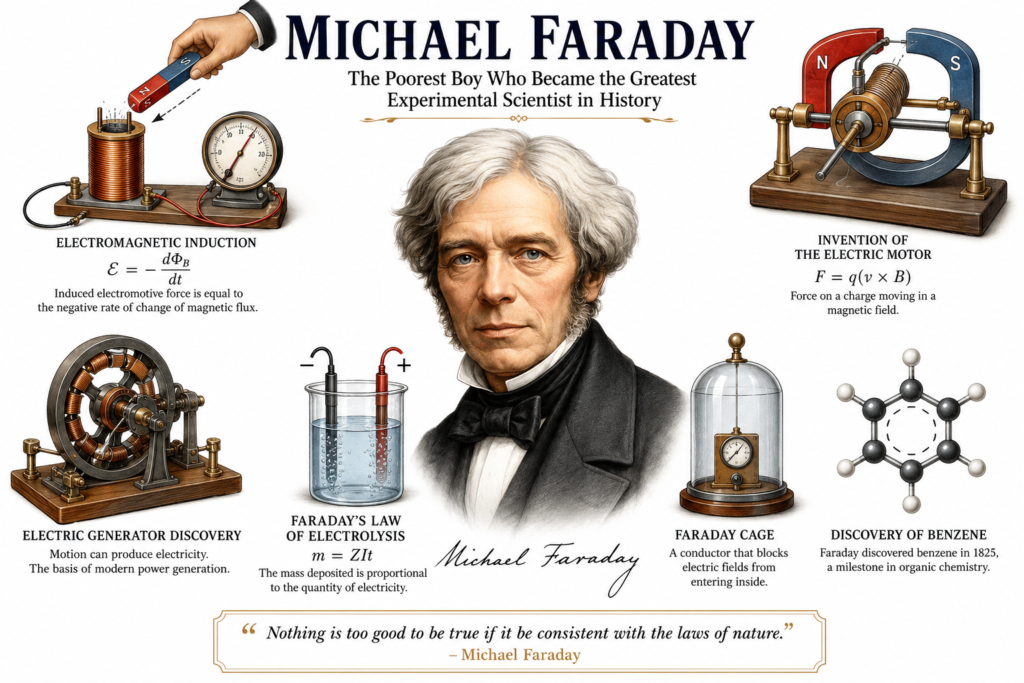
One of Faraday’s greatest achievements was electromagnetic induction.
He discovered that moving a magnet near a wire could produce electricity. This discovery became the foundation of modern electrical power systems.
The basic mathematical expression of Faraday’s law is:
Where:
- = Induced electromotive force
- = Magnetic flux
- = Rate of change over time
This principle powers electric generators, transformers, and many modern machines.
Without michael faraday, modern electricity generation would not exist.
Later articles will explain this discovery in detail through faraday’s law of induction.
The Invention of the Electric Motor
Faraday also played a major role in the invention of the electric motor.
He discovered that electricity could create continuous motion through magnetic interaction. His early motor experiment became the foundation for electric motors used today in:
- Fans
- Washing machines
- Electric vehicles
- Industrial machinery
The force between electricity and magnetism can be represented as:
Where:
- = Magnetic force
- = Electric charge
- = Velocity
- = Magnetic field
Faraday’s motor experiments showed how electrical energy could become mechanical energy.
Electric Generator Discovery
Another revolutionary achievement was the electric generator discovery.
Faraday realized that if electricity could create motion, then motion could also create electricity.
This idea became the basis of generators used in power stations worldwide.
Modern power plants still rely on Faraday’s induction principles discovered nearly two centuries ago.
His experiments transformed 19th-century physics and changed human civilization forever.
Faraday’s Work in Chemistry
Michael Faraday was not only a physicist. He was also a brilliant chemist.
He made important contributions to chemistry through experiments involving gases, electrolysis, and organic compounds.
One major achievement was the faraday discovery of benzene in 1825. Benzene later became essential in industrial chemistry and manufacturing.
Faraday also studied electrolysis and introduced important scientific terms such as:
- Electrode
- Anode
- Cathode
- Ion
These terms are still used today.
Faraday’s Law of Electrolysis
Faraday created important electrochemical laws that explained how electricity affects chemical reactions.
The first law of electrolysis can be expressed mathematically as:m=ZQ
Where:
- = Mass deposited
- = Electrochemical equivalent
- = Electric charge
Since:
Then:
Where:
- = Current
- = Time
These equations became the foundation of electrochemistry.
Future articles will explain faraday’s law of electrolysis in greater depth.
Liquefying Gases and Chemical Experiments
Faraday also conducted the famous liquefying gases experiment.
At the time, many scientists believed gases could never become liquids. Faraday proved otherwise by compressing and cooling gases.
His work later influenced refrigeration systems and low temperature physics.
He also studied chlorine compounds and accidentally contributed to the understanding of chlorine clathrates.
These experiments expanded the history of science significantly.
Faraday Cage and Scientific Innovation
One of Faraday’s practical inventions was the Faraday Cage.
A Faraday Cage blocks external electric fields and protects objects inside.
Today, Faraday Cage technology is used in:
- Aircraft safety
- MRI rooms
- Electronic shielding
- Laboratories
- Communication systems
The electric field inside a conductor becomes:
This simple but powerful principle made Faraday’s invention extremely important.
A future article will fully explain faraday cage explained concepts and applications.
Michael Faraday and Public Lectures
Faraday was not only a scientist but also a great teacher.
At the Royal Institution, he gave famous public lectures that made science exciting for ordinary people.
His Christmas Lectures became legendary and inspired generations of students.
Faraday believed science should be understandable to everyone, not only educated elites.
His book The Chemical History of a Candle became one of the most famous science books ever written.
Future articles will discuss chemical history of a candle in detail.
Faraday and Maxwell Connection
Faraday introduced the idea of fields and lines of force. Although he was not highly trained in mathematics, his physical intuition was extraordinary.
Later, James Clerk Maxwell transformed Faraday’s ideas into mathematical equations.
The famous Maxwell equations include:
These equations unified electricity and magnetism.
The faraday and maxwell connection became one of the greatest scientific partnerships in history, even though they worked in different ways.
Awards and Scientific Recognition
Michael Faraday eventually became one of the most respected scientists in Britain.
He received:
- Membership in the Royal Society
- The Copley Medal
- International recognition for scientific excellence
Despite his fame, Faraday remained humble.
He refused wealth and political power because he wanted to focus on science and truth.
This humility in science made him admired by both scientists and ordinary people.
Michael Faraday’s Personality and Values
Faraday’s character was as remarkable as his discoveries.
He was:
- Honest
- Humble
- Curious
- Hardworking
- Deeply religious
- Dedicated to learning
Unlike many scientists seeking fame, Faraday focused on discovery and public education.
His scientific legacy continues to inspire students and researchers worldwide.
The Last Years of Michael Faraday (1850 – 1867)
As Faraday grew older, his memory and health slowly weakened.
Even during illness, he remained respected across Europe.
He spent his later years quietly studying science and living peacefully with his wife Sarah Barnard.
Michael Faraday died on August 25, 1867.
Although he passed away more than 150 years ago, his influence remains everywhere in modern life.
Every electric motor, generator, and power station carries part of Faraday’s scientific vision.
Why Michael Faraday Still Matters Today
Modern civilization depends heavily on discoveries made by michael faraday.
His work shaped:
- Electricity generation
- Electronics
- Telecommunications
- Chemistry
- Physics
- Engineering
Without Faraday, modern technology would look completely different.
He proved that a poor self-taught scientist could transform the world through curiosity and persistence.
His life remains one of the greatest examples in the history of science.
FAQs About Michael Faraday
Who was Michael Faraday?
Michael Faraday was a British scientist known for major discoveries in electricity, magnetism, chemistry, and experimental science.
Why is Michael Faraday important?
He discovered electromagnetic induction and helped create the foundations of modern electrical technology.
Was Michael Faraday self taught?
Yes. Faraday had little formal education and learned mainly through reading books and performing experiments.
What did Michael Faraday invent?
He helped develop the electric motor, electric generator, and important electrochemical principles.
What is Faraday’s most famous discovery?
His most famous discovery is electromagnetic induction, which powers modern electricity generation.
Did Michael Faraday work with Maxwell?
Faraday and Maxwell did not directly work together much, but Maxwell mathematically developed Faraday’s field theories.
Conclusion
The story of michael faraday is one of courage, intelligence, humility, and determination. From a poor bookbinder’s apprentice to one of the greatest scientists in history, Faraday changed the world through experimental philosophy and relentless curiosity.
His discoveries became the foundation of modern electricity, chemistry, and physics. More importantly, his life proved that passion for learning can overcome poverty and lack of formal education.
In future articles, we will explore each of Faraday’s discoveries in detail, including electromagnetic induction, electric motors, electrolysis, and field theory. His scientific journey also connects beautifully with the broader history of discovery, much like how ancient greek scientists changed modern science and shaped humanity’s understanding of nature.