The story of the first color photograph is one of the most fascinating chapters in scientific history. Today, billions of color photographs are taken every day using smartphones, digital cameras, and satellites. Color photography feels so natural that most people never stop to wonder how it began.
The answer leads directly to James Clerk Maxwell.
Although Maxwell is best known for his groundbreaking work on electromagnetism, he also played a crucial role in the development of color photography. In 1861, he demonstrated a revolutionary idea that proved color could be captured, separated, and recreated using light itself.
The creation of the first color photograph was more than a photographic achievement. It was a scientific breakthrough that confirmed Maxwell’s theory of color vision and laid the foundation for modern imaging technology.
The World Before Color Photography (1800 – 1860)
Before the invention of the first color photograph, photography existed only in black and white.
Photographers could capture shapes, textures, and brightness, but not color.
This limitation frustrated scientists and artists alike.
People wondered whether photography could ever reproduce the rich colors seen by the human eye.
The challenge was enormous because scientists did not fully understand how color perception worked.
The solution would come from the brilliant mind of James Clerk Maxwell.
Maxwell’s Interest in Color Science
Most people associate Maxwell with electricity and magnetism.
However, Maxwell also had a deep interest in optics and human vision.
He wanted to understand how the eye perceives color.
Through experiments and mathematical analysis, Maxwell developed what became known as maxwell color vision theory.
His theory proposed that all visible colors could be created by combining three primary colors:
- Red
- Green
- Blue
This concept became the foundation of modern RGB technology.
Today every smartphone screen, television, and computer monitor uses the same principle.
Understanding Color Vision
Maxwell’s theory was based on the idea that the human eye contains receptors sensitive to different wavelengths of light.
Modern science confirms this concept.
The three-color model can be represented mathematically.
If:
R = Red intensity
G = Green intensity
B = Blue intensity
Then any visible color can be represented as:
Color = R + G + B
Different combinations produce different colors.
For example:
White = R + G + B
Yellow = R + G
Magenta = R + B
Cyan = G + B
This process is known as additive color mixing.
The theory would soon lead directly to the first color photograph.
The Scientific Goal (1855 – 1861)
Maxwell wanted to demonstrate that color could be reproduced using only red, green, and blue light.
If his theory was correct, then a photograph could be separated into three color components and later reconstructed.
This idea became known as three-color process photography.
At the time, many scientists doubted it would work.
Photography was still relatively new, and color science remained poorly understood.
Nevertheless, Maxwell was confident.
The Famous Royal Institution Lecture (1861)
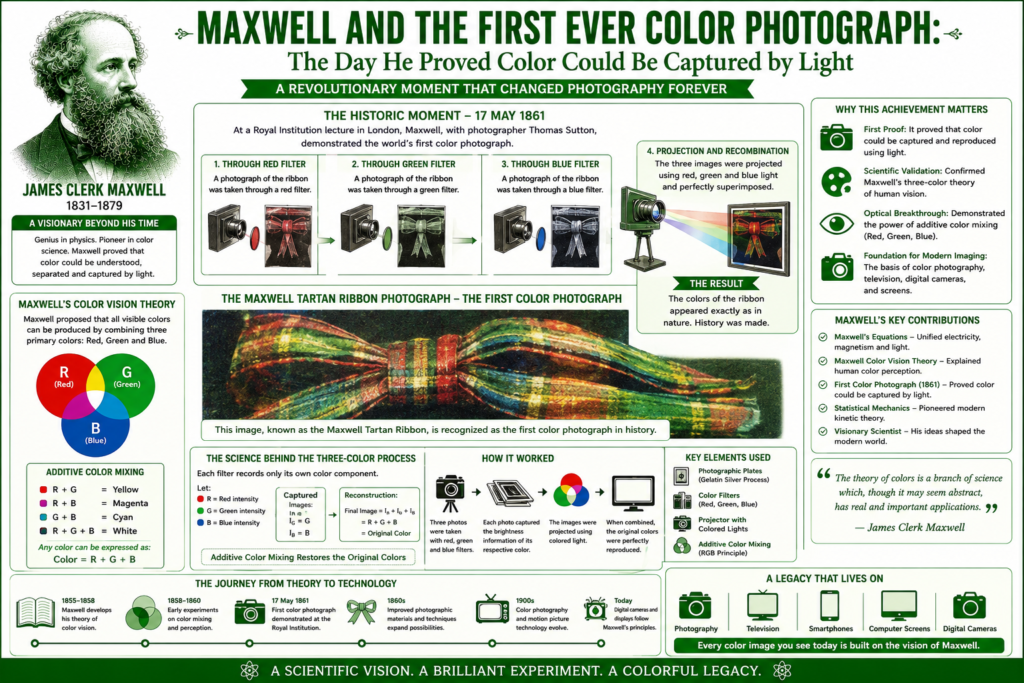
The historic demonstration of the first color photograph occurred on May 17, 1861.
The event took place during a Royal Institution lecture in London.
Maxwell collaborated with photographer Thomas Sutton, who later became famous as the inventor of the single-lens reflex camera.
Sutton produced three separate photographs of a tartan ribbon.
Each image was taken through a different color filter:
- Red filter
- Green filter
- Blue filter
These photographs formed the basis of the experiment.
The Maxwell Tartan Ribbon Photograph
The resulting image became known as the Maxwell tartan ribbon photograph.
It is widely regarded as the first color photograph in history.
The process worked as follows:
- Photograph through a red filter.
- Photograph through a green filter.
- Photograph through a blue filter.
- Project each image using the same colored light.
- Superimpose the projections.
The combined image recreated the ribbon’s original colors.
The demonstration stunned the audience.
For the first time, color had been captured and reconstructed scientifically.
How the Three Color Process Worked
The science behind the first color photograph is surprisingly elegant.
Suppose a scene contains red, green, and blue light intensities.
Each filter records a portion of the incoming light.
Mathematically:
Image = R + G + B
The red filter records:
I_R = R
The green filter records:
I_G = G
The blue filter records:
I_B = B
When projected together:
Final Image = I_R + I_G + I_B
Result:
Final Image = R + G + B
The original colors reappear.
This mathematical simplicity helped convince scientists that Maxwell’s theory was correct.
Why the Experiment Was Revolutionary
The success of the first color photograph demonstrated several important ideas.
First, it proved that color information could be separated into components.
Second, it showed that color could be reconstructed using additive color mixing.
Third, it confirmed key predictions of Maxwell’s color theory.
The experiment represented a perfect combination of theoretical science and practical technology.
It became one of the most famous optical demonstrations in history.
Technical Challenges and Limitations
Although the first color photograph was revolutionary, it was not perfect.
Photographic plates of the era had significant limitations.
Most photographic plates were highly sensitive to blue light but much less sensitive to red and green wavelengths.
As a result, the color reproduction was incomplete.
Nevertheless, the experiment succeeded well enough to demonstrate the underlying principle.
Future improvements in photographic materials would solve many of these problems.
The Science Behind Color Filters
Color filters played a crucial role in the creation of the first color photograph.
A red filter transmits red wavelengths while blocking most others.
Similarly:
Green Filter → Green wavelengths
Blue Filter → Blue wavelengths
This process creates color separation.
The technique remains fundamental to photography today.
Modern digital cameras still use color filters based on the same principles Maxwell demonstrated.
Maxwell’s Broader Scientific Vision
The achievement of the first color photograph reveals an important aspect of Maxwell’s genius.
He did not limit himself to one scientific field.
His interests included:
- Optics
- Mathematics
- Electromagnetism
- Thermodynamics
- Astronomy
The same creative thinking that produced maxwell electromagnetic theory also helped transform photography.
This versatility explains why Maxwell remains one of history’s greatest scientists.
James Clerk Maxwell Contributions Beyond Physics
When discussing James Clerk Maxwell Contributions, many people focus only on electromagnetism.
However, his work on color vision was equally influential.
His achievements include:
- Electromagnetic theory
- Color vision research
- Color photography
- Statistical mechanics
- Gas theory
- Mathematical physics
The first color photograph stands as one of the most visible examples of his scientific creativity.
Influence on Modern Photography
The legacy of the first color photograph continues today.
Modern cameras use principles remarkably similar to Maxwell’s original concept.
Digital sensors record color information through red, green, and blue channels.
Modern displays reproduce images using RGB pixels.
Every digital photograph depends on ideas first demonstrated in 1861.
The history of color photography traces directly back to Maxwell’s experiment.
Connection to Modern Displays
Every smartphone screen contains millions of tiny RGB subpixels.
Each pixel combines:
Red light
Green light
Blue light
The brightness of each component determines the final color.
This process follows Maxwell’s original theory exactly.
Whether watching a movie, editing a photo, or using social media, people rely on principles proven during the first color photograph demonstration.
From Photography to Television
The influence of the first color photograph extended far beyond photography.
The RGB model became essential for:
- Color television
- Computer monitors
- Digital cameras
- Smartphones
- Virtual reality displays
Without Maxwell’s work, modern visual technology might have developed very differently.
His ideas helped shape the digital world.
Maxwell’s Place in Scientific History
The success of the first color photograph demonstrates Maxwell’s unique ability to combine theory and experimentation.
Like the partnership of faraday and maxwell, his work often united abstract ideas with practical demonstrations.
His achievements also influenced later scientists.
The intellectual journey from maxwell to einstein helped shape modern science.
Although Maxwell is most famous for electromagnetism, his contributions to color science remain equally remarkable.
Why the First Color Photograph Still Matters
More than 160 years later, the first color photograph remains one of the most important demonstrations in scientific history.
It proved:
- Color can be analyzed mathematically.
- Color information can be separated.
- Color can be reconstructed accurately.
- Human vision follows predictable principles.
These ideas remain fundamental to imaging science.
Modern photography still builds upon Maxwell’s discoveries.
Frequently Asked Questions (FAQs)
What was the first color photograph?
The first color photograph was the famous tartan ribbon image demonstrated by Maxwell in 1861 using red, green, and blue filters.
Who took the first color photograph?
The photograph was produced by Thomas Sutton under the direction and scientific guidance of James Clerk Maxwell.
Why is the tartan ribbon photograph important?
It demonstrated that color could be captured and reconstructed using three primary colors.
What is Maxwell color vision theory?
It is the theory that all visible colors can be created by combining red, green, and blue light.
How does modern photography relate to Maxwell’s work?
Modern digital cameras and displays use RGB color systems based on the same principles Maxwell demonstrated.
Conclusion
The story of the first color photograph is far more than a photographic milestone. It represents a brilliant scientific breakthrough that transformed humanity’s understanding of color, vision, and light.
By demonstrating that color could be separated into red, green, and blue components and later reconstructed, James Clerk Maxwell laid the foundation for modern photography, television, computer displays, and digital imaging.
More than 160 years later, every color image viewed on a smartphone or computer screen owes something to Maxwell’s revolutionary experiment. The tartan ribbon photograph was not merely the first color photograph. It was proof that color itself could be captured by light, analyzed by science, and recreated through human ingenuity.