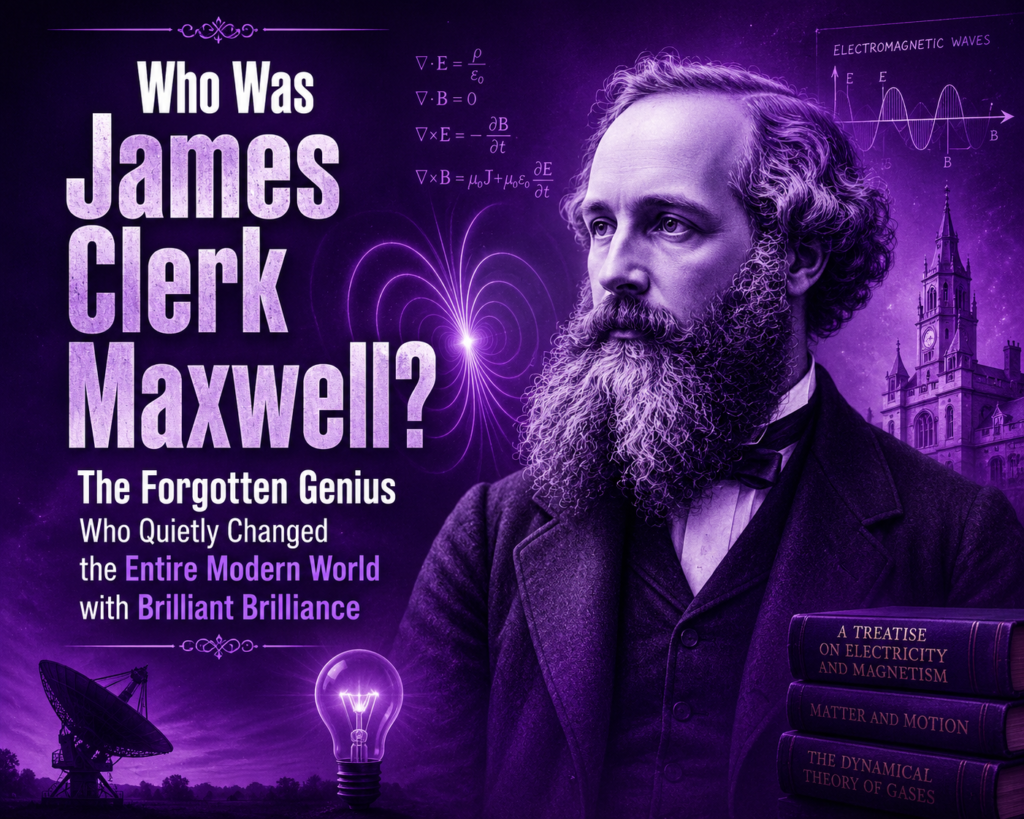
The story of james clerk maxwell is one of the most remarkable stories in the history of science. Although names like Isaac Newton and Albert Einstein are widely recognized, many people are unaware that Maxwell built the bridge between their discoveries. His ideas transformed physics, technology, communication, and our understanding of the universe.
Today, every radio signal, television broadcast, WiFi connection, mobile phone network, and satellite communication system owes something to the work of james clerk maxwell. His theories changed the world so profoundly that Albert Einstein once admitted that his own work was heavily influenced by Maxwell’s discoveries.
This article explores the life, achievements, and lasting influence of james clerk maxwell, one of the greatest scientific minds ever born.
Early Life and Childhood (1831 – 1845)
James Clerk Maxwell was born on June 13, 1831, in Edinburgh, Scotland. He spent much of his childhood at Glenlair, the family estate in rural Scotland.
From an early age, young Maxwell displayed an extraordinary curiosity about nature. He constantly asked questions about how things worked. Whether it was the shape of a flower, the movement of water, or the behavior of light, he wanted to understand the hidden rules behind everything.
He attended Edinburgh Academy, where his classmates initially considered him unusual because of his intense interest in science and mathematics. However, his intelligence soon became impossible to ignore.
By the age of 14, he had already published a scientific paper describing how to draw mathematical curves using pins and string. Such achievements hinted at the greatness that would later define james clerk maxwell.
Education and Scientific Development (1846 – 1856)
After studying at the University of Edinburgh, Maxwell continued his education at University of Cambridge.
Cambridge provided the perfect environment for his growing talents. There he developed exceptional skills in mathematics and mathematical physics.
His professors quickly recognized that Maxwell possessed a rare ability to connect abstract mathematical equations with real physical phenomena. This skill would later allow him to solve some of the greatest mysteries in science.
During these years, he became fascinated by electricity, magnetism, and light. Scientists knew these phenomena existed, but nobody fully understood how they were connected.
That challenge would become Maxwell’s greatest achievement.
The Scientific World Before Maxwell
Before james clerk maxwell, scientists viewed electricity and magnetism as separate forces.
Important discoveries had already been made by Michael Faraday, who demonstrated that electric and magnetic fields could influence each other. However, Faraday lacked advanced mathematical training and could not fully describe his discoveries using equations.
Maxwell recognized the genius of Faraday’s experiments and decided to provide the mathematical foundation that Faraday’s work needed.
This collaboration across generations eventually became known through the famous relationship of faraday and maxwell.
Maxwell’s Greatest Achievement (1861 – 1865)
The most important contribution of james clerk maxwell was the development of maxwell electromagnetic theory.
He combined decades of experimental observations into a unified mathematical framework.
His revolutionary equations showed that electricity and magnetism were not separate forces at all. Instead, they were different aspects of the same phenomenon called electromagnetism.
The famous maxwell equations can be written as:
∇ · E = ρ/ε₀
∇ · B = 0
∇ × E = − ∂B/∂t
∇ × B = μ₀J + μ₀ε₀(∂E/∂t)
These equations remain among the most important equations in all of science.
They describe how electric and magnetic fields interact, change, and propagate through space.
Einstein later stated that these equations were among the most profound discoveries ever made.
The Discovery of Light’s True Nature
One of the most astonishing conclusions from Maxwell’s equations involved the speed of electromagnetic waves.
Using known constants, Maxwell calculated:
c = 1/√(μ₀ε₀)
The result was approximately:
c ≈ 3 × 10⁸ m/s
This value matched the measured speed of light.
Maxwell realized something extraordinary.
Light itself was an electromagnetic wave.
This breakthrough became the foundation of electromagnetic wave theory.
For the first time in human history, scientists understood what light truly was.
The discovery unified optics, electricity, and magnetism into one scientific framework.
How Maxwell Changed Modern Technology
Nearly every communication technology today depends on principles discovered by james clerk maxwell.
His theories eventually led to:
- Radio broadcasting
- Television
- Radar systems
- Mobile phones
- WiFi networks
- Satellite communications
- GPS technology
- Wireless internet
Without Maxwell’s discoveries, the modern digital world would look completely different.
The smartphone in your pocket operates because electromagnetic waves behave exactly as Maxwell predicted more than 150 years ago.
The Brilliant Idea of Displacement Current
One of Maxwell’s most revolutionary insights was the concept of displacement current.
Scientists knew that electric currents produced magnetic fields. However, Maxwell noticed a problem in existing theories.
To solve it, he proposed that changing electric fields could also generate magnetic fields even without traditional electric current.
Mathematically:
I_d = ε₀(dΦ_E/dt)
where:
- I_d = displacement current
- ε₀ = permittivity of free space
- Φ_E = electric flux
This seemingly simple correction completed electromagnetic theory and enabled the prediction of electromagnetic waves.
Many historians consider displacement current one of the most brilliant theoretical ideas ever proposed.
Maxwell and the Kinetic Theory of Gases (1859 – 1873)
While james clerk maxwell is best known for electromagnetism, his contributions extended far beyond that field.
He made groundbreaking advances in the kinetic theory of gases.
Maxwell realized that gas molecules move at different speeds rather than a single uniform speed.
This insight led to the famous maxwell boltzmann distribution.
The probability distribution can be written as:
f(v) = 4π(m/2πkT)^(3/2)v²e^(-mv²/2kT)
This equation describes how molecular speeds are distributed within a gas.
It became one of the foundations of modern statistical physics.
Today it remains essential in chemistry, physics, engineering, and thermodynamics.
The First Color Photograph (1861)
Many people are surprised to learn that Maxwell also helped create the world’s first color photograph.
He proposed that all visible colors could be produced by combining red, green, and blue light.
This idea eventually became known as the maxwell color vision theory.
To demonstrate his theory, a photograph was taken through red, green, and blue filters. The images were then projected together.
The result became the first successful color photograph in history.
Modern televisions, computer screens, smartphones, and digital cameras still use the RGB color principle developed from Maxwell’s ideas.
Maxwell and Saturn’s Rings
Another remarkable achievement involved astronomy.
Scientists debated whether Saturn’s rings were solid, liquid, or composed of separate particles.
Using advanced mathematics, Maxwell proved that the rings could only remain stable if they consisted of countless small particles orbiting independently.
Modern space missions later confirmed his conclusion.
This achievement demonstrated the extraordinary range of Maxwell’s intellect.
Leadership at Cavendish Laboratory (1871 – 1879)
In 1871, Maxwell became the first director of the famous Cavendish Laboratory at the University of Cambridge.
The laboratory would later become one of the world’s most important scientific research centers.
Under Maxwell’s guidance, the institution emphasized precision measurement and experimental excellence.
Future discoveries made there would include the electron, the structure of DNA, and many Nobel Prize winning breakthroughs.
His leadership helped establish a culture of scientific excellence that continues today.
Einstein’s Admiration for Maxwell
The influence of james clerk maxwell extended directly into the twentieth century.
Albert Einstein frequently expressed admiration for Maxwell’s work.
The relationship between einstein hero maxwell is one of the most fascinating connections in scientific history.
Einstein once explained that his theory of relativity was built upon the foundations Maxwell created.
The concept of a constant speed of light emerged directly from Maxwell’s equations.
Without Maxwell, relativity might never have existed.
The scientific journey from maxwell to einstein represents one of the greatest intellectual progressions in human history.
James Clerk Maxwell Contributions That Changed Civilization
When discussing James Clerk Maxwell Contributions, it is difficult to overstate his impact.
His achievements include:
- Unifying electricity and magnetism
- Predicting electromagnetic waves
- Explaining the nature of light
- Advancing statistical mechanics
- Creating foundations for wireless communication
- Developing color vision theory
- Explaining Saturn’s rings
- Leading Cavendish Laboratory
Very few scientists have influenced as many different fields as Maxwell.
His scientific legacy continues to shape technology, engineering, astronomy, and physics.
Why Maxwell Remains a Forgotten Genius
Despite his extraordinary achievements, Maxwell often receives less public recognition than Newton or Einstein.
There are several reasons:
- His discoveries were highly mathematical.
- Much of his work was difficult for non scientists to understand.
- Later technologies based on his discoveries overshadowed the man himself.
- Public attention often focuses on inventors rather than theoretical scientists.
Yet many physicists believe Maxwell belongs in the same category as Newton and Einstein.
Some even argue that his influence on modern civilization rivals both.
His work represents one of the greatest examples of unification of forces in scientific history.
Scientific Legacy in the Modern Era
Today, the influence of james clerk maxwell appears everywhere.
Whenever someone sends a text message, uses WiFi, listens to radio, watches television, or connects to the internet, they are benefiting from Maxwell’s discoveries.
His ideas continue guiding research in:
- Quantum physics
- Telecommunications
- Space science
- Electronics
- Optical engineering
- Medical imaging
- Artificial intelligence hardware
The history of electromagnetism cannot be told without placing Maxwell at its center.
His role among the great scientists of the Victorian era remains unmatched.
Frequently Asked Questions
Who was James Clerk Maxwell?
James Clerk Maxwell was a Scottish physicist 19th century scientist who developed electromagnetic theory and transformed modern physics.
Why are Maxwell’s equations important?
Maxwell’s equations explain how electric and magnetic fields interact and form the foundation of modern communication technology.
Did Maxwell discover electromagnetic waves?
Yes. Maxwell mathematically predicted electromagnetic waves decades before they were experimentally confirmed.
How did Maxwell influence Einstein?
Einstein built parts of his theory of relativity upon Maxwell’s electromagnetic theories and often praised Maxwell’s work.
What was Maxwell’s contribution to color photography?
He demonstrated the principles behind color photography using red, green, and blue light combinations.
Conclusion
James Clerk Maxwell was far more than a brilliant physicist. He was a visionary thinker whose discoveries transformed humanity’s understanding of nature.
From maxwell equations to wireless communication, from color photography to statistical mechanics, Maxwell’s influence surrounds us every day.
Although history sometimes overlooks him, the truth remains clear. James Clerk Maxwell was one of the greatest scientific minds ever born. His work connected the discoveries of Faraday to the innovations of Einstein and laid the foundation for the technological world we live in today.
His scientific legacy proves that sometimes the quietest geniuses create the loudest revolutions.