The story of maxwell control theory is one of the most overlooked yet influential chapters in the history of science and engineering. While James Clerk Maxwell is widely celebrated for electromagnetism, color vision, and statistical physics, few people realize that he also helped create the foundations of modern control theory.
Today, control systems are everywhere.
They operate:
- Robots
- Aircraft
- Spacecraft
- Industrial machines
- Autonomous vehicles
- Power plants
- Artificial intelligence systems
The origins of many of these technologies can be traced back to Maxwell’s groundbreaking 1868 paper, On Governors.
In that work, Maxwell became one of the first scientists to mathematically analyze feedback systems, stability, and automatic regulation. His ideas transformed engineering and established the foundations of automation engineering.
The story of maxwell control theory demonstrates how a nineteenth century study of steam engines helped shape the technological world of the twenty first century.
The Industrial Revolution and the Need for Control (1760 – 1860)
Before the development of maxwell control theory, engineers faced a major challenge.
Steam engines powered factories, trains, and industrial machinery.
However, engine speed constantly fluctuated.
When load changed:
- Engines sped up.
- Engines slowed down.
- Mechanical failures became possible.
Engineers needed a way to regulate speed automatically.
This requirement led to one of history’s most important engineering inventions.
The Steam Engine Regulator
The solution came through the steam engine regulator, commonly known as the governor.
The governor automatically adjusted steam input to maintain a nearly constant speed.
It represented one of the earliest practical examples of automatic control.
The most famous design was the centrifugal governor developed by James Watt.
Although highly effective, engineers did not fully understand why governors sometimes became unstable.
This mystery eventually attracted Maxwell’s attention.
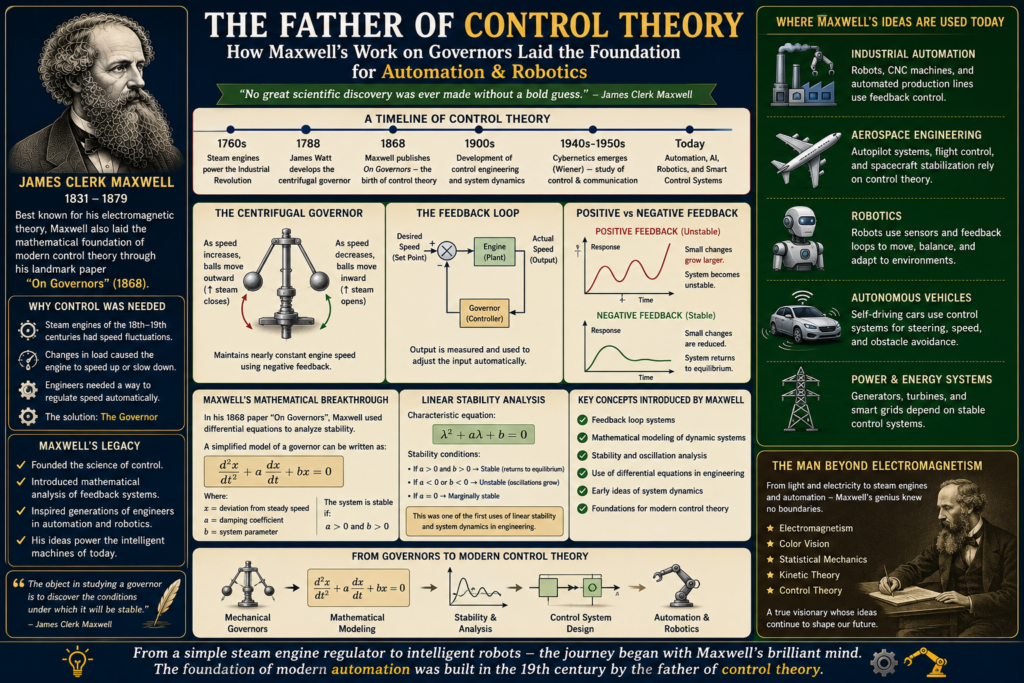
How the Centrifugal Governor Worked
The centrifugal governor analysis begins with two rotating balls attached to arms.
As rotational speed increases:
- Centrifugal force increases.
- Balls move outward.
- Steam flow decreases.
As speed decreases:
- Balls move inward.
- Steam flow increases.
This process creates a feedback loop.
The governor continuously adjusts engine behavior.
The mechanism appears simple today, but its mathematical analysis was surprisingly difficult.
The Concept of Feedback
The foundation of maxwell control theory is feedback.
Feedback occurs when system output influences future system behavior.
In a governor:
Output → Engine speed
Input → Steam flow
The governor measures speed indirectly and adjusts steam accordingly.
This creates a closed loop system.
Modern feedback loop systems operate using the same principle.
Positive and Negative Feedback
Maxwell recognized two important forms of feedback.
Positive Feedback
Changes become amplified.
Small disturbances grow larger.
Systems become unstable.
Negative Feedback
Changes become reduced.
Systems move toward stability.
Governors depend upon negative feedback.
This concept remains central to maxwell control theory today.
Maxwell’s Famous Paper On Governors (1868)
The most important contribution to maxwell control theory came in Maxwell’s landmark paper:
“On Governors”
Published in 1868, the paper introduced rigorous mathematical analysis into automatic control systems.
Maxwell asked a profound question:
Why do some governors maintain stability while others oscillate uncontrollably?
Answering this question required mathematics rather than intuition.
The result transformed engineering forever.
The Birth of System Dynamics
One of Maxwell’s greatest achievements was introducing system dynamics into engineering.
Instead of studying isolated components, he analyzed entire systems.
He examined:
- Inputs
- Outputs
- Feedback
- Stability
- Response behavior
This holistic approach became one of the foundations of maxwell control theory.
Modern control engineers still use similar methods.
Differential Equations and Control Systems
Maxwell realized that governors could be described using differential equations.
A simplified control system equation is:
d²x/dt² + a(dx/dt) + bx = 0
Where:
- x = System response
- a = Damping coefficient
- b = System parameter
This equation describes how a system evolves over time.
The approach allowed Maxwell to predict stability mathematically.
It represented a revolutionary advance.
Understanding Stability
The central goal of maxwell control theory is stability.
A stable system returns to equilibrium after disturbance.
An unstable system diverges from equilibrium.
Maxwell discovered that mathematical conditions determine stability.
Small disturbances should decrease rather than grow.
This idea became known as linear stability analysis.
Today it remains a cornerstone of engineering.
Oscillations and Instability
Maxwell observed that governors sometimes oscillated.
Instead of smoothly regulating speed, they repeatedly overcorrected.
Engine speed rose and fell continuously.
The phenomenon resembles:
- Vehicle steering oscillations
- Aircraft control problems
- Robot instability
Maxwell’s analysis explained why these oscillations occur.
His work established a scientific basis for controller design.
Linear Stability Analysis
One of the greatest achievements of maxwell control theory involved linear stability.
Consider a characteristic equation:
λ² + aλ + b = 0
If:
a > 0
and
b > 0
the system tends toward stability.
If parameters violate these conditions, instability may occur.
This simple idea became enormously influential.
Modern engineering still relies upon stability analysis techniques descended from Maxwell’s work.
The Origins of Control Theory
Because of his governor research, many historians view Maxwell as a founding figure in the origins of control theory.
His achievements included:
- Stability analysis
- Feedback modeling
- Dynamic system analysis
- Mathematical regulation theory
These concepts later evolved into modern control engineering.
The influence of maxwell control theory continues expanding even today.
From Governors to Transfer Functions
Although transfer functions were developed later, Maxwell’s work laid the groundwork.
A basic transfer function is:
G(s) = Output(s)/Input(s)
This representation simplifies complex system analysis.
Modern engineers use transfer functions for:
- Robotics
- Aerospace
- Industrial automation
- Electronics
The conceptual foundation originated with Maxwell’s governor studies.
Maxwell and the Birth of Automation Engineering
The field of automation engineering owes much to maxwell control theory.
Automation involves systems capable of self-regulation.
Examples include:
- Manufacturing robots
- Temperature controllers
- Cruise control systems
- Industrial process control
All depend upon feedback principles Maxwell helped formalize.
His work transformed automation from mechanical experimentation into scientific engineering.
Cybernetics History and Maxwell
The history of cybernetics also connects to maxwell control theory.
Cybernetics studies:
- Communication
- Feedback
- Control
- Self regulation
In the twentieth century, Norbert Wiener expanded these ideas dramatically.
However, many foundational concepts already appeared in Maxwell’s governor analysis.
His influence extends far beyond nineteenth century engineering.
The Robotics Foundation
Modern robotics represents one of the most visible descendants of maxwell control theory.
Robots constantly monitor:
- Position
- Speed
- Orientation
- Environmental conditions
Feedback systems adjust behavior automatically.
Without control theory, robots would be incapable of accurate movement.
The robotics foundation traces directly to principles Maxwell helped establish.
Aerospace Applications
Aircraft and spacecraft rely heavily on maxwell control theory.
Flight control systems continuously correct:
- Pitch
- Roll
- Yaw
- Altitude
Autopilot systems depend on negative feedback.
Modern aerospace engineering remains deeply connected to Maxwell’s insights.
His ideas help keep aircraft stable and safe.
Artificial Intelligence and Feedback
Even artificial intelligence systems benefit from concepts related to maxwell control theory.
Learning systems often use feedback mechanisms.
Outputs influence future decisions.
Optimization algorithms adjust behavior based on performance.
Although AI differs greatly from steam governors, the underlying principle remains similar.
Feedback enables adaptation.
James Clerk Maxwell Contributions Beyond Electromagnetism
When discussing James Clerk Maxwell Contributions, control theory deserves much greater recognition.
His major achievements include:
- Electromagnetic theory
- Statistical mechanics
- Color vision
- Governor stability analysis
- Control systems theory
Few scientists have influenced such a diverse range of disciplines.
The legacy of maxwell control theory continues growing.
From Maxwell to Einstein
The intellectual journey from maxwell to einstein transformed modern science.
Although Einstein is primarily associated with relativity, Maxwell’s broader influence extends throughout engineering and physics.
The relationship known as einstein hero maxwell reflects Maxwell’s enormous scientific impact.
His work helped shape both theoretical and applied science.
Why Maxwell’s Work Still Matters
More than 150 years after publication of On Governors, maxwell control theory remains essential.
Its principles appear in:
- Robotics
- Automation
- Manufacturing
- Aerospace
- Artificial intelligence
- Electrical engineering
Every modern feedback system owes something to Maxwell’s pioneering insights.
His ideas remain as relevant today as they were in 1868.
The Lasting Legacy of Control Theory
The success of maxwell control theory demonstrates the power of mathematical thinking.
Maxwell transformed a practical engineering problem into a scientific discipline.
By studying governors, he created tools that later engineers applied across countless technologies.
His work helped humanity move from simple machines toward intelligent automated systems.
Frequently Asked Questions (FAQs)
What is Maxwell control theory?
Maxwell control theory refers to Maxwell’s pioneering work on feedback systems, stability analysis, and automatic regulation in his 1868 paper On Governors.
Why is Maxwell called a father of control theory?
He was among the first scientists to mathematically analyze feedback loops and system stability.
What is a governor?
A governor is a mechanical device that automatically regulates engine speed using feedback.
What is negative feedback?
Negative feedback reduces deviations from desired behavior and helps maintain stability.
How does Maxwell’s work relate to robotics?
Modern robots use feedback systems and stability principles derived from control theory concepts that Maxwell helped establish.
Conclusion
The story of maxwell control theory reveals yet another dimension of James Clerk Maxwell’s extraordinary genius. Through his analysis of steam engine governors, Maxwell created the mathematical foundations of feedback, stability, and automatic control.
What began as an investigation into engine regulation eventually became the basis for automation, robotics, aerospace systems, industrial control, and modern engineering. His work demonstrated that complex systems could be understood, predicted, and controlled through mathematics.
More than a century and a half later, Maxwell’s ideas continue guiding technologies that shape everyday life, proving that even a study of spinning governor balls can change the future of civilization.