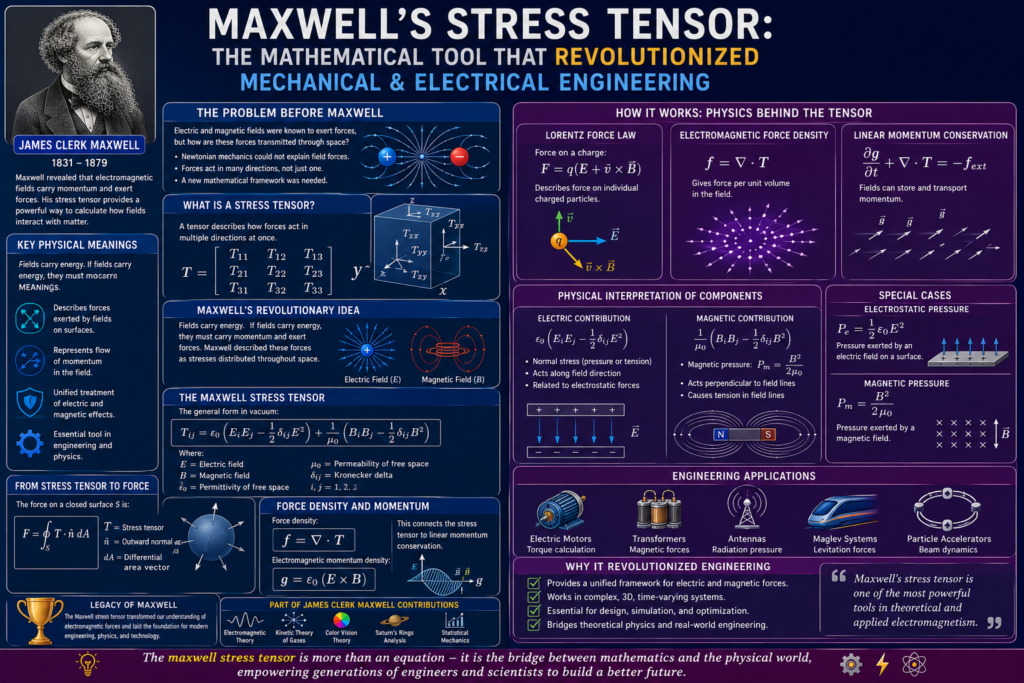
The story of the maxwell stress tensor is one of the most important yet least understood achievements in the history of physics and engineering. While James Clerk Maxwell is widely known for his equations of electromagnetism, one of his most powerful contributions was the development of a mathematical framework capable of describing how electromagnetic fields exert forces on objects.
Today, engineers use the maxwell stress tensor in electric motors, generators, transformers, magnetic levitation systems, particle accelerators, antennas, and advanced electrical machinery. It provides a precise method for calculating electromagnetic forces and momentum transfer within fields.
Without this mathematical tool, modern electrical engineering would be far more difficult. The maxwell stress tensor transformed abstract electromagnetic fields into measurable mechanical forces, bridging the gap between mathematics and real-world engineering.
The Problem Before Maxwell (1820 – 1865)
Before the development of the maxwell stress tensor, scientists understood that electric and magnetic fields could exert forces.
Experiments showed:
- Magnets attract and repel.
- Electric charges exert forces.
- Currents generate magnetic fields.
However, an important question remained unanswered:
How are these forces transmitted through space?
Newtonian mechanics described forces between objects, but electromagnetism introduced invisible fields filling space.
Scientists needed a mathematical framework capable of describing force transmission within fields.
This challenge motivated Maxwell’s work.
Maxwell’s Vision of Fields
The foundation of the maxwell stress tensor originated from Maxwell’s revolutionary field concept.
Inspired by faraday and maxwell, Maxwell believed that fields were physical entities rather than merely mathematical conveniences.
Electric fields and magnetic fields carry energy.
If they carry energy, they should also carry momentum.
If they carry momentum, they must be capable of exerting forces.
This reasoning eventually led to the development of the stress tensor.
What Is a Stress Tensor?
In engineering, stress describes internal forces acting within materials.
A simple normal stress equation is:
σ = F/A
Where:
- σ = Stress
- F = Force
- A = Area
However, electromagnetic fields create forces in multiple directions simultaneously.
A single number cannot fully describe such behavior.
Instead, engineers use tensors.
A tensor can represent complex directional interactions throughout space.
The maxwell stress tensor applies this concept to electromagnetic fields.
Understanding Stress in Continuum Mechanics
Before exploring the maxwell stress tensor, it is useful to understand continuum mechanics.
In continuum mechanics, stress is represented using a matrix:
T =
| T₁₁ T₁₂ T₁₃ |
| T₂₁ T₂₂ T₂₃ |
| T₃₁ T₃₂ T₃₃ |
Each component describes forces acting in different directions.
This matrix framework became the basis for Maxwell’s electromagnetic version.
Maxwell’s Revolutionary Idea (1865 – 1873)
Maxwell realized that electromagnetic fields behave similarly to mechanical stresses.
Electric fields produce tension and compression effects.
Magnetic fields generate pressures and directional forces.
Instead of treating forces as mysterious actions at a distance, Maxwell described them as stresses distributed throughout space.
This concept became the maxwell stress tensor.
It transformed the understanding of electromagnetic force transmission.
The Mathematical Form of Maxwell’s Stress Tensor
The general form of the maxwell stress tensor in vacuum is:
Tᵢⱼ = ε₀(EᵢEⱼ − ½δᵢⱼE²) + (1/μ₀)(BᵢBⱼ − ½δᵢⱼB²)
Where:
- Tᵢⱼ = Tensor components
- E = Electric field
- B = Magnetic field
- ε₀ = Permittivity of vacuum
- μ₀ = Permeability of free space
- δᵢⱼ = Kronecker delta
Although the equation appears complex, its purpose is simple.
It describes how electromagnetic fields generate forces and momentum flow.
Why the Maxwell Stress Tensor Matters
The significance of the maxwell stress tensor lies in its ability to calculate forces directly from fields.
Instead of tracking individual charges, engineers analyze field distributions.
This approach simplifies many practical problems.
Applications include:
- Electrical machines
- Magnetic systems
- Antennas
- Plasma physics
- Aerospace engineering
The tensor became one of the most powerful tools in engineering physics.
Connection to the Lorentz Force Law
The maxwell stress tensor is closely related to the Lorentz force law.
The Lorentz force equation is:
F = q(E + v × B)
Where:
- F = Force
- q = Charge
- E = Electric field
- v = Velocity
- B = Magnetic field
The Lorentz force describes forces on individual charges.
The stress tensor extends this concept to continuous field distributions.
Together they form the foundation of electromagnetic force analysis.
Electromagnetic Force Density
One important application of the maxwell stress tensor involves electromagnetic force density.
Force density describes force per unit volume.
The general relationship is:
f = ∇ · T
Where:
- f = Force density
- T = Stress tensor
- ∇ · T = Tensor divergence
This equation allows engineers to calculate force distributions throughout electromagnetic systems.
Linear Momentum Conservation
The maxwell stress tensor also plays a crucial role in linear momentum conservation.
In electromagnetism:
Momentum can exist within fields.
Electromagnetic momentum density is:
g = ε₀(E × B)
This relationship demonstrates that fields carry momentum.
The stress tensor describes how that momentum moves through space.
The concept revolutionized electromagnetic theory.
Maxwell Stress Tensor and Electrostatic Forces
One practical use of the maxwell stress tensor involves electrostatic forces.
Electric fields exert pressure on charged surfaces.
Electrostatic pressure can be approximated as:
P = ½ε₀E²
Where:
- P = Pressure
- E = Electric field strength
This relationship appears in capacitors and high-voltage systems.
Engineers use it when designing electrical equipment.
Magnetic Pressure and Magnetic Fields
The maxwell stress tensor also explains magnetic pressure.
Magnetic pressure is:
P_m = B²/(2μ₀)
Where:
- P_m = Magnetic pressure
- B = Magnetic field
This concept appears in:
- Fusion reactors
- Electromagnets
- Plasma confinement
- Magnetic levitation systems
The ability to quantify magnetic pressure transformed engineering design.
Engineering Applications (1900 – Present)
Modern engineering relies heavily on the maxwell stress tensor.
Applications include:
Electric Motors
Motor torque depends on electromagnetic forces.
Engineers use stress tensor calculations to optimize performance.
Generators
Force distributions inside generators are analyzed using tensor methods.
Transformers
Magnetic stresses influence mechanical stability.
Electromagnetic Actuators
The tensor helps predict force generation accurately.
Maxwell Stress Tensor Electromagnetism
The field of Maxwell stress tensor electromagnetism became essential for advanced engineering.
Without it, calculating complex electromagnetic interactions would be extremely difficult.
Modern simulation software uses tensor methods extensively.
Examples include:
- Finite element analysis
- Electromagnetic modeling
- Motor design
- Power system optimization
The theory remains central to modern technology.
Structural Mechanics Stress Tensor and Maxwell’s Influence
The maxwell stress tensor shares similarities with the structural mechanics stress tensor used in mechanical engineering.
Both describe:
- Force transmission
- Internal stresses
- Momentum transfer
- Material interactions
Maxwell helped demonstrate that field theory and mechanics could be unified through mathematical methods.
This insight influenced generations of engineers.
Matrix Calculus and Tensor Analysis
Understanding the maxwell stress tensor requires matrix calculus.
Tensors generalize vectors and matrices.
Unlike simple forces, electromagnetic interactions occur in multiple directions simultaneously.
Tensor mathematics captures this complexity elegantly.
Today tensor methods appear throughout:
- Engineering
- Physics
- Relativity
- Fluid dynamics
- Materials science
Maxwell helped pioneer this mathematical approach.
James Clerk Maxwell Contributions Beyond Electromagnetism
When discussing James Clerk Maxwell Contributions, the stress tensor deserves special recognition.
His achievements include:
- Electromagnetic theory
- Statistical mechanics
- Color vision science
- Electromagnetic momentum theory
- Tensor analysis
Few scientists have produced such a broad scientific legacy.
The maxwell stress tensor remains one of his most practical contributions.
From Maxwell to Einstein
The influence of the maxwell stress tensor extended beyond engineering.
The intellectual journey from maxwell to einstein transformed theoretical physics.
Einstein admired Maxwell’s work deeply.
The relationship known as einstein hero maxwell reflects Maxwell’s enormous influence on relativity.
Tensor methods later became central to Einstein’s General Theory of Relativity.
Modern Software and Engineering Design
Today, the maxwell stress tensor is embedded within engineering software.
Programs simulate:
- Electric motors
- Magnetic fields
- Electromagnetic actuators
- High-voltage systems
Engineers rarely solve tensor equations manually.
Instead, software performs millions of calculations automatically.
Nevertheless, the underlying mathematics still comes from Maxwell’s original ideas.
Why Maxwell’s Stress Tensor Still Matters
More than 150 years later, the maxwell stress tensor remains indispensable.
It helps engineers understand:
- Electromagnetic force density
- Momentum tensor physics
- Magnetic pressure
- Electrostatic forces
- Field interactions
Its predictive power continues shaping modern technology.
The theory remains one of the great achievements of mathematical physics.
Frequently Asked Questions (FAQs)
What is Maxwell’s stress tensor?
Maxwell’s stress tensor is a mathematical framework used to calculate forces, pressures, and momentum transfer within electromagnetic fields.
Why is Maxwell’s stress tensor important?
It allows engineers to determine electromagnetic forces in motors, generators, transformers, and other electrical systems.
What does the stress tensor describe?
It describes how electromagnetic fields transmit forces through space.
How is Maxwell’s stress tensor used in engineering?
Engineers use it for electromagnetic simulations, machine design, force calculations, and field analysis.
Is Maxwell’s stress tensor still used today?
Yes. It remains a fundamental tool in electrical engineering, mechanical engineering, and physics.
Conclusion
The maxwell stress tensor stands as one of the most powerful mathematical tools ever developed for engineering and physics. By transforming invisible electromagnetic fields into measurable force distributions, James Clerk Maxwell provided a framework that continues driving technological innovation today.
From electric motors and generators to magnetic levitation and advanced simulation software, the stress tensor remains essential for understanding how electromagnetic systems function. Its ability to connect mathematics, force, momentum, and engineering design makes it one of Maxwell’s most enduring achievements.
More than a century and a half later, the Maxwell stress tensor continues proving that elegant mathematics can unlock practical solutions to some of engineering’s most complex challenges.