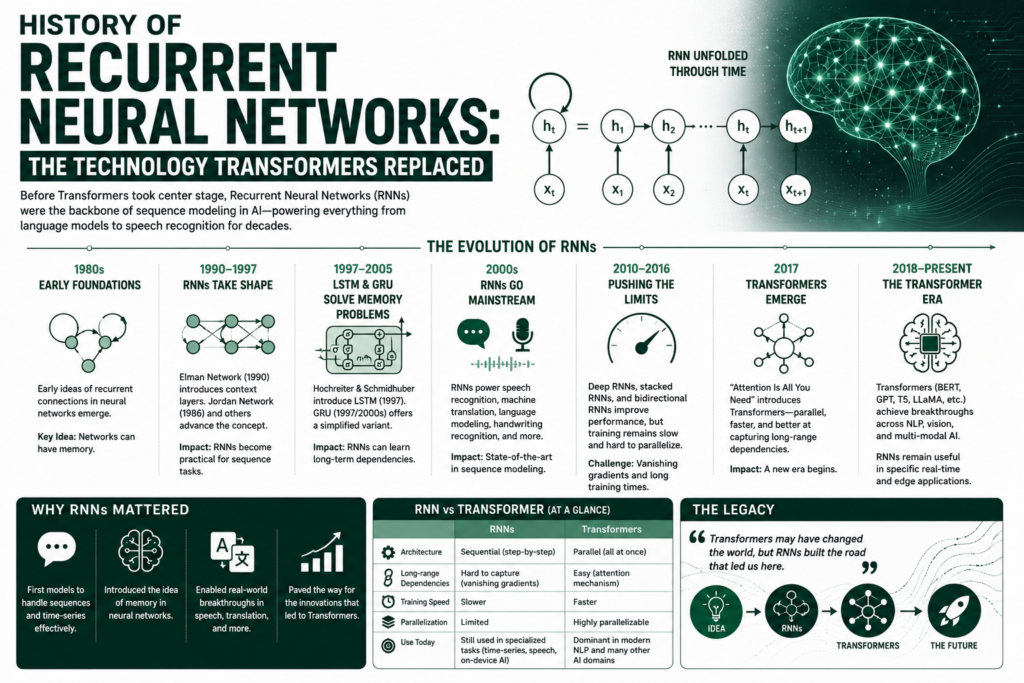
The recurrent neural networks history is one of the most dramatic stories in all of artificial intelligence. It is a story of brilliant ideas arriving decades too early, of researchers grinding through AI winters with limited compute and even more limited recognition, and of a technology that genuinely changed the world before being swept aside by something even more powerful.
Understanding the recurrent neural networks history means understanding how machines first learned to process sequences, and why that problem turned out to be so much harder than anyone expected.
The Earliest Roots of Recurrent Thinking (1940 – 1970)
The recurrent neural networks history does not begin with the internet era. Its philosophical roots go back to the 1940s, when Warren McCulloch and Walter Pitts created the first mathematical model of a neuron. Their work established that networks of simple computational units could, in theory, perform any logical operation.
What made recurrent networks special was the idea of feedback loops, connections that allowed the output of a network to influence its own future inputs. This was inspired by how biological neural systems work. The brain does not process each moment in isolation. It carries forward context, memory, and expectation from moment to moment. Building artificial networks that could do the same became the central challenge of the recurrent neural networks history.
Early work in connectionist models and parallel distributed processing throughout the 1960s and 1970s explored these ideas theoretically, but the computational tools to test them at any meaningful scale simply did not exist yet.
Hopfield Networks: A Real Beginning (1982)
The recurrent neural networks history has a clear landmark moment in 1982, when physicist John Hopfield published his paper on what became known as the Hopfield Network. This was a fully connected recurrent network where every unit was connected to every other unit with symmetric weights.
Hopfield Networks were designed as associative memory systems. You could show them a partial or corrupted pattern, and they would settle into the nearest stored memory through a process of energy minimization. They used nonlinear dynamics to converge to stable states, making them one of the first practical demonstrations that recurrent connections could store and retrieve information.
The Hopfield Network was not a sequence processor in the modern sense, but it proved that recurrent connections could create useful computational properties. It energized the field and inspired a new generation of researchers to take recurrent architectures seriously.
Jordan and Elman Networks: Learning Sequences (1986 – 1990)
The next major chapter in the recurrent neural networks history came with the work of Michael Jordan in 1986 and Jeffrey Elman in 1990. These researchers built simpler, more practical recurrent networks specifically designed for sequential data processing.
Jordan networks added context units that received feedback from the output layer, allowing the network to condition its next output on what it had just produced. Elman networks used context units fed from the hidden layer, giving the network a simple form of working memory that carried information from one time step to the next.
These were not deep networks by modern standards, but they were genuine sequence learners. Elman networks in particular became important tools in cognitive science modeling, used to study how humans learn grammar and sequential structure in language. The recurrent neural networks history through this period was as much about understanding the mind as about building practical AI systems.
Backpropagation Through Time and Its Terrible Problem (1990 – 1995)
As the recurrent neural networks history moved into the early 1990s, researchers developed backpropagation through time, or BPTT, as the standard method for training recurrent networks. The idea was elegant: unroll the recurrent network through time, treat each time step as a separate layer, and apply standard backpropagation through the entire unrolled sequence.
In theory, this should have allowed RNNs to learn from arbitrarily long sequences. In practice, it revealed a catastrophic problem. As gradients were propagated backward through many time steps, they either shrank toward zero through the vanishing gradient problem or grew exponentially through the gradient exploding problem.
The vanishing gradient meant the network could not learn long-range dependencies. By the time the error signal reached the early time steps in a long sequence, it was essentially zero and carried no useful learning information. The gradient exploding problem caused training to become numerically unstable and diverge completely.
These problems defined the central crisis of the recurrent neural networks history for nearly a decade. Researchers tried gradient clipping, careful weights and biases initialization, and architectural modifications, but nothing fully solved the core problem.
The AI Winter and Slow Progress (1988 – 1997)
The recurrent neural networks history through the late 1980s and early 1990s was deeply shaped by the broader AI winter, a period of reduced funding and skepticism toward AI research. Neural networks of all types fell out of favor as the limitations of available compute and training algorithms became painfully clear.
The feedforward vs recurrent architecture debate during this period often came down to practical realities. Feedforward networks were easier to train and more predictable in behavior. Recurrent networks were theoretically more powerful, possessing what researchers recognized as Turing completeness of RNNs in principle, but this theoretical power was almost impossible to realize in practice given the gradient problems.
The artificial intelligence winter forced many researchers to work in relative obscurity, continuing to develop recurrent ideas even when the mainstream AI community had largely moved on. This persistent, unfashionable work would eventually pay enormous dividends.
LSTM Breaks Through the Wall (1997)
The most important single event in the recurrent neural networks history after the Hopfield Network was the publication of Long Short-Term Memory by Sepp Hochreiter and Jürgen Schmidhuber in 1997. LSTM introduced a gating mechanism that solved the vanishing gradient problem by creating a protected memory cell state that gradients could flow through without decaying.
This was a genuine breakthrough. For the first time, a recurrent architecture could reliably learn dependencies spanning hundreds of time steps. The recurrent neural networks history split clearly into before LSTM and after LSTM.
To understand exactly how LSTMs worked and why they were so powerful, the what is lstm in ai breakdown covers the gating system, memory cell state, and training dynamics in full detail.
Echo State Networks and Reservoir Computing (2001 – 2004)
While LSTM was gaining traction, another branch of the recurrent neural networks history was developing in parallel. Echo State Networks, or ESNs, introduced a radically different approach called reservoir computing.
Instead of training all the weights in a recurrent network, reservoir computing used a large fixed random recurrent layer, called the reservoir, and only trained the output weights on top of it. The reservoir acted as a rich dynamic memory, transforming input sequences into high-dimensional representations that the output layer could read from.
ESNs were surprisingly effective for many time series tasks and were far cheaper to train than LSTMs. They represented an important alternative approach in the recurrent neural networks history, showing that not all the power of recurrent computation required end-to-end gradient-based training.
The Seq2Seq Revolution and Peak RNN (2014)
The recurrent neural networks history reached its absolute peak influence around 2014 with the development of sequence-to-sequence models. By stacking multiple LSTM layers into deep encoder-decoder architectures, researchers at Google and elsewhere built systems that could translate between languages, summarize documents, and generate captions for images.
Google’s neural machine translation system, deployed in 2016, was built on deep stacked LSTMs and improved translation quality more in one year than the previous decade of rule-based and phrase-based systems combined. This was the moment when the recurrent neural networks history intersected with mainstream public awareness of AI capability.
The what is word2vec story from this same period shows how word embeddings and recurrent networks worked together as complementary technologies, with Word2Vec providing rich word representations that RNNs could process as sequences.
Understanding how these models connected to each other is also captured in the gpt models history, which shows how the first GPT models moved away from recurrent architectures toward transformers, marking the beginning of the end for RNN dominance.
The Attention Mechanism: The Beginning of the End (2015)
The recurrent neural networks history began its terminal decline in 2015, not because RNNs stopped working, but because researchers found something better. The attention mechanism, developed by Dzmitry Bahdanau and colleagues, allowed decoder RNNs to look back at all encoder hidden states rather than relying on a single compressed context vector.
This dramatically improved translation quality for long sentences. But it also quietly demonstrated something profound: the most important part of the seq2seq model was now the attention connections between encoder and decoder, not the recurrent processing itself. The recurrent components were becoming scaffolding around the truly important computation.
When the 2017 transformer paper removed the recurrent scaffolding entirely and built a model purely on attention, the recurrent neural networks history entered its legacy phase.
Why Transformers Won and RNNs Lost
The recurrent neural networks history ended as the dominant paradigm not because RNNs became useless but because they could not scale. Their sequential processing made parallelization during training extremely difficult. You could not process step 5 until you had finished step 4, which meant training on long sequences was painfully slow even on powerful hardware.
Transformers processed all sequence positions simultaneously, making them orders of magnitude faster to train on modern GPU and TPU clusters. Combined with the superior modeling of long-range dependencies through self-attention, transformers simply outcompeted RNNs at every scale.
The transformer model explained in detail shows exactly what architectural choices made transformers so much more scalable than anything in the recurrent neural networks history.
If you want to see what the tools built on transformer foundations can do today, exploring the best free ai tools 2026 gives you a vivid picture of how far AI has traveled since the early days of Hopfield Networks and gradient descent through time.
The Lasting Legacy of RNNs
The recurrent neural networks history is not a story of failure. It is a story of a technology that solved real problems, powered real products, and taught researchers lessons that shaped everything that followed. The ideas of sequential processing, temporal dependency modeling, and learned memory mechanisms are all alive in modern AI, even if the specific RNN architecture has been largely superseded.
Continuous-time RNNs and their connections to computational neuroscience continue to inspire research at the intersection of AI and brain science. The recurrent neural networks history showed that machines could learn to process time, and that insight remains as valuable as ever even in the transformer age.
The gpt-3 history is in many ways the closing chapter of what recurrent neural networks history made possible, a demonstration that the scaling and training techniques pioneered in the RNN era could be taken to previously unimaginable heights with a new architecture.
Frequently Asked Questions (FAQs)
What is the recurrent neural networks history in brief?
Recurrent neural networks were developed from the 1980s onward to process sequential data. They evolved from Hopfield Networks through Jordan and Elman nets to LSTMs and GRUs, dominating NLP and speech recognition before transformers replaced them after 2017.
Who were the key figures in recurrent neural networks history?
Key figures include John Hopfield, who created Hopfield Networks in 1982, Sepp Hochreiter and Jürgen Schmidhuber who invented LSTM in 1997, and Jeffrey Elman and Michael Jordan who developed early practical sequence-learning architectures in the late 1980s.
Why did recurrent neural networks fail on long sequences?
The vanishing gradient problem caused learning signals to decay to near zero as they propagated backward through many time steps during BPTT training. This prevented RNNs from learning connections between events separated by more than a few steps.
What replaced recurrent neural networks?
Transformers, introduced in the 2017 paper “Attention Is All You Need,” replaced recurrent neural networks as the dominant architecture. Transformers process sequences in parallel rather than sequentially, making them dramatically faster to train at scale.
Are recurrent neural networks still used today?
Yes. RNNs and LSTMs are still used in embedded systems, real-time audio processing, industrial time series analysis, and applications where transformer models are too large or computationally expensive to deploy.
Conclusion
The recurrent neural networks history is a testament to the power of persistent, principled research in the face of enormous practical obstacles. From Hopfield Networks in 1982 to the peak of LSTM-powered machine translation in 2016, recurrent networks carried the field of sequential AI on their shoulders for three and a half decades. They were imperfect, difficult to train, and eventually outpaced by transformers, but without them the recurrent neural networks history shows us clearly that the transformer revolution could never have happened. Every modern AI system that understands language owes a quiet debt to the researchers who refused to give up on teaching machines to remember.