When Nikola Tesla conducted his groundbreaking experiments with oscillators and vibrations, he was not merely tinkering in his laboratory. He was uncovering the fundamental nature of energy transmission, resonance frequency experiments, and the mechanical waves that permeate our universe. Tesla’s work on oscillators and vibrations represented a revolutionary departure from conventional physics, exploring how rhythmic impulses and cyclic motion could reshape our understanding of energy itself. This article examines Tesla’s profound contributions to oscillators and vibrations science and their lasting impact on modern physics and engineering.
Early Innovations in Oscillator Technology (1870s to 1890s)
Nikola Tesla’s fascination with oscillators and vibrations began early in his scientific career. While most scientists focused on static phenomena, Tesla recognized that oscillators and vibrations held the key to understanding energy transfer at the most fundamental level. His early work demonstrated that tuning fork analogy principles could be scaled to industrial applications, creating what we now call mechanical oscillators physics.
In his New York laboratory, Tesla constructed mechanical devices designed to produce precise vibrational dynamics. These experiments revealed something extraordinary: every material object has a natural resonance frequency at which it vibrates most efficiently. When external energy matches this frequency, amplification occurs naturally, creating harmonic resonance mechanics that seemed almost magical to observers.
Tesla understood that oscillators and vibrations weren’t random phenomena. Instead, they followed mathematical principles that could be calculated, predicted, and harnessed. This insight separated his work from mere empirical observation and established oscillators and vibrations as a serious scientific discipline worthy of rigorous mathematical treatment.
The Tesla Coil: Harnessing Resonant Vibrations (1891 to 1900)
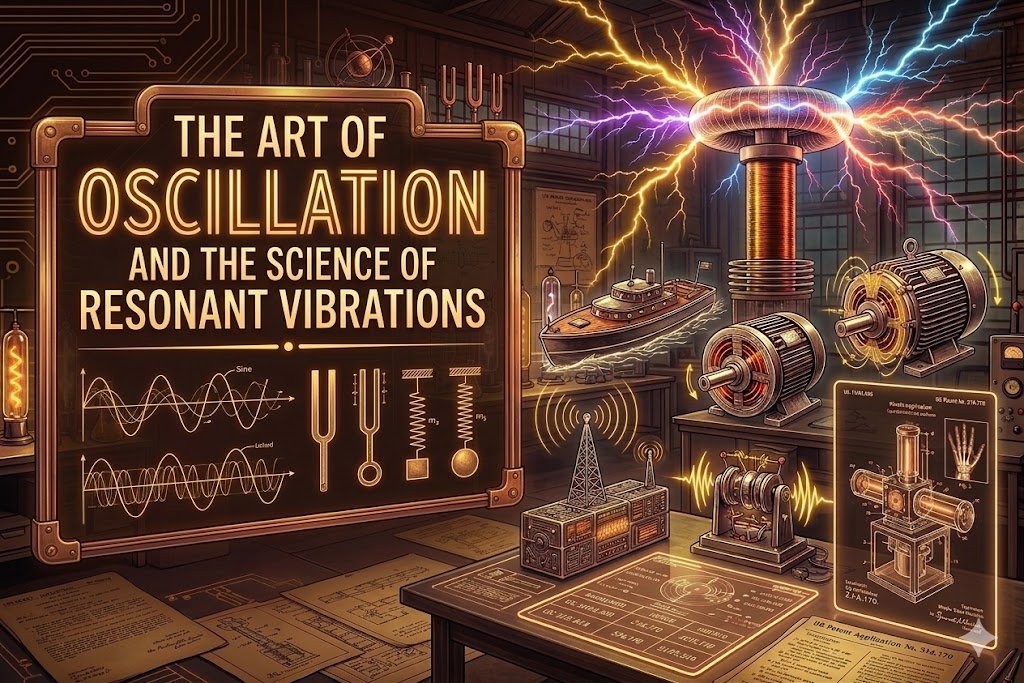
Tesla’s most famous contribution to oscillators and vibrations technology was his innovative coil design. The Tesla coil represented a breakthrough in understanding how electromagnetic oscillations could be generated and controlled. Rather than relying on simple spark gaps, Tesla engineered a system where primary and secondary coils worked in harmonic resonance mechanics, creating standing waves of electrical energy.
The mathematical principle underlying the Tesla coil involves resonant frequency calculations. For a simple LC circuit (inductor-capacitor), the resonant frequency is expressed as:
f = 1 / (2π√LC)
Where f represents frequency in hertz, L is inductance in henries, and C is capacitance in farads. Tesla intuited this relationship long before the mathematics became standardized, designing his coils empirically but with remarkable precision.
The genius of Tesla’s approach lay in understanding that oscillators and vibrations could amplify energy when operating at resonance. A small initial energy input, when matched to the natural oscillation frequency, could produce enormous secondary effects. This principle of resonance frequency experiments became central to both Tesla’s wireless power transmission concepts and his later mechanical vibration work.
Mechanical Oscillators and the Earthquake Machine (1898 to 1910)
Perhaps Tesla’s most controversial work involved mechanical oscillators and vibrations designed to produce controllable vibrations. In 1898, Tesla developed what became known as the “oscillating machine” or, more dramatically, the “earthquake machine.” This device represented pure oscillators and vibrations engineering at its most ambitious scale.
The mechanical oscillator consisted of a small piston-driven device capable of producing rhythmic impulses at precisely controlled frequencies. Tesla would attach this device to steel structures and adjust the frequency until he achieved resonance. When the frequency matched the natural oscillation frequency of the structure, extraordinary vibrations resulted from seemingly modest input energy.
The mathematics of forced vibration systems helps explain this phenomenon. For a damped harmonic oscillator subjected to a driving force, the amplitude of oscillation becomes:
A = F₀ / (m√((ω₀² – ω²)² + (2γω)²))
Where A is amplitude, F₀ is driving force magnitude, m is mass, ω is driving frequency, ω₀ is natural frequency, and γ is damping coefficient. When ω approaches ω₀, the denominator becomes very small, causing A to become very large. This is the physics of resonance, and Tesla exploited it masterfully.
According to Tesla, he once attached his oscillating device to a steel girder in his New York laboratory. Operating at the structural resonance frequency, the vibrations became so intense that Tesla had to shut down the device to prevent serious damage. This experiment demonstrated the practical power of oscillators and vibrations engineering, though many contemporaries dismissed his claims as exaggeration.
The Physics of Resonance and Frequency Modulation (1900 to 1915)
Tesla’s research into oscillators and vibrations extended beyond mechanical applications. He recognized that frequency modulation concepts applied across multiple domains, from electromagnetic phenomena to structural integrity challenges in engineering. His work contributed significantly to understanding vibrational dynamics in materials and structures.
The relationship between frequency and energy in oscillating systems follows principles Tesla understood intuitively. The energy stored in a harmonic oscillator is given by:
E = (1/2)kA²
Where E represents total energy, k is the spring constant, and A is amplitude of oscillation. This equation reveals why tuning oscillators to resonance frequency is so efficient: small amplitude changes produce proportionally larger energy variations.
Tesla also explored how different materials responded to specific frequencies. He conducted extensive vibration analysis experiments, measuring how wave frequency affected material fatigue and structural response. These investigations represented early work in what we now call structural vibration analysis, a field critical to modern engineering and architecture.
High Frequency Mechanical Power and Energy Transmission (1905 to 1920)
Building on his oscillators and vibrations research, Tesla conceived of applications for high-frequency mechanical power generation. He envisioned that oscillators operating at extremely high frequencies could produce pocket-sized generator devices capable of delivering significant energy. While these devices were never fully realized in his lifetime, the theoretical foundations were sound.
Tesla believed that energy frequency vibration could be transmitted through the earth itself, much like his wireless power transmission concepts. If mechanical oscillators could operate at sufficient frequencies, they might establish standing wave patterns through geological materials, enabling energy transfer over vast distances without wires.
The concept involved creating localized tremors at specific frequencies that would resonate through rock and soil. By understanding the natural oscillation cycles of geological formations, Tesla reasoned that one could establish sympathetic resonance at distant locations. Though the practical implementation proved impossible with available technology, the underlying physics reflected genuine insight into mechanical waves exploration.
The Mathematics of Coupled Oscillators (1910 to 1925)
As Tesla’s work matured, he increasingly dealt with systems of coupled oscillators rather than single devices. When multiple oscillators and vibrations systems interact, their behavior becomes more complex but also more powerful. Two coupled oscillators can exchange energy in fascinating patterns governed by their relative frequencies and damping characteristics.
For two identical coupled oscillators, normal mode frequencies are given by:
ω± = √(ω₀² ± k/m)
Where ω₀ is the individual natural frequency, k is the coupling coefficient, and m is mass. This reveals that coupled systems develop two characteristic frequencies: one where both oscillators move in phase and one where they oscillate out of phase. Tesla’s mechanical engineering physics exploited these principles to create complex vibrational patterns.
Controversies and Misconceptions
Tesla’s work with oscillators and vibrations became subject to considerable legend and exaggeration. The “earthquake machine” story became embellished over time, with some versions claiming Tesla nearly demolished his building. While the core event likely occurred, the dramatic retelling obscured the genuine scientific achievement in oscillators and vibrations engineering.
Critics, including some contemporaries, dismissed his theories about wireless power transmission through the earth using oscillators and vibrations. Modern seismology has largely confirmed Tesla’s intuitions about how vibrations propagate through geological materials, though not in the specific manner he imagined. His theoretical framework proved more sound than his practical applications.
Legacy in Modern Physics
Tesla’s exploration of oscillators and vibrations influenced subsequent research in multiple fields. His insights into resonance frequency experiments established foundational principles for acoustical engineering, mechanical engineering physics, and materials science. Modern structural engineers routinely conduct vibration analysis experiments directly descended from Tesla’s work.
The principle that oscillators and vibrations at specific frequencies could amplify energy transfer became central to twentieth-century physics. His work prefigured later developments in understanding rhythmic impulses in quantum mechanics, wave frequency analysis in signal processing, and amplitude amplification in amplifier design.
Frequently Asked Questions
What exactly was Tesla’s oscillating machine designed to do?
Tesla’s oscillating machine produced rhythmic impulses tuned to specific frequencies. By matching these frequencies to the natural resonance frequency of structures, the device could generate significant vibrations from minimal input energy. Tesla believed such oscillators and vibrations technology could have practical applications in mining, construction, and energy transmission, though none were successfully commercialized.
Did Tesla really cause an earthquake with his machine?
No credible evidence supports that Tesla caused actual earthquakes. However, he did demonstrate that his oscillating device could produce substantial structural vibrations when operating at resonance frequencies. The dramatic stories likely represent exaggerations of genuine, though less spectacular, experimental results in oscillators and vibrations engineering.
How does resonance frequency relate to Tesla’s wireless power concepts?
Tesla believed that oscillators operating at specific resonance frequencies could establish standing waves through the earth, enabling wireless power transmission. While this particular application never worked as envisioned, the underlying physics of resonance frequency experiments was valid. Modern wireless power transmission uses different principles but owes conceptual debts to Tesla’s oscillators and vibrations research.
Are Tesla’s oscillator theories accepted by modern science?
The fundamental physics underlying Tesla’s oscillators and vibrations work is well-established and accepted. Modern physics confirms his intuitions about resonance, amplitude amplification, and harmonic resonance mechanics. However, some of his specific applications and theoretical extensions remain controversial or unproven.
What practical applications emerged from oscillators and vibrations research?
Modern applications include structural health monitoring, mechanical vibration testing, acoustic engineering, and various industrial processes. Tesla’s early work in oscillators and vibrations provided theoretical foundations for these technologies, even when practical implementations diverged from his original concepts.
Conclusion
Nikola Tesla’s systematic investigation of oscillators and vibrations represented a profound contribution to physics and engineering. By treating oscillators and vibrations as fundamental phenomena worthy of mathematical analysis and rigorous experimentation, Tesla helped establish new scientific frameworks for understanding energy transfer and resonance. Though some of his specific applications never materialized, his work on oscillators and vibrations continues influencing modern science and engineering.
Tesla recognized that oscillators and vibrations held secrets about the universe’s deepest structures. His legacy reminds us that behind apparently simple oscillatory motion lies remarkable physics and extraordinary potential. As a true Nikola Tesla visionary inventor, he opened doors to understanding mechanical waves exploration and energy frequency vibration that scientists continue exploring today. The oscillators and vibrations Tesla studied so intensely remain central to modern technology and theoretical physics, confirming his prescient vision of how hidden frequencies shape our universe.