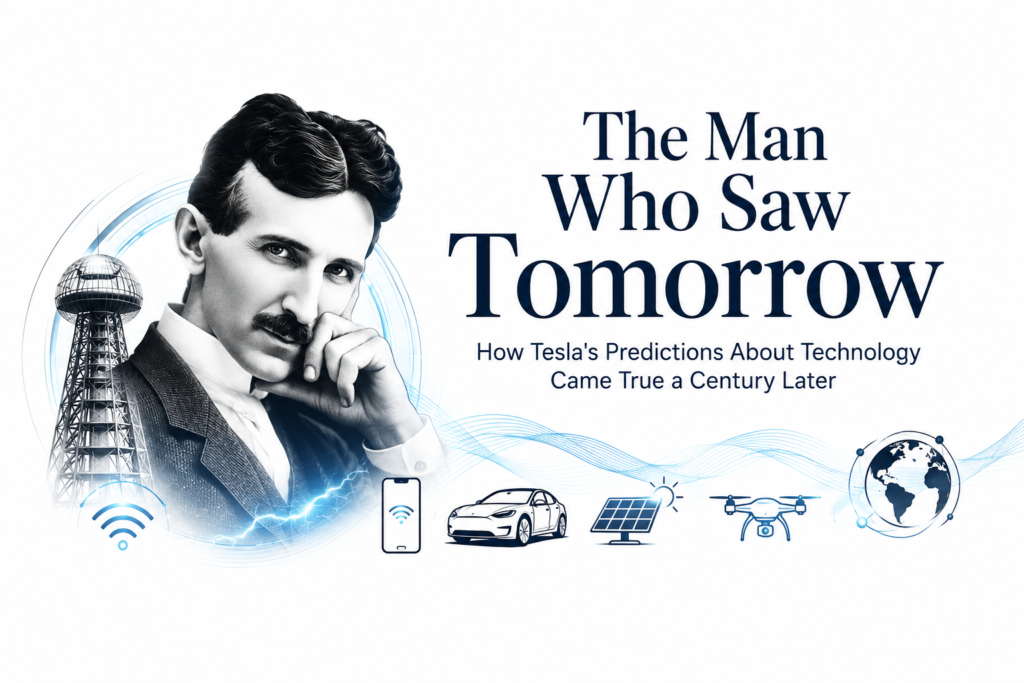
Some people see what is. Rarer people see what could be. And then there is Nikola Tesla, a man who looked at the bare copper wires and spinning machines of the 1890s and described, with stunning precision, the smartphones, wireless internet, drone warfare, artificial intelligence, and global communication networks that define life in the twenty-first century. tesla technology predictions were not guesses. They were the logical extensions of physical laws that Tesla understood more deeply than almost anyone alive in his era. The world did not catch up to him in his lifetime. It is still catching up now.
This article examines the most remarkable of tesla technology predictions, the science behind them, the mathematics that made them inevitable, and the astonishing accuracy with which this nineteenth-century visionary mapped the technological landscape of the twenty-first century.
A Mind Built for the Future: Tesla’s Predictive Method (1890 – 1920)
Before examining individual predictions, it is worth understanding how Tesla made them. He was not a science fiction writer speculating freely. He was a working engineer with a precise grasp of electromagnetic theory, fluid dynamics, and resonance physics, and his tesla technology predictions emerged from tracing physical laws to their logical conclusions.
Tesla once wrote that the human mind was itself a receiving apparatus, tuned to pick up impressions from the environment and the cosmos. But beneath the poetic language was a practical method: identify the fundamental physics of a phenomenon, calculate its scaling behavior, and project what becomes possible as materials, energy sources, and manufacturing capabilities improve with time.
His predictive vision operated on what engineers today call a technology roadmap approach: mapping current capabilities against known physical limits and forecasting when the gap would be closed. The fact that tesla technology predictions proved so accurate is not mystical. It is what happens when a mind of extraordinary depth works with complete command of the underlying science.
The Smartphone: Predicted in 1909
Perhaps the most startling of all tesla technology predictions is his description of what we now call the smartphone. In a 1909 interview with the New York Times, Tesla described a future in which a person could carry a small device in their pocket that would allow them to receive news, send and receive messages, and communicate with anyone anywhere on earth through a wireless communication network. He specified that this device would be small enough to fit in a vest pocket and would connect to a global transmitter system that distributed both information and, eventually, energy.
The mathematics behind wireless communication that Tesla was already working with in 1909 describes exactly the kind of system his prediction required. The relationship governing information capacity in a wireless channel is Shannon’s theorem, formalized decades after Tesla’s prediction:
C = B × log₂(1 + S/N)
Where:
- C = channel capacity in bits per second
- B = bandwidth in Hz
- S/N = signal-to-noise ratio
Tesla’s high-frequency oscillator patents from the 1890s described wireless transmission across frequency bands far wider than the low-frequency Marconi radio systems of his era. He understood intuitively that higher frequencies meant greater bandwidth and therefore greater information-carrying capacity, the exact relationship Shannon’s theorem would later formalize mathematically.
The global connection network Tesla imagined in 1909, which he called a “world wireless system,” is structurally identical to the internet: a distributed web of transmitters and receivers through which information flows between any two points on the planet’s surface. The electronic information grid that now connects eight billion smartphones is the direct realization of what Tesla described in newspaper interviews more than a century ago.
Wireless Internet: The World Brain Vision (1900 – 1926)
Closely connected to his smartphone prediction was Tesla’s broader vision of a global wireless information network that he articulated in multiple publications between 1900 and 1926. In a remarkable 1926 interview with Collier’s magazine, Tesla described a world in which “we shall be able to communicate with one another instantly, irrespective of distance,” and in which a handheld device would allow access to all of humanity’s accumulated knowledge.
This world brain concept, the idea of a universally accessible repository of human knowledge distributed through a wireless network, is the intellectual blueprint of the World Wide Web. Tesla’s predictive engineering in this case was not merely directional but architectural: he specified the key features of the system, wireless access, global reach, instantaneous response, and universal availability, with a clarity that anticipates the internet’s design principles.
The propagation of radio signals across the earth’s surface that Tesla studied mathematically in the context of his wardenclyffe tower project relied on the earth-ionosphere waveguide. Signal attenuation over distance follows:
P_received = P_transmitted × G_t × G_r × (λ / 4πd)²
Where:
- P_received = received signal power (W)
- P_transmitted = transmitted signal power (W)
- G_t, G_r = transmitter and receiver antenna gains
- λ = wavelength (m)
- d = distance (m)
This is the Friis transmission equation, describing how signal power diminishes with distance in free space. Tesla understood that overcoming this attenuation for global coverage required either extremely high transmission power, extremely sensitive receivers, or a network of relay stations, all three solutions that the modern internet infrastructure uses simultaneously. His conceptual frameworks for global wireless connectivity were sound in every engineering dimension.
Drone Warfare and Remote-Controlled Machines (1898 – 1915)
In 1898, at Madison Square Garden’s Electrical Exhibition, Tesla demonstrated a small radio-controlled boat that could be directed wirelessly from a distance. He called it a “teleautomaton” and immediately began describing its military implications. He predicted that future wars would be fought not by human soldiers but by remotely controlled machines, autonomous vehicles, and mechanical warriors directed from safe distances by operators who never approached the battlefield.
This tesla remote control invention was not merely a toy demonstration. Tesla filed patents on the radio control mechanisms and wrote extensively about the military future of remotely operated weapons systems. He described drone warfare prediction scenarios in which fleets of unmanned boats, aircraft, and land vehicles would engage each other in combat while human operators remained far behind the front lines.
The mathematics of remote control systems involves signal propagation time and control bandwidth. The round-trip signal latency for a control signal traveling at the speed of light over a distance d is:
t = 2d / c
Where c = 3 × 10⁸ m/s. For a drone operating 10 km from its controller:
t = (2 × 10,000) / (3 × 10⁸) = 6.67 × 10⁻⁵ s ≈ 0.067 milliseconds
This near-instantaneous latency at tactical distances means that the control bandwidth, not propagation delay, limits drone responsiveness, exactly the engineering insight that modern military drone designers work with today. Tesla identified this constraint in his original teleautomaton patents, specifying the frequency range and control signal encoding needed for reliable wireless command at practical battlefield distances.
The Predator drones, autonomous naval vessels, and remotely piloted combat aircraft that define twenty-first-century warfare are the direct realization of what Tesla demonstrated and described in 1898. This is among the most precise and consequential of all tesla technology predictions.
Renewable Energy and Environmental Foresight (1900 – 1930)
Tesla’s predictive vision extended beyond communication and warfare into energy and environment. In multiple interviews and publications in the early twentieth century, he warned with striking clarity about the dangers of burning fossil fuels and predicted that future energy sources would be clean, renewable, and derived from solar, wind, and geothermal energy. These environmental warning signs, issued when coal was king and petroleum was beginning its rise to dominance, placed Tesla among the earliest voices for what we now call the energy transition.
Tesla calculated the total solar energy intercepted by the earth and recognized that humanity’s total energy consumption was a microscopic fraction of what the sun continuously supplied. The solar energy flux at earth’s orbit, now called the solar constant, is approximately:
S₀ = 1,361 W/m²
The total solar power intercepted by the earth’s disc is:
P_solar = S₀ × π × R_E²
Where R_E = 6.371 × 10⁶ m is earth’s radius:
P_solar = 1,361 × π × (6.371 × 10⁶)² ≈ 1.74 × 10¹⁷ W = 174,000 TW
Global human energy consumption in 2025 is approximately 18 TW. Solar power intercepted by the earth exceeds human energy demand by a factor of nearly 10,000. Tesla was making this argument, in less precise but directionally correct terms, in the first decade of the twentieth century, insisting that tapping even a tiny fraction of renewable natural energy flows would render fossil fuels unnecessary.
His vision of future energy sources also encompassed wireless power transmission from large renewable generation stations to consumers anywhere on earth, a concept that researchers in the twenty-first century are actively pursuing through space-based solar power proposals and long-range microwave energy transmission experiments.
Artificial Intelligence and the Thinking Machine (1920s – 1935)
Among the most haunting of tesla technology predictions are his statements about machine intelligence in the 1920s and 1930s. Tesla wrote and spoke repeatedly about the possibility of mechanical devices that could replicate human mental functions, process information at speeds beyond human capability, and eventually perform tasks requiring what we would today recognize as artificial intelligence.
He described automated factory visions in which machines would make decisions, adjust their operations in response to changing conditions, and perform complex manufacturing processes without human intervention at each step. He wrote about “mechanical brains” that could solve problems by systematically testing possibilities at speeds impossible for human cognition.
The conceptual framework Tesla applied to machine intelligence paralleled his approach to electrical resonance: find the natural operating parameters of a system, amplify them artificially, and apply the result to useful work. For a biological neuron, the information transmission rate is limited by the action potential propagation speed of approximately 1 to 120 m/s and synaptic delay of approximately 1 millisecond. The information processing rate of a biological neural network of N neurons with average firing rate f is approximately:
I_bio ≈ N × f × log₂(k)
Where k is the number of distinguishable firing states. For N = 86 × 10⁹ neurons, f = 40 Hz, and k = 2:
I_bio ≈ 86 × 10⁹ × 40 × 1 ≈ 3.44 × 10¹² bits/s
Tesla argued that electronic systems, operating at frequencies millions of times higher than biological neurons, could eventually exceed biological intelligence in raw processing capacity. This argument, made in the 1920s, is the foundational premise of modern AI research and is what Jensen Huang, Sam Altman, and every major AI researcher in 2025 is now implementing in silicon.
Radar and the Detection of Objects at Distance (1900 – 1917)
One of the least publicized but most technically precise of tesla technology predictions was his proposal for a system to detect distant objects using reflected electromagnetic waves. In a 1917 article in the Electrical Experimenter, Tesla described using high-frequency radio waves to detect ships and aircraft at distance by observing the reflection of transmitted energy from their metal surfaces.
This radar system conceptualization, articulated seventeen years before Robert Watson-Watt’s practical radar demonstration in 1935, described the core operating principle of all radar systems in use today. The radar range equation governing the detected signal strength is:
P_r = (P_t × G² × λ² × σ) / ((4π)³ × R⁴)
Where:
- P_r = received power (W)
- P_t = transmitted power (W)
- G = antenna gain
- λ = wavelength (m)
- σ = radar cross-section of target (m²)
- R = range to target (m)
The critical R⁴ dependence in the denominator means that doubling detection range requires sixteen times more transmitted power, a constraint that Tesla’s high-power resonant transmitters were specifically capable of addressing. His understanding of electromagnetic wave reflection from conductive surfaces, developed through his extensive work with high-frequency radio apparatus, gave him the physical basis for this prediction in precise engineering terms.
As a Nikola Tesla visionary inventor, Tesla never received credit for the radar concept during his lifetime, just as he did not receive proper credit for radio itself. The pattern of predictive genius followed by historical erasure is among the most consistent themes in his biography.
The Global Wireless Power Grid: Still Approaching (1900 – Present)
The grandest and most ambitious of all tesla technology predictions was his vision of a global wireless power transmission network centered on his Wardenclyffe Tower design. While this prediction has not yet been fully realized, it is the one that twenty-first-century researchers are actively working toward most directly.
Tesla predicted that electrical energy from massive renewable generating stations could be transmitted wirelessly to any point on earth using the earth-ionosphere cavity as a resonant waveguide. The Schumann resonance frequencies of this cavity, which Tesla anticipated decades before they were formally measured, cluster around:
f_n = (c / 2πR_E) × √(n(n + 1))
For n = 1 (fundamental mode), with c = 3 × 10⁸ m/s and R_E = 6.371 × 10⁶ m:
f_1 = (3 × 10⁸ / (2π × 6.371 × 10⁶)) × √2 ≈ 10.6 Hz
The measured fundamental Schumann resonance is approximately 7.83 Hz, with the discrepancy from Tesla’s estimate attributable to ionospheric conductivity effects he did not have the data to account for precisely. But the existence of these resonances, confirming that the earth-ionosphere system behaves as a resonant electromagnetic cavity exactly as Tesla theorized, was not experimentally confirmed until Winfried Otto Schumann published his measurements in 1952, nine years after Tesla’s death.
Modern space-based solar power proposals, which would beam microwave energy from orbiting solar panels to receiving stations on earth using tesla wireless power transmission principles, are the direct descendants of the global wireless power grid Tesla described at the turn of the twentieth century.
FAQs:
Which of Tesla’s technology predictions came true most accurately?
His 1909 prediction of a pocket-sized wireless communication device connected to a global network is arguably the most precise. The description maps directly onto the modern smartphone and mobile internet infrastructure, including the key features of portability, global reach, and universal information access.
Did Tesla predict artificial intelligence?
Yes. In writings from the 1920s and 1930s, Tesla described mechanical thinking devices that could perform mental functions at superhuman speeds. His conceptual framework, applying the amplification principle to cognitive processes as he had applied it to electrical resonance, is the foundational logic of modern AI development.
Did Tesla predict radar?
Tesla explicitly described a system for detecting distant objects using reflected high-frequency radio waves in a 1917 article. This description predates the practical radar demonstration by Robert Watson-Watt in 1935 by nearly two decades and accurately captures the core operating principle of all modern radar systems.
Why were Tesla’s technology predictions so accurate?
Unlike science fiction speculation, tesla technology predictions were rooted in deep understanding of physical laws. Tesla traced known electromagnetic, mechanical, and energy principles to their scaling limits and described what would become possible when materials and manufacturing capabilities caught up. His predictions were essentially engineering forecasts, not imaginative guesses.
Is Tesla’s global wireless power grid still being developed?
Yes, actively. Space-based solar power programs in the United States, Japan, China, and the European Union are pursuing microwave energy transmission from orbit to earth-based receivers, a direct technological descendant of Tesla’s Wardenclyffe wireless power transmission concept. Resonant inductive coupling for shorter-range wireless power is already commercial in billions of consumer devices.
Conclusion
The life and work of Nikola Tesla present one of history’s most extraordinary cases of prophetic intellect outrunning the civilization it inhabits. Tesla technology predictions about smartphones, wireless internet, drone warfare, artificial intelligence, radar, renewable energy, and global wireless power were not wishful thinking. They were engineering forecasts derived from physical laws that Tesla understood with a clarity and depth that few contemporaries matched.
The world that surrounds us in the twenty-first century, its wireless devices, its automated systems, its renewable energy transition, its remotely operated weapons platforms, its global information networks, is the world Tesla described in interviews, patent filings, and technical publications between 1890 and 1935. We are living inside his predictions.
That should give us pause. If tesla technology predictions about the technologies of our present proved so accurate, then his unfulfilled visions, the global wireless power grid, the truly free and universally available energy system, the world without fossil fuels, deserve to be taken seriously as engineering targets rather than dismissed as dreams. The man saw tomorrow. We are still building it.