For nearly two centuries, physics rested on a comforting assumption: nature is smooth, continuous, and predictable. Energy flowed like water, light behaved like a wave, and the universe followed strict, deterministic rules laid out by Isaac Newton and later refined by James Clerk Maxwell. Then, in the year 1900, a cautious German physicist introduced an idea that quietly demolished this worldview.
That idea was the quantum hypothesis, and it remains one of the most consequential proposals in scientific history. It suggested something radical: energy is not continuous. It comes in tiny, discrete units. This single insight, born from an attempt to solve an obscure thermodynamics problem, eventually reshaped every corner of modern physics.
What Is the Quantum Hypothesis?
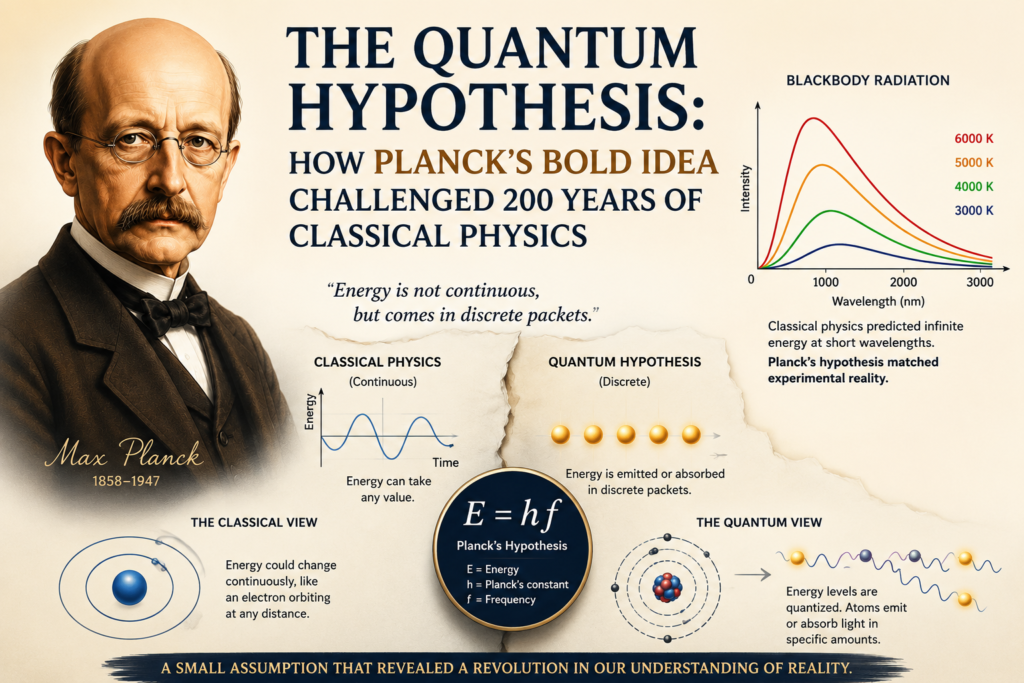
At its core, the quantum hypothesis proposes that energy is emitted, absorbed, and exchanged only in fixed, indivisible amounts called quanta, rather than as a continuous flow. Before this idea, physicists assumed energy could take on any value along a smooth, unbroken spectrum, much like a dial that can be turned to any position.
The quantum hypothesis shattered that assumption. It proposed instead that energy behaves more like a staircase than a ramp, moving in discrete steps rather than gradual transitions. This idea directly contradicted the deterministic physics that had dominated science since Newton, and it marked the beginning of what historians now call the quantum revolution.
The Crisis in Classical Physics That Demanded a New Idea (1859 – 1900)
To understand why the quantum hypothesis emerged, you have to understand the crisis that preceded it. By the late nineteenth century, physicists were confronted with the blackbody radiation problem, a puzzle involving how idealized objects emit energy purely based on temperature.
Using classical thermodynamics and electromagnetic wave theory, scientists calculated how much energy a blackbody should radiate at each wavelength. Their equations worked reasonably well at longer wavelengths but produced an absurd result at shorter, ultraviolet wavelengths, predicting infinite energy output. This impossible prediction became infamously known as the ultraviolet catastrophe, and it exposed a fundamental flaw in classical physics that no amount of adjustment could fix.
Nineteenth century science, built on continuous energy flow and deterministic physics, simply had no explanation for this failure. Something entirely new was needed.
Planck’s Radical Proposal (1900)
Max Planck, a physicist deeply rooted in classical thermodynamics and statistical mechanics, approached the blackbody problem using mathematical techniques borrowed from Ludwig Boltzmann. In December 1900, he presented a solution that would later be recognized as the birth of quantum mechanics.
Planck proposed that energy is not exchanged continuously, but only in discrete packets, or quanta, with each packet’s energy directly proportional to its frequency. This relationship is expressed through the now famous equation:
E = hν
In this formula, E represents the energy of a single quantum, ν (nu) represents the frequency of radiation, and h is a new fundamental constant, now known as planck’s constant, with an approximate value of 6.626 × 10⁻³⁴ joule seconds.
This simple looking equation carried enormous implications. It meant that energy could not take just any value. It could only exist in specific, quantized amounts, a direct challenge to two hundred years of classical physics.
The Mathematics Behind the Quantum Hypothesis
To resolve the ultraviolet catastrophe, Planck developed what became known as planck’s law of radiation, a formula describing the spectral energy density of a blackbody at any given temperature:
B(ν, T) = (2hν³ / c²) × 1 / (e^(hν / kT) − 1)
Where:
- B(ν, T) is the spectral radiance at frequency ν and temperature T
- h is planck’s constant
- c is the speed of light
- k is the Boltzmann constant
- T is the absolute temperature
Unlike classical formulas, this equation matched experimental blackbody data precisely across all wavelengths, including the ultraviolet range where classical physics had failed. The success of this formula depended entirely on accepting the quantum hypothesis as a genuine mathematical necessity, not merely a convenient trick.
Why This Idea Challenged 200 Years of Physics
Classical physics, from Newtonian mechanics to Maxwell’s theory of electromagnetic waves, was built on the assumption of continuity and determinism. Physical quantities like energy, position, and momentum were believed to change smoothly, and given enough information, future outcomes could be predicted with complete certainty.
The quantum hypothesis directly undermined this foundation. If energy exists only in discrete steps, then the smooth, continuous world described by classical physics was, at best, an approximation that only appeared accurate at large scales. At the atomic and subatomic level, reality behaved in an entirely different, quantized manner.
This is why the quantum hypothesis is often described as a genuine paradigm shift rather than a simple scientific update. It did not refine classical physics. It exposed its limits.
Planck’s Reluctance and Einstein’s Confirmation (1900 – 1921)
Interestingly, Planck himself was hesitant to accept the full implications of his own idea. He initially treated the quantum hypothesis as a mathematical device rather than a literal description of physical reality, hoping it could eventually be reconciled with classical physics.
It was Albert Einstein who took the hypothesis further. In 1905, drawing directly on planck and einstein‘s intertwined legacy, Einstein applied the quantum hypothesis to explain the photoelectric effect, proposing that light itself travels in discrete packets called photons. His success in explaining this phenomenon provided strong experimental support for the reality of energy quanta, earning him the Nobel Prize in Physics in 1921.
Niels Bohr later extended the quantum hypothesis to atomic structure, proposing that electrons occupy discrete energy levels rather than smoothly varying orbits, further reinforcing the idea that nature operates on quantized principles at small scales.
From Hypothesis to Foundation of Modern Physics
What began as a tentative mathematical proposal gradually became the foundation of an entirely new field. The quantum hypothesis evolved into full quantum mechanics through the work of physicists including Werner Heisenberg, Erwin Schrödinger, and Paul Dirac during the 1920s.
Today, planck’s legacy in modern physics is impossible to overstate. Quantum mechanics, built directly on the original quantum hypothesis, underlies our understanding of atomic structure, chemical bonding, semiconductors, lasers, and even emerging technologies like quantum computing.
The Legacy: Max Planck Quantum Universe
The world that Planck’s quantum hypothesis revealed is often referred to as the Max Planck Quantum Universe, a reality where energy, matter, and even probability itself behave in fundamentally discrete, non intuitive ways. This universe stands in stark contrast to the smooth, predictable world described by classical physics, and it continues to shape scientific research well over a century later.
Frequently Asked Questions
What is the quantum hypothesis in simple terms?
The quantum hypothesis states that energy is exchanged in discrete, fixed units called quanta, rather than flowing continuously as classical physics assumed.
Who introduced the quantum hypothesis?
Max Planck introduced the quantum hypothesis in 1900 while solving the blackbody radiation problem, marking the beginning of quantum mechanics.
Why did the quantum hypothesis challenge classical physics?
Classical physics assumed energy changes smoothly and continuously. The quantum hypothesis proposed that energy exists only in discrete steps, undermining the deterministic foundation of nineteenth century science.
How did Einstein support the quantum hypothesis?
Einstein used the quantum hypothesis in 1905 to explain the photoelectric effect, showing that light behaves as discrete photons, which provided strong experimental evidence for quantized energy.
What field of science grew out of the quantum hypothesis?
The quantum hypothesis became the foundation of quantum mechanics, a branch of physics describing the behavior of particles at atomic and subatomic scales.
Conclusion
The quantum hypothesis stands as one of the boldest ideas in scientific history, not because its creator sought to overturn established physics, but because the mathematics demanded it. What started as a solution to a stubborn radiation problem grew into a complete rewriting of how scientists understand energy, matter, and reality itself. Two hundred years of classical certainty gave way to a universe built on discrete, quantized steps, a shift that continues to define the frontier of physics today.