Some numbers change the way humanity understands the universe. Planck’s constant is one of them. It is a tiny, almost unimaginably small figure, yet it sits at the very foundation of modern physics, quietly dictating how energy, light, and matter behave at the smallest possible scales. Without this single constant, there would be no quantum mechanics, no semiconductors, no lasers, and no modern computing.
At its core, planck’s constant tells us something astonishing: energy is not smooth and continuous the way classical physics once assumed. Instead, it comes in tiny, discrete packets. This single realization cracked open an entirely new branch of science and forced physicists to rethink reality itself.
What Is Planck’s Constant? A Simple Explanation
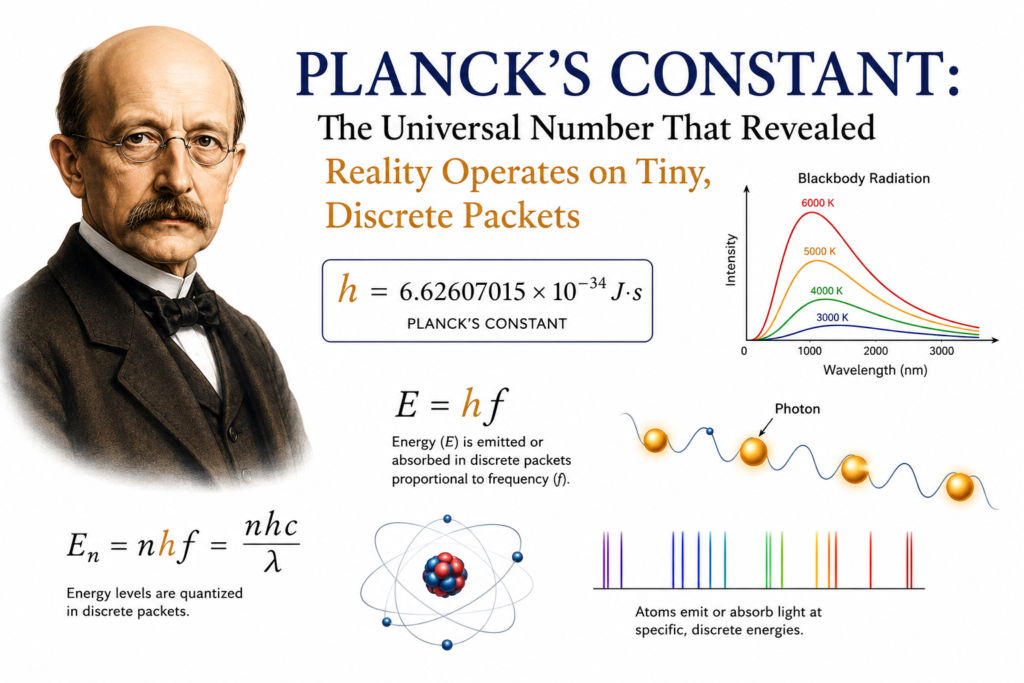
Planck’s constant, symbolized as h, is a fundamental physical constant that defines the smallest possible unit of action in the universe. Its accepted value is approximately:
h = 6.626 × 10⁻³⁴ joule seconds
This number is extraordinarily small, which explains why quantum effects are invisible in everyday life but dominate at the level of atoms, electrons, and photons. Anyone asking what is planck’s constant in practical terms should understand it as the conversion factor that links the energy of a quantum particle to its frequency of oscillation.
The core equation involving planck’s constant is elegantly simple:
E = hν
Here, E represents the energy of a photon, h is planck’s constant, and ν (the Greek letter nu) represents frequency. This equation, first introduced in 1900, became one of the most important formulas in the history of physics.
The Origin Story: Solving the Blackbody Radiation Problem (1859 – 1900)
To understand why planck’s constant exists at all, you need to understand the crisis it solved. In the late nineteenth century, physicists were struggling with the blackbody radiation problem, a puzzle involving how objects emit energy based purely on their temperature.
Classical physics, using the Rayleigh-Jeans law, predicted that a blackbody should emit infinite energy as wavelength decreased toward the ultraviolet range. This nonsensical prediction became known as the ultraviolet catastrophe, and it exposed a fundamental gap in classical understanding of energy and radiation.
German physicist Max Planck approached this puzzle in 1900 and proposed a radical solution. Instead of assuming energy could be emitted continuously, he suggested that energy is emitted and absorbed only in fixed, discrete amounts, or “quanta.” This became known as the quantum hypothesis, and it directly required the introduction of a new constant of proportionality, later named in Planck’s honor.
Planck’s Law of Radiation and the Mathematics Behind It
To resolve the ultraviolet catastrophe, Planck developed a formula now called planck’s law of radiation, which accurately describes the spectral energy density emitted by a blackbody at any given temperature:
B(ν, T) = (2hν³ / c²) × 1 / (e^(hν / kT) − 1)
Where:
- B(ν, T) is the spectral radiance at frequency ν and temperature T
- h is planck’s constant
- ν is the frequency of radiation
- c is the speed of light
- k is the Boltzmann constant
- T is the absolute temperature in kelvin
This formula matched experimental data with remarkable precision, something classical physics had failed to achieve. The critical ingredient making this equation work was the assumption that energy exists in discrete units proportional to frequency, governed entirely by planck’s constant.
Why Planck’s Constant Is So Small, and Why That Matters
The value of h, roughly 6.626 × 10⁻³⁴ joule seconds, is so small that it becomes practically irrelevant in the macroscopic world we experience daily. A basketball, a car, or a falling apple do not visibly display quantum behavior because the energy differences involved are astronomically larger than the scale defined by planck’s constant.
However, at the level of subatomic particles, electrons, and photons, planck’s constant becomes the dominant factor determining behavior. It sets the boundary between classical physics, which describes large-scale smooth motion, and quantum mechanics, which describes the strange, probabilistic behavior of particles at atomic and subatomic scales.
From Planck to Einstein: Confirming the Reality of Quanta (1900 – 1921)
Although Planck introduced his constant somewhat reluctantly, viewing it initially as a mathematical convenience, Albert Einstein took the idea further in 1905. Einstein used planck’s constant to explain the photoelectric effect, demonstrating that light itself behaves as discrete packets of energy called photons, with energy calculated directly through E = hν.
This confirmation, for which Einstein later received the Nobel Prize, proved that planck’s constant was not simply a mathematical trick but a genuine feature of physical reality. Niels Bohr later used the same constant to explain the discrete energy levels of electrons within atoms, further cementing its central role in physics.
Planck’s Constant and the Uncertainty Principle
Planck’s constant also plays a critical role in Werner Heisenberg’s uncertainty principle, one of the most famous results in quantum mechanics. The principle states that the more precisely you know a particle’s position, the less precisely you can know its momentum, and vice versa. This relationship is mathematically expressed as:
Δx × Δp ≥ h / 4π
Here, Δx represents uncertainty in position and Δp represents uncertainty in momentum. The presence of planck’s constant in this equation shows that this uncertainty is not a limitation of measurement tools, but a fundamental property of the universe itself.
The Planck Scale: Where Physics Reaches Its Limits
Physicists also use planck’s constant, along with the speed of light and the gravitational constant, to define what is known as the planck scale, the smallest meaningful length, time, and energy scales in the universe. Below the planck scale, our current understanding of physics, including general relativity, is believed to break down entirely.
This makes planck’s constant essential not only for describing atoms and photons, but for exploring the theoretical boundaries where quantum mechanics and gravity may eventually unify, an area still actively researched in theoretical physics today.
Real World Applications of Planck’s Constant
The practical impact of planck’s constant extends far beyond theoretical physics textbooks. It underlies the operation of lasers, LED lighting, solar panels, and semiconductor electronics found in virtually every modern device. Medical imaging technologies such as MRI machines rely on quantum principles rooted directly in this constant.
Even more remarkably, since 2019, the kilogram itself has been redefined in terms of planck’s constant, replacing the old physical prototype kept in France. This means one of the most practical units of measurement in daily life is now permanently tied to this quantum constant, cementing its role in both theoretical and applied science.
The Legacy: Max Planck Quantum Universe
The discovery of planck’s constant opened what many physicists now call the Max Planck Quantum Universe, a reality governed not by smooth continuous change, but by discrete, quantized steps. This shift in understanding remains one of the most profound in scientific history, reshaping chemistry, electronics, computing, and even our philosophical understanding of reality itself.
Modern research into quantum computing continues to build directly upon the foundation planck’s constant established over a century ago, proving that this single number continues to shape the frontier of science today.
Frequently Asked Questions
What is planck’s constant in simple terms?
Planck’s constant is a fundamental number in physics that links the energy of a quantum particle, such as a photon, to its frequency. It defines the smallest scale at which quantum effects become significant.
What is the value of planck’s constant?
The accepted value of planck’s constant is approximately 6.626 × 10⁻³⁴ joule seconds, an extremely small number that explains why quantum effects are not visible in everyday objects.
Why is planck’s constant important in physics?
Planck’s constant is essential because it forms the mathematical foundation of quantum mechanics, appearing in key equations such as photon energy, the uncertainty principle, and blackbody radiation formulas.
How is planck’s constant used in modern technology?
Planck’s constant underlies technologies including lasers, semiconductors, LED lighting, and solar panels. It is also used in the modern scientific definition of the kilogram.
Who discovered planck’s constant?
German physicist Max Planck introduced the constant in 1900 while solving the blackbody radiation problem, marking the beginning of quantum theory.
Conclusion
Planck’s constant may be one of the smallest numbers in physics, but its influence is anything but small. From solving the ultraviolet catastrophe to enabling modern quantum computing research, this single figure reshaped how scientists understand energy, matter, and reality itself. What began as a mathematical solution to a stubborn thermodynamics problem became the cornerstone of an entirely new scientific era. More than a century later, planck’s constant continues to define the boundary between the world we can see and the strange, quantized universe operating just beneath it.