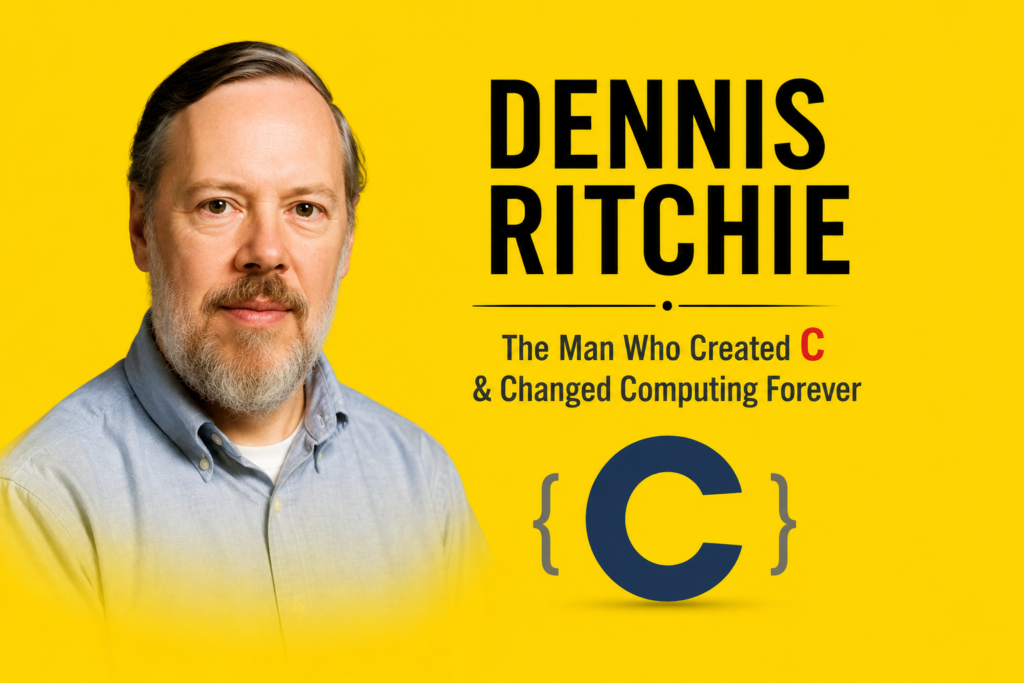
When people talk about the titans of computing, names like Steve Jobs and Bill Gates dominate the conversation. Yet the man whose work made their achievements possible is far less celebrated outside technical circles. dennis ritchie quietly revolutionized the entire computing world from a modest office at Bell Labs, creating both the C programming language and the UNIX operating system. Without his contributions, the software stack that powers every smartphone, server, and supercomputer on earth would look unrecognizably different. This is the story of a genius who changed everything and received far too little credit for doing it.
Early Life and the Making of a Computer Scientist (1941 – 1967)
dennis ritchie was born on September 9, 1941, in Bronxville, New York. His father, Alistair Ritchie, was a scientist at Bell Telephone Laboratories, and that environment of rigorous intellectual inquiry shaped Dennis from an early age. He showed exceptional aptitude in mathematics and physics, earning a Bachelor of Science degree in physics from Harvard University in 1963. He then went on to complete graduate work in applied mathematics, though he never formally completed his doctorate. His interests had already migrated decisively toward a new frontier: computing.
In 1967, dennis ritchie joined Bell Labs in Murray Hill, New Jersey, the same institution where his father had spent his career. It was a place unlike any other in the world at the time, a research powerhouse that produced transistors, information theory, and laser technology. For a young computer scientist with radical ideas about operating systems and programming languages, it was the perfect laboratory.
The Multics Project and the Seeds of UNIX
When dennis ritchie arrived at Bell Labs, he joined a collaborative project called Multics, short for Multiplexed Information and Computing Service. Multics was a joint effort between MIT, General Electric, and Bell Labs to create a time-sharing operating system that could serve many users simultaneously. The project was ambitious, sprawling, and ultimately too complex to deliver what its creators promised on schedule.
Bell Labs withdrew from Multics in 1969, and that withdrawal proved to be one of the most consequential decisions in computing history. Dennis Ritchie, along with his close collaborator Ken Thompson, did not abandon their vision. They simply scaled it down and rebuilt it with ruthless elegance on a discarded PDP-7 minicomputer. Thompson wrote an early version of the new system in assembly language. They named it UNIX, a playful pun on Multics, and the operating system revolution had begun.
The move from Multics to UNIX exemplified the philosophy that would define dennis ritchie’s entire career: make things simple, make them composable, and make them fast. Where Multics had been baroque and overwhelming, UNIX was lean, modular, and strikingly powerful.
The B Language and the Birth of C (1969 – 1972)
UNIX needed a programming language worthy of its design. The early versions ran on assembly language, which was powerful but brutally difficult to write and entirely non-portable. You wrote assembly for one machine architecture and you rewrote it from scratch for another. Scaling UNIX to new hardware would have been nearly impossible without a better solution.
Ken Thompson had already created a language called B, itself derived from BCPL, a language developed by Martin Richards. B was an improvement but it lacked critical features, most notably the ability to work efficiently with different data types. dennis ritchie took B as his starting point and transformed it into something genuinely new.
Between 1969 and 1972, dennis ritchie developed the C programming language on the PDP-11 computer at Bell Labs. C introduced data types, structures, a powerful pointer system, and a syntax that was expressive without being verbose. It sat at a uniquely productive level of abstraction: high enough to write complex software quickly, low enough to manipulate memory and hardware directly. That combination had never existed in quite the same form before, and it has never been fully replicated since.
The practical proof of C’s power came swiftly. By 1973, the UNIX kernel itself had been rewritten in C. An operating system written in a high-level language rather than assembly was a genuinely shocking achievement. It meant that UNIX could be ported to new hardware with a fraction of the effort previously required. C had made operating systems portable, and that changed everything about how software was built.
#include <stdio.h>

int main() {
    printf("Hello, World!\n");
    return 0;
}
This simple program, the traditional introduction to any programming language, runs on virtually every computing platform on earth today. That universality is dennis ritchie’s legacy in its most visible form.
The K&R C Book: Defining a Language for a Generation
In 1978, dennis ritchie co-authored “The C Programming Language” with Brian Kernighan. The book, universally known in programming circles as K&R C after its authors’ initials, became one of the most influential technical books ever published. It was a masterpiece of technical writing: precise, complete, and remarkably readable.
K&R C did not just document the language; it defined best practices, established idioms, and essentially taught an entire generation of programmers how to think in C. The book’s opening Hello World example became the universal first program for learners of every language that followed. For anyone exploring the history of C programming, K&R C remains essential primary source material even today.
Dennis ritchie’s ability to communicate technical ideas with clarity and economy matched his ability to design elegant systems. The combination was extraordinarily rare and extraordinarily powerful.
UNIX: The Operating System That Ate the World
While C was spreading through academia and industry, UNIX was doing the same, often carried on the back of C’s portability. AT&T began licensing UNIX to universities in the early 1970s at nominal cost, and those universities produced entire generations of computer scientists who grew up thinking in the UNIX philosophy.
The UNIX philosophy, deeply shaped by dennis ritchie’s thinking, can be summarized in a few principles: write programs that do one thing and do it well, write programs that work together, and write programs that handle text streams because that is a universal interface. These principles sound simple. Their consequences were profound.
Linux, the open-source operating system that today runs the majority of the world’s servers, cloud infrastructure, and Android devices, is directly descended from the UNIX philosophy. macOS and iOS are built on a UNIX-certified foundation. The shell scripting, file system hierarchies, and process models that developers work with every day trace directly back to what dennis ritchie and Ken Thompson built in the late 1960s and early 1970s.
Understanding the difference between C and its successors is illuminating. A careful look at C vs C++ reveals exactly how Bjarne Stroustrup built on Ritchie’s foundation by adding object-oriented programming while deliberately preserving C’s performance characteristics and low-level control.
The Turing Award and National Recognition
In 1983, dennis ritchie and Ken Thompson jointly received the ACM Turing Award, the highest honor in computer science, sometimes called the Nobel Prize of computing. The citation recognized their development of generic operating systems theory and specifically the implementation of UNIX. It was long overdue and richly deserved.
In 1998, President Bill Clinton awarded dennis ritchie and Ken Thompson the National Medal of Technology, the United States’ highest honor for technological achievement. The citation noted their lasting contribution to the computing industry, a contribution that by that point had already shaped decades of software development and would shape decades more.
dennis ritchie received these honors with characteristic modesty. He was never comfortable with the spotlight, preferring the work itself to any recognition it brought. That humility, combined with the scale of his impact, makes him one of the most genuinely admirable figures in the history of technology.
Dennis ritchie and the C Programming Legacy in Systems Software
The reach of dennis ritchie’s work extends into virtually every corner of modern computing. The C programming language he created became the foundation on which an astonishing proportion of the world’s software was built. Operating system kernels, database engines, network routers, embedded controllers, and compilers are written in C. Languages including C++, Java, Python, JavaScript, PHP, Perl, and Go all drew syntactic and conceptual inspiration directly from C.
The C programming legacy is not merely historical. C remains the dominant language for C for embedded systems development, where direct hardware control and deterministic performance are non-negotiable requirements. It is the language of choice for writing device drivers, real-time operating systems, and firmware for microcontrollers with severely limited resources.
// Simple C function demonstrating pointers and memory
#include <stdio.h>
#include <stdlib.h>

void doubleValue(int *ptr) {
    *ptr = (*ptr) * 2;
}

int main() {
    int num = 21;
    doubleValue(&num);
    printf("Doubled value: %d\n", num);
    return 0;
}
This kind of direct pointer manipulation, passing the memory address of a variable and operating on it directly, is quintessentially C. Understanding this mechanism is foundational to system programming and is one reason C pointers explained remains one of the most searched topics among programmers learning the language at a deep level.
For developers serious about systems programming, advanced C programming topics like memory management, buffer handling, and low-level I/O are areas where Ritchie’s original design decisions still guide best practices today.
Dennis ritchie vs Steve Jobs: The Unsung Hero Problem
October 2011 was a painful month for the technology world. Steve Jobs passed away on October 5, 2011, triggering an outpouring of global mourning that dominated headlines for weeks. dennis ritchie passed away just days later, on October 12, 2011, at the age of 70, following a long illness. His death received a fraction of the media attention despite the fact that the iPhone Steve Jobs unveiled ran on a UNIX-based operating system written substantially in C.
This disparity troubled many in the computing community. Rob Pike, a longtime colleague of Ritchie at Bell Labs, wrote that the people who most mourned dennis ritchie were the people who understood most clearly what they had lost. The irony was acute: Steve Jobs built beautiful products on a foundation that dennis ritchie had largely constructed. Without Ritchie, Jobs’s work would have looked very different, if it had been possible at all.
The lesson is worth internalizing. The most foundational contributions to technology are often the least visible to the public. The engineers who build the platforms on which visible innovations stand are frequently invisible themselves.
Why C Still Matters for Beginners and Experts Alike
Despite being over fifty years old, C remains one of the most important languages for new programmers to study. Learning C forces you to confront the realities of memory management in C, understand how computers actually store and retrieve data, and write code that cannot hide behind a runtime environment’s safety net. These lessons transfer powerfully to every other language you learn afterward.
For anyone starting out, the path through C programming for beginners teaches lessons that Python and JavaScript simply cannot. The discipline of managing your own memory, thinking in terms of pointers and references, and reasoning about execution at a near-hardware level builds programming instincts that last a career.
Developers who want to understand how C compares to newer alternatives will find the comparison of C vs Python particularly illuminating. Python wins on developer speed and readable syntax, but C wins decisively on execution performance, deployment flexibility, and the ability to operate in environments where a Python interpreter cannot exist.
Frequently Asked Questions
Who Was Dennis Ritchie and Why Is He Important?
dennis ritchie was an American computer scientist who worked at Bell Labs from 1967 until his death in 2011. He is best known as the creator of the C programming language and the co-creator of the UNIX operating system alongside Ken Thompson. His work forms the foundation of modern operating systems, system programming languages, and virtually the entire family of C-derived programming languages. Despite his enormous influence, he remained relatively unknown to the general public throughout his life.
When Did Dennis Ritchie Create the C Language?
dennis ritchie developed C between approximately 1969 and 1972 at Bell Labs, working primarily on the PDP-11 minicomputer. The language grew out of his work improving the B language created by Ken Thompson, which was itself derived from BCPL. C was first widely described in the 1978 book “The C Programming Language,” co-authored with Brian Kernighan. The first formal standardization of C by the American National Standards Institute (ANSI) occurred in 1989, producing what is known as ANSI C or C89.
What Did Dennis Ritchie Win the Turing Award For?
dennis ritchie and Ken Thompson jointly received the ACM Turing Award in 1983 for their development of generic operating systems theory and specifically for implementing UNIX. The Turing Award is the highest honor in computer science, roughly equivalent in prestige to the Nobel Prize. Ritchie and Thompson also received the US National Medal of Technology in 1998 from President Clinton for their lasting contributions to computing.
How Did C Change Programming Languages Forever?
C established a syntactic and conceptual template that virtually every subsequent major programming language has drawn from. Its use of curly braces for code blocks, semicolons as statement terminators, the structure of function definitions, and the approach to control flow became standard across C++, Java, JavaScript, C#, Python, Go, Rust, and dozens of others. C also demonstrated that a high-level language could produce code efficient enough to write operating systems, fundamentally changing what developers expected from programming languages.
What Is the Relationship Between UNIX and C?
C and UNIX were developed together and are deeply intertwined. UNIX was initially written in assembly language but was rewritten in C in 1973, demonstrating for the first time that an operating system could be written in a high-level language. This portability made UNIX far easier to deploy across different hardware architectures. The two technologies spread together through academia and industry, each reinforcing the other’s adoption. Today’s Linux, macOS, iOS, and Android all descend from this UNIX tradition, and all are built substantially in C.
How Did Dennis Ritchie Die?
dennis ritchie passed away on October 12, 2011, at his home in Berkeley Heights, New Jersey, at the age of 70. He had been in poor health for several years following treatment for prostate cancer and heart disease. His death came just days after the passing of Steve Jobs, which meant it received significantly less media coverage than it deserved. The computing community mourned deeply, recognizing that one of the true architects of modern computing had been lost.
Conclusion
Dennis ritchie did not seek fame. He sought elegance, simplicity, and solutions to hard problems. He found all three in a Bell Labs office during one of the most creative periods in the history of technology, and the tools he built there, C and UNIX, became the bedrock on which the entire modern computing industry was constructed.
Every time a server handles a web request, every time a smartphone processes a touch, every time a compiler transforms source code into machine instructions, the intellectual DNA of dennis ritchie is present. His influence is not historical in the sense of being past; it is architectural in the sense of being permanent. The man who created C did not just change computing. He defined the shape it would take for generations, and that shape has proven extraordinarily durable.
Learning C today is not nostalgia. It is an act of understanding: understanding how computers really work, how software really executes, and how one quiet, brilliant scientist at Bell Labs gave the world tools that it will be using long after the rest of us are gone.