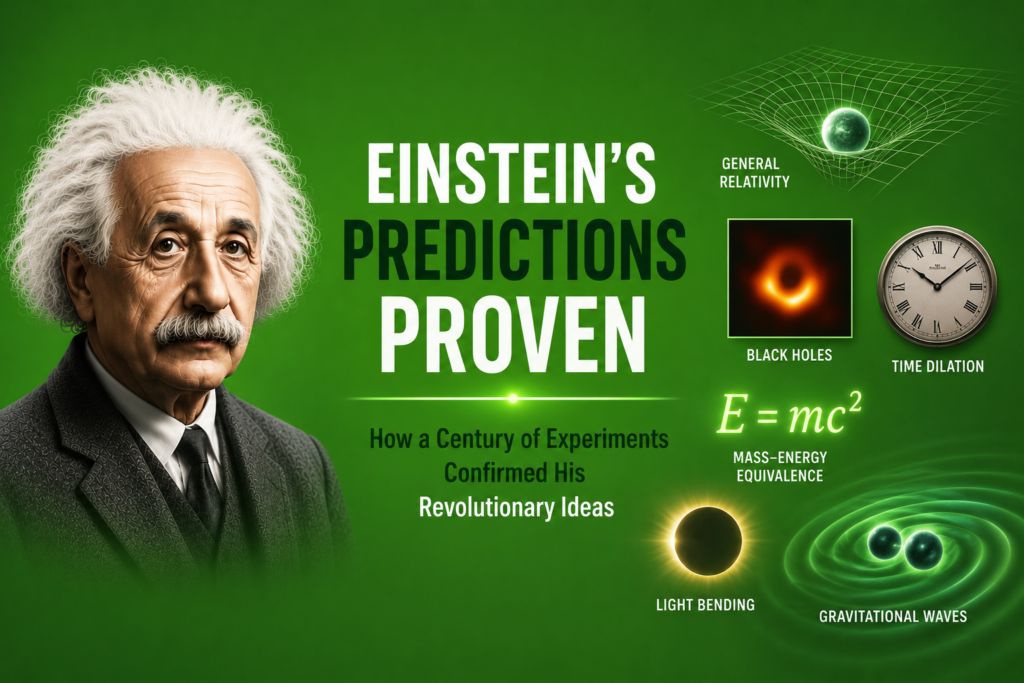
When Albert Einstein published his groundbreaking theories in the early twentieth century, many of his predictions seemed almost too strange to be true. Bending starlight, slowing time, gravitational waves rippling through empty space, these ideas sounded more like science fiction than serious physics. Yet across more than a century of increasingly precise experiments, einstein predictions proven through rigorous scientific testing have consistently confirmed his revolutionary insights, transforming once radical theoretical claims into thoroughly established scientific fact.
Understanding how einstein predictions proven emerged through decades of careful experimentation reveals one of science’s greatest success stories, a testament to how mathematical reasoning, applied correctly, can reveal genuine truths about the universe decades before technology catches up to verify them.
The First Major Test: Bending Starlight (1919)
The earliest and perhaps most dramatic confirmation among einstein predictions proven came through the famous Arthur Eddington Principe eclipse 1919 expedition. Einstein’s general relativity explained theory predicted that massive objects like the sun should bend light passing near them, since gravity is curved spacetime rather than a traditional force acting instantly across distance.
Arthur Eddington organized an expedition to the island of Principe specifically to photograph stars positioned near the sun during a total solar eclipse, when sunlight would not overwhelm the fainter starlight. The resulting curved starlight photo measurement matched Einstein’s predictions with remarkable precision, instantly transforming Einstein into an international scientific celebrity and providing the first major piece of testing general relativity evidence.
Solving Mercury’s Century-Old Mystery
Another crucial confirmation among einstein predictions proven involved the precession of Mercury’s perihelion, a small but persistent anomaly in Mercury’s orbital path that had puzzled astronomers for decades. Classical Newtonian physics simply could not account for this precise perihelion of Mercury proof discrepancy, regardless of how carefully astronomers adjusted their calculations.
Einstein’s general relativity equations, however, predicted the exact additional orbital shift observed in Mercury’s actual path around the sun, providing a precise mathematical match without requiring any additional adjustable parameters. This success demonstrated that einstein predictions proven correct where established Newtonian physics had failed entirely.
Time Itself Slows Down: Proving Time Dilation
Perhaps the most personally relatable confirmation among einstein predictions proven involves time dilation explained through Einstein’s earlier special relativity explained theory. In 1971, scientists conducted the celebrated Hafele Keating experiment proof, placing extraordinarily precise atomic clocks aboard commercial airplanes flying around the world in both directions.
The results matched Einstein’s mathematical predictions with impressive accuracy, demonstrating that atomic clock satellite altitude test conditions genuinely affect the passage of time itself. This effect is expressed through the equation:
t’ = t / √(1 − v²/c²)
Here, t’ represents dilated time, t represents proper time, v represents relative velocity, and c represents the speed of light. Modern GPS satellites must continuously account for this exact relativistic effect to maintain accurate positioning, representing a genuinely practical, everyday confirmation of Einstein’s century old theoretical prediction.
Gravitational Redshift: Light Losing Energy
Scientists further confirmed einstein predictions proven through the gravitational redshift Pound-Rebka experiment conducted in 1959. This remarkably precise laboratory test measured how photons lose energy while climbing away from Earth’s gravitational field, shifting toward longer, redder wavelengths exactly as general relativity predicted.
This experiment provided compelling evidence supporting Einstein’s broader claims regarding how mass and gravity influence not just the passage of time, but the fundamental properties of light itself as it travels through curved spacetime.
Time Delays Near Massive Objects
Another elegant confirmation involves what scientists call the Shapiro time delay effect, predicting that radio signals passing near a massive object like the sun should experience a measurable delay due to spacetime curvature along their path. Precise radar measurements bouncing signals off other planets confirmed this subtle but genuine relativistic effect, adding yet another entry to the growing list of einstein predictions proven through increasingly sophisticated experimental techniques.
Confirming Frame Dragging: Gravity Probe B (2004 – 2011)
Between 2004 and 2011, NASA conducted the ambitious Gravity Probe B gyroscope precession experiment, launching an extraordinarily precise satellite specifically designed to detect a subtle relativistic effect called frame dragging, where a rotating massive object like Earth should slightly drag surrounding spacetime along with its rotation.
This mission successfully detected both the predicted geodetic effect measurement and the more subtle frame dragging phenomenon, confirming yet another sophisticated theoretical prediction that had remained untested for nearly a century after Einstein first developed his complete gravitational theory.
Pulsars Provide Powerful Confirmation
Throughout the 1970s and beyond, astronomers studying a binary pulsar Hulse-Taylor test system discovered compelling indirect evidence supporting Einstein’s predictions regarding gravitational waves, ripples in spacetime itself predicted by general relativity. By precisely measuring how this binary pulsar system’s orbit gradually decayed over time, scientists confirmed that energy was being lost in a manner exactly matching predictions for gravitational wave emission, decades before such waves could be directly detected.
Direct Gravitational Wave Detection (2015)
The most spectacular recent addition to einstein predictions proven arrived in 2015, when the LIGO laser interferometer observatory achieved something once considered practically impossible. Scientists directly detected gravitational wave strain detection signals produced by the merger of binary black holes occurring over a billion years ago, ripples in spacetime itself exactly matching predictions Einstein’s equations had made a full century earlier.
This landmark LIGO gravitational wave discovery represented one of the most significant scientific achievements in modern physics, providing direct, unambiguous confirmation of predictions regarding einstein and black holes and gravitational wave physics that had remained purely theoretical for generations.
Seeing a Black Hole Directly (2019)
Just a few years later, astronomers achieved another remarkable milestone among einstein predictions proven through the Event Horizon Telescope collaboration. This EHT M87 black hole shadow project successfully captured the first direct image of a black hole’s silhouette, using a coordinated global network of telescopes to photograph the supermassive black hole at the center of galaxy M87.
This unprecedented achievement provided undeniable visual proof that black holes, predicted mathematically through Einstein’s equations over a century earlier, genuinely exist as real astronomical objects, representing perhaps the most visually striking confirmation among all einstein predictions proven throughout this remarkable century of testing.
Why These Confirmations Still Matter
The consistent pattern of einstein predictions proven across increasingly sophisticated experimental techniques demonstrates something profound about the nature of scientific theory itself. Unlike ideas that require constant revision or special exceptions, Einstein’s theories have withstood over a century of precision relativity tests, from simple eclipse photography through cutting edge gravitational wave detection, without requiring fundamental modification.
The broader Albert Einstein legacy surrounding these confirmations continues inspiring ongoing physics research, as scientists develop ever more precise instruments capable of testing relativity under increasingly extreme conditions, from weak field tests general relativity in everyday satellite technology to strong field gravity test scenarios involving colliding black holes.
Frequently Asked Questions
What was the first major experimental proof of Einstein’s theories?
The 1919 solar eclipse expedition led by Arthur Eddington provided the first major confirmation, demonstrating that gravity bends starlight exactly as Einstein’s general relativity predicted.
How was gravitational time dilation proven experimentally?
The 1971 Hafele Keating experiment used atomic clocks aboard airplanes to confirm that time passes differently depending on velocity and altitude, exactly matching Einstein’s predictions.
When were gravitational waves first directly detected?
Scientists at LIGO directly detected gravitational waves in 2015, produced by two merging black holes, confirming a prediction Einstein’s equations had made a century earlier.
How was the black hole image in 2019 significant?
The Event Horizon Telescope captured the first direct image of a black hole’s shadow, providing undeniable visual confirmation of objects predicted mathematically through Einstein’s equations.
Are all of Einstein’s predictions considered proven today?
Yes, virtually all major predictions from both special and general relativity have been confirmed through increasingly precise experiments spanning over a century of scientific testing.
Conclusion
The remarkable history of einstein predictions proven across more than a century of scientific testing stands as one of the most compelling success stories in the history of physics. From Eddington’s eclipse photographs in 1919 to LIGO’s gravitational wave detection and the historic black hole imaging achievement in 2019, Einstein’s theoretical insights have consistently matched observed reality with extraordinary precision. This unbroken chain of experimental confirmation demonstrates the extraordinary power of mathematical physics to reveal genuine truths about the universe, proving that Einstein’s revolutionary ideas were never merely theoretical speculation, but accurate descriptions of how our universe truly works.