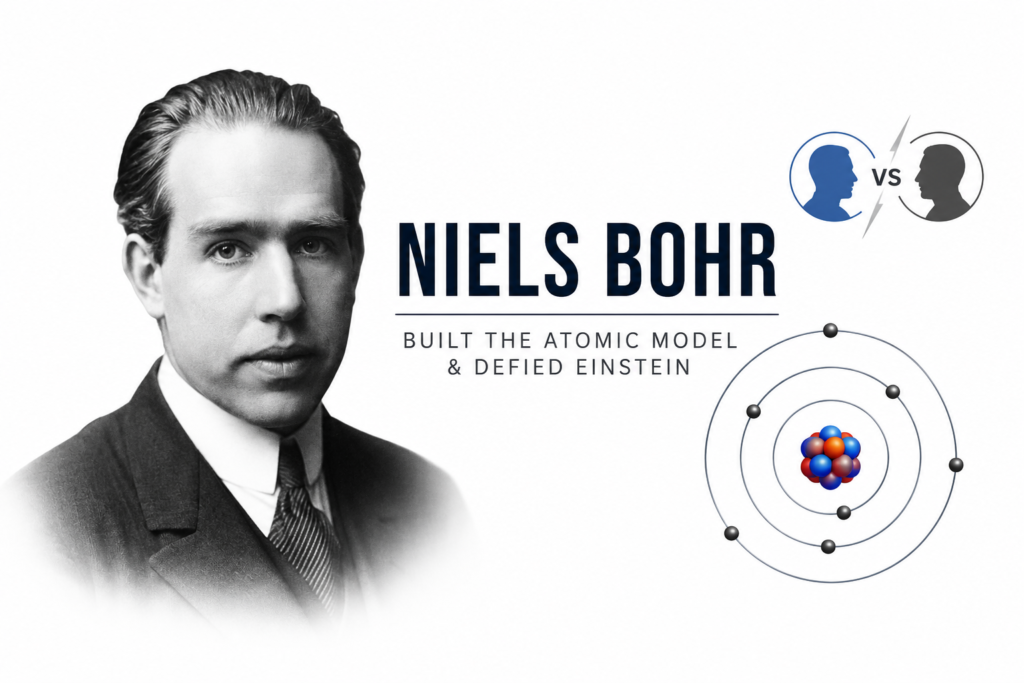
Few scientists in history dared to challenge Albert Einstein directly and hold their ground. Yet who was niels bohr if not exactly that kind of thinker, a brilliant Danish physicist whose model of the atom permanently reshaped chemistry and physics, and whose philosophical courage led him into one of the most famous intellectual rivalries in scientific history. Understanding who was niels bohr means understanding a mind capable of building an entirely new picture of the atom while simultaneously defending an unsettling new view of reality itself against the objections of the century’s most celebrated genius.
Early Life and Education in Copenhagen (1885 – 1911)
Niels Henrik David Bohr was born on October 7, 1885, in Copenhagen, Denmark, into an academically distinguished family. His father was a respected physiology professor, and this household of intellectual seriousness shaped young Bohr’s early fascination with science and philosophy alike.
Anyone researching who was niels bohr academically will find his path led him to the University of Copenhagen, where he studied physics with remarkable dedication, eventually completing his doctorate in 1911. This early Niels Bohr early life and education phase gave him the rigorous theoretical foundation needed for the groundbreaking work that would soon follow.
Learning Under the Masters: Thomson and Rutherford (1911 – 1913)
Following his doctorate, Bohr traveled to England, first working briefly under J.J. Thomson at Cambridge before moving to Manchester University to study under Ernest Rutherford, whose recent discovery of the atomic nucleus had left physics with an unsolved puzzle. Rutherford’s model suggested electrons orbited a dense nucleus, yet classical physics predicted such orbiting electrons should rapidly lose energy and spiral into the nucleus, causing atomic collapse almost instantly.
This unresolved problem, inherited directly from his mentor Niels Bohr mentor Ernest Rutherford, became the central challenge that would define Bohr’s early scientific career and eventually lead to his most celebrated discovery.
Solving the Atomic Puzzle: The Bohr Model (1913)
In 1913, Bohr proposed a radical solution now known simply as the Bohr model, answering the question of who invented the Bohr model with a groundbreaking theoretical framework. Rather than allowing electrons to orbit at any arbitrary distance, Bohr suggested that electrons could only occupy specific, quantized orbits, corresponding to discrete energy levels.
This model relied on Bohr’s frequency condition, expressed through the equation:
E = hf
Here, E represents the energy difference between two orbital levels, h is Planck’s constant, and f represents the frequency of light either absorbed or emitted during a transition. When an electron jumped between these fixed orbits, it would absorb or release energy corresponding precisely to the difference between allowed levels, producing what physicists call an electron energy jumps event, visible as specific spectral lines within an atom’s emission spectrum.
Explaining Hydrogen’s Mysterious Spectrum
Bohr’s hydrogen atom solution successfully explained something that had puzzled scientists for decades, the specific pattern of spectral lines emitted by hydrogen gas when energized. Using his quantized orbital model, Bohr calculated the precise energy levels available to hydrogen’s single electron, deriving a formula matching experimental spectral observations with remarkable accuracy.
This breakthrough provided the first genuinely successful theoretical explanation connecting quantum theory directly to observable atomic behavior, cementing Bohr’s early reputation as a rising force within theoretical physics.
Building an Institution: The Bohr Institute (1921)
In 1921, Bohr founded what became known as the Bohr Institute, officially the Danish Institute for Theoretical Physics founder achievement that transformed Copenhagen into one of the world’s leading centers for quantum research. This institution attracted brilliant young physicists from across Europe, fostering the collaborative intellectual environment that would eventually produce many of quantum mechanics’ most important breakthroughs.
The Bohr Institute became closely associated with what physicists now call the copenhagen interpretation, the dominant philosophical framework describing how quantum measurements and probability function within physical reality, a direct product of the vigorous scientific discussions taking place within Bohr’s own institute walls.
Nobel Recognition and Growing Influence (1922)
In 1922, Bohr received the Niels Bohr Nobel Prize 1922 recognition for his foundational contributions to understanding atomic structure and quantized energy levels. This achievement cemented his position among the era’s leading Nobel laureate in Physics figures, alongside contemporaries like Max Planck, whose earlier quantum hypothesis had helped inspire Bohr’s own atomic model.
The Correspondence Principle: Bridging Old and New Physics
As quantum theory matured throughout the 1920s, Bohr introduced what became known as the correspondence principle, a foundational idea stating that quantum mechanical predictions must align with classical physics results under conditions involving large quantum numbers. This principle helped ensure that revolutionary new quantum mechanics remained logically consistent with the well-established classical physics it was gradually replacing.
The Great Debate: Bohr Versus Einstein (1927 – 1935)
Perhaps nothing defines who was niels bohr more vividly than his legendary intellectual rivalry with Albert Einstein. The Niels Bohr vs Einstein debates, playing out publicly across multiple Solvay Conference gatherings throughout the late 1920s and 1930s, centered on fundamental disagreements regarding the true nature of quantum reality.
Bohr championed the wave-particle duality and probabilistic interpretation at the heart of quantum mechanics, while Einstein remained deeply skeptical, famously objecting that “God does not play dice.” This tension crystallized further through the EPR paradox, a thought experiment Einstein co-developed specifically to challenge quantum theory’s completeness, suggesting quantum mechanics might be missing hidden variables explaining what Einstein dismissively called spooky action at a distance.
Bohr’s reply to Einstein consistently defended the completeness of quantum theory, arguing through his complementarity principle that particles genuinely exist in probabilistic states until measured, a position that modern experimental physics has largely vindicated despite Einstein’s persistent philosophical objections.
Escaping Nazi Occupation (1943)
As World War II engulfed Europe, Bohr faced direct personal danger due to his partial Jewish heritage. In 1943, Bohr executed a dramatic Niels Bohr escape from Denmark WWII, fleeing occupied territory to eventually reach safety in England and later the United States, where he became peripherally involved with nuclear research efforts.
Bohr’s Role in Wartime Science
During this period, Bohr’s Niels Bohr Manhattan Project role remained largely advisory, offering theoretical insight regarding atomic energy commission matters while also expressing growing concern about the postwar implications of nuclear weapons technology. His involvement extended to broader wartime intelligence matters, including awareness of Operation Epsilon efforts monitoring German nuclear research, though Bohr never worked directly at Los Alamos facilities himself.
Later Recognition and Philosophical Legacy
Bohr received numerous honors throughout his later life, including Denmark’s prestigious Order of the Elephant recognition. His son, Aage Bohr, would later win his own Nobel Prize, making the Bohr family Nobel laureates a rare father-son achievement within physics history.
Bohr’s philosophical legacy extended well beyond pure physics, influencing broader questions regarding scientific epistemology, measurement, and the fundamental limits of human knowledge, ideas that continue shaping Niels Bohr philosophical views discussions among physicists and philosophers alike.
Why Bohr’s Work Still Matters Today
Understanding from Bohr model to modern technology reveals just how foundational his contributions remain. Modern semiconductor technology, laser systems, and chemical bonding theory all trace their theoretical roots directly back to Bohr’s original quantized atomic model, demonstrating how thoroughly his early twentieth century insights continue shaping contemporary science and engineering.
Frequently Asked Questions
Who was Niels Bohr in simple terms?
Niels Bohr was a Danish physicist who developed the quantized atomic model explaining electron orbits and energy levels, later becoming a foundational figure in quantum mechanics and its philosophical interpretation.
What did Niels Bohr discover about atoms?
Bohr discovered that electrons occupy specific, quantized orbits around the nucleus, jumping between these energy levels while absorbing or emitting precise amounts of energy.
Why did Bohr and Einstein disagree?
Bohr and Einstein disagreed over the fundamental nature of quantum mechanics, with Bohr defending probabilistic quantum theory while Einstein believed hidden variables might restore determinism to physics.
Did Niels Bohr win the Nobel Prize?
Yes, Bohr received the Nobel Prize in Physics in 1922 for his foundational contributions to understanding atomic structure.
What role did Bohr play during World War II?
Bohr escaped Nazi occupied Denmark in 1943 and later provided advisory input regarding atomic energy research, though he never worked directly on weapons development at Los Alamos.
Conclusion
The question of who was niels bohr reveals one of physics’ most consequential figures, a Danish scientist whose quantized atomic model transformed chemistry and physics forever, while his philosophical courage in debating Einstein helped establish quantum mechanics as our modern understanding of reality. From founding his influential institute in Copenhagen to defending quantum theory against history’s most celebrated skeptic, Bohr’s legacy continues shaping science, technology, and our fundamental understanding of the atomic world more than a century after his groundbreaking 1913 discovery.