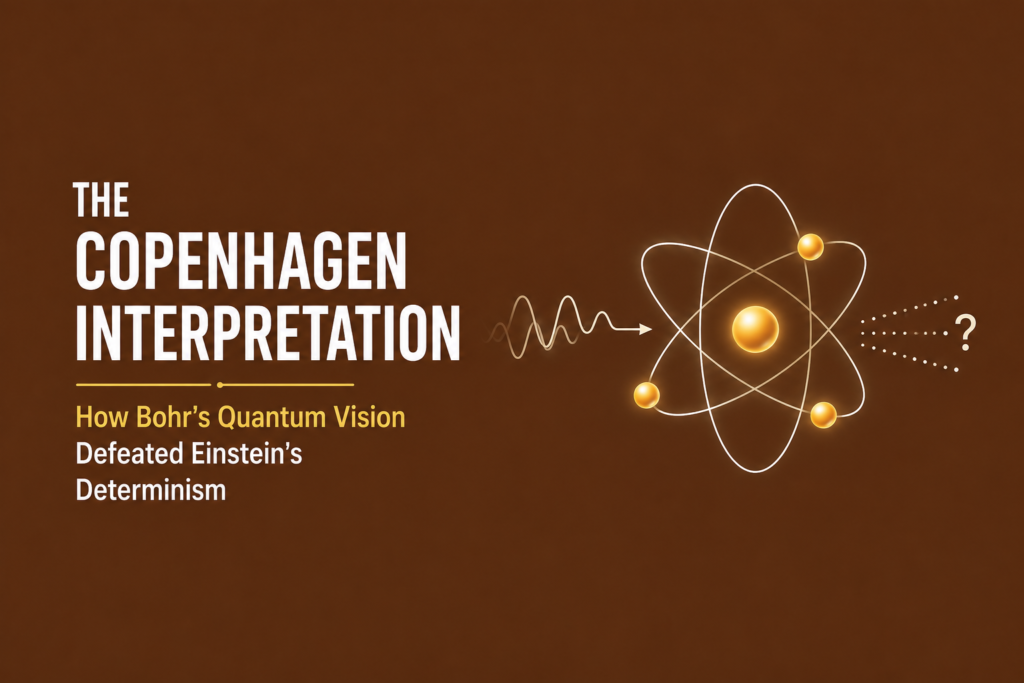
Is the universe fundamentally predictable, or does chance sit at the very heart of physical reality? This question, seemingly abstract and philosophical, became the battleground for one of history’s most consequential scientific disputes. The Copenhagen interpretation, developed largely by Niels Bohr and his collaborators throughout the 1920s, proposed something genuinely unsettling: that nature itself is fundamentally probabilistic, not merely appearing random due to incomplete human knowledge. This idea directly confronted Albert Einstein’s deeply held belief in classical determinism, sparking a debate that would define twentieth century physics.
Understanding the Copenhagen interpretation means confronting one of science’s deepest philosophical questions, whether physical reality possesses definite properties independent of observation, or whether measurement itself plays an irreducible role in bringing reality into definite existence.
The World Before Quantum Uncertainty
Before the Copenhagen interpretation emerged, classical physics operated according to strict determinism. Isaac Newton’s laws suggested that given complete knowledge of a system’s current state, its entire future could theoretically be calculated with perfect precision. This deterministic worldview dominated scientific thinking for over two centuries, treating the universe as an enormous, predictable clockwork mechanism.
Quantum mechanics, emerging throughout the early twentieth century, threatened to shatter this comfortable picture entirely. Experiments revealed strange behavior at the atomic scale that classical determinism failure could simply not explain, forcing physicists to develop an entirely new framework for understanding physical reality.
Building the Framework (1925 – 1927)
The Copenhagen interpretation emerged gradually throughout the mid-1920s, developed largely through intense discussions occurring at Bohr’s own research institute in Denmark, sometimes called the Copenhagen school physics movement. This period saw crucial theoretical contributions from Werner Heisenberg, whose matrix mechanics formulation and Heisenberg uncertainty principle provided essential mathematical tools, alongside Erwin Schrödinger’s alternative Schrödinger wave equation approach describing quantum systems.
Niels Bohr played the central role synthesizing these developments into a coherent philosophical framework, incorporating his own complementarity principle and earlier insights regarding electron orbits and energy levels into what would become the standard interpretation of quantum mechanics taught throughout physics education worldwide.
The Wave Function: Describing Quantum Possibility
Central to the Copenhagen interpretation is the concept of the quantum state vector, mathematically described through the Schrödinger wave equation. This wave function does not describe a definite physical state the way classical mechanics would, but rather represents a probability density describing the likelihood of finding a particle in various possible states or positions.
This probabilistic nature connects directly to what physicists call the Born rule probability, developed by Max Born, which states that the probability of finding a particle at any given location equals the squared magnitude of its wave function at that point. This represented a genuinely radical departure from classical physics, replacing definite predictions with statistical interpretation calculations.
Wave Function Collapse: The Measurement Problem
Perhaps the most philosophically challenging aspect of the Copenhagen interpretation involves wave function collapse, sometimes called wave function reduction. Before measurement, a quantum system exists in a superposition of multiple possible states simultaneously, described entirely through its probability-based wave function.
Upon measurement, this quantum superposition seemingly disappears instantaneously, with the system settling into one specific, definite outcome. This transition, from probabilistic superposition to definite classical reality, represents what physicists call the measurement problem, a puzzle that continues generating philosophical debate nearly a century after the Copenhagen interpretation first proposed this framework.
The Observer Effect: Does Measurement Create Reality?
The Copenhagen interpretation suggests something genuinely unsettling regarding observer involvement in physical reality. According to this framework, quantum properties simply do not possess definite values until the specific act of physical measurement act forces a particular outcome to manifest. This observer effect does not necessarily require conscious awareness, but rather refers to any interaction with a macroscopic measuring apparatus capable of distinguishing between different possible quantum states.
This represents a fundamental departure from classical assumptions regarding an objective reality debate existing independently of observation, suggesting instead that certain properties remain genuinely undetermined until measurement occurs, blurring the traditional boundary between observer and observed system.
Einstein’s Deep Discomfort
Albert Einstein found the Copenhagen interpretation deeply unsatisfying throughout his life, famously objecting through his oft-quoted statement that “God does not play dice.” Einstein believed physical reality must possess definite properties independent of observation, viewing quantum indeterminism as merely reflecting incomplete human knowledge rather than genuine randomness inherent within nature itself.
This fundamental disagreement crystallized through the historic Einstein–Bohr debate, playing out across multiple Solvay Conference gatherings throughout the late 1920s and 1930s. Einstein consistently attempted constructing thought experiments designed to reveal apparent contradictions within quantum mechanics, hoping to demonstrate that hidden variables might eventually restore classical determinism to physics.
The EPR Paradox: Einstein’s Strongest Challenge
Einstein’s most sophisticated challenge to the Copenhagen interpretation arrived through the EPR paradox, developed alongside colleagues Podolsky and Rosen in 1935. This thought experiment proposed a scenario involving two entangled particles, suggesting that measuring one particle’s properties should not instantaneously affect its distant partner unless some hidden, pre-existing information already determined both outcomes.
Einstein described this apparent instantaneous connection as spooky action at a distance, arguing it violated basic principles of locality and suggested quantum mechanics remained fundamentally incomplete. Bohr’s reply to Einstein consistently defended the Copenhagen interpretation, arguing that quantum entanglement represented a genuine, non-local collapse phenomenon rather than evidence of missing hidden variables.
Experimental Vindication: Bell’s Theorem and Beyond
Decades after the original Niels Bohr vs Einstein debates, physicist John Bell developed a mathematical framework capable of experimentally testing whether hidden variables could actually explain quantum entanglement. Subsequent experiments throughout the following decades consistently violated Bell’s inequalities, providing strong experimental support for the Copenhagen interpretation’s genuinely probabilistic, non-local view of quantum reality over Einstein’s preferred deterministic alternative.
Bridging Quantum and Classical Worlds
An important aspect of the Copenhagen interpretation involves explaining the classical limit, precisely where the quantum probabilistic universe transitions into the deterministic, predictable macro vs micro world we experience in everyday life. Bohr’s earlier correspondence principle helped establish this crucial boundary, ensuring quantum predictions align properly with classical physics results under conditions involving large-scale, macroscopic systems.
Why the Copenhagen Interpretation Still Dominates
Despite ongoing philosophical debates and alternative interpretations proposed over subsequent decades, the Copenhagen interpretation remains the most widely taught and practically applied framework throughout physics education and research. This Copenhagen orthodoxy, sometimes critically called Copenhagen dogma by proponents of competing interpretations, continues providing the essential conceptual foundation underlying from Bohr model to modern technology developments, including quantum computing, quantum cryptography, and countless other technologies exploiting genuine quantum randomness.
The Broader Philosophical Impact
Beyond pure physics, the Copenhagen interpretation fundamentally reshaped Bohr’s philosophical legacy regarding scientific epistemology itself. This framework suggested that certain fundamental limits exist regarding what can genuinely be known about physical reality, not merely due to technological limitations, but as an irreducible feature of nature itself. This represented a profound philosophical shift away from centuries of confident classical certainty toward a more humble acknowledgment of nature’s inherent probabilistic character.
Frequently Asked Questions
What is the Copenhagen interpretation in simple terms?
The Copenhagen interpretation states that quantum systems exist in probabilistic superpositions until measurement forces them into definite states, suggesting reality itself is fundamentally probabilistic rather than deterministic.
Why did Einstein disagree with the Copenhagen interpretation?
Einstein believed physical reality must possess definite properties independent of observation, famously stating that “God does not play dice,” reflecting his preference for deterministic rather than probabilistic physics.
What is wave function collapse?
Wave function collapse describes the transition from a quantum system existing in multiple possible states simultaneously to settling into one definite, observable outcome upon measurement.
How was the Einstein-Bohr debate eventually resolved?
Subsequent experiments testing Bell’s theorem throughout later decades provided strong support for the Copenhagen interpretation’s probabilistic view, largely vindicating Bohr’s position over Einstein’s preference for hidden variables.
Is the Copenhagen interpretation still accepted today?
Yes, it remains the most widely taught and applied interpretation of quantum mechanics, though some physicists continue exploring alternative interpretations regarding the fundamental nature of quantum reality.
Conclusion
The Copenhagen interpretation stands as one of the most philosophically significant achievements in the history of science, fundamentally challenging centuries of confident classical determinism through Bohr’s probabilistic vision of quantum reality. From wave function collapse to the historic clash with Einstein over hidden variables, this framework ultimately prevailed through decades of rigorous experimental testing, confirming that nature genuinely operates according to probability rather than strict predictability at its most fundamental level. More than a century after its development, the Copenhagen interpretation continues shaping how physicists understand measurement, reality, and the strange, probabilistic universe quantum mechanics revealed.