Introduction
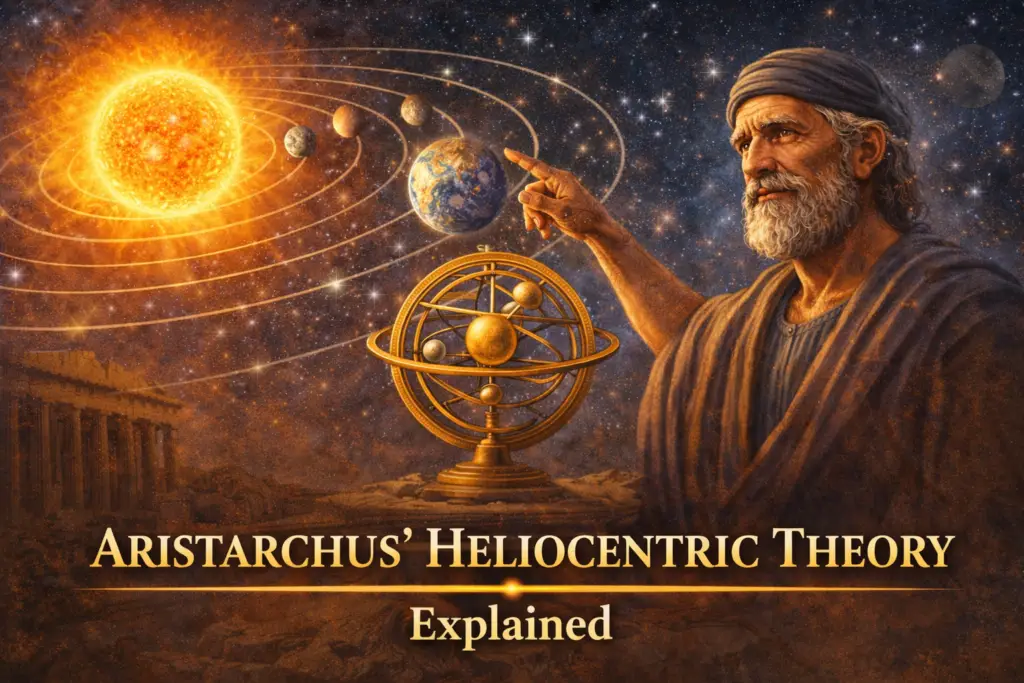
Long before the Renaissance changed our understanding of the cosmos, a brilliant spark of intuition emerged from the Hellenistic world. Aristarchus’ Heliocentric Theory stands as one of the most daring intellectual leaps in human history. In an age where the common senses suggested that the Earth was the stationary center of all things, Aristarchus of Samos dared to suggest the opposite. He proposed that the Earth was merely a planet revolving around a central, massive Sun. This radical shift was not merely a guess; it was the result of the first mathematical attempts to measure the scale of our solar system.
Who Was the Man Behind the Sun-Centered Model?
To understand the theory, one must understand the thinker. Aristarchus of Samos (c. 310 – 230 BCE) was a Greek mathematician and astronomer who lived during the height of the Alexandrian era. While many of his contemporaries were focused on perfecting the Geocentric (Earth-centered) model to explain the erratic movements of planets, Aristarchus utilized geometry to look at the “big picture.”
Though most of his original writings have been lost to time—with the exception of his treatise on the sizes and distances of the Sun and Moon—we know of his revolutionary ideas primarily through the writings of Archimedes and Plutarch. They describe a man who looked at the heavens not as a mystical tapestry, but as a geometric puzzle waiting to be solved.
The Core Idea Behind the Theory
The essence of Aristarchus’ Heliocentric Theory was strikingly modern. He posited three fundamental truths that contradicted the prevailing wisdom of his time:
- Centrality of the Sun: The Sun, not the Earth, remains immobile at the center of the universe.
- Earth in Motion: The Earth revolves around the Sun in a circular orbit.
- Planetary Rotation: The Earth rotates daily on its own axis, which explains the apparent rising and setting of the stars.
Aristarchus also correctly surmised that the stars were incredibly distant—much further away than the Sun. He argued that the reason we do not see the stars shifting positions as we move in our orbit (a phenomenon known as stellar parallax) is that the distance to the stars is so vast that the Earth’s orbit is like a tiny point in comparison.
Measuring the Heavens: The Geometry of a Genius
Aristarchus did not arrive at his heliocentric conclusion by accident. His theory was fueled by his attempts at celestial measurement. In his work, How Aristarchus Measured the Sun/Moon Distances, he used the phase of the “half-moon” to calculate the relative distances between the Earth, Moon, and Sun.
He reasoned that when the Moon appears exactly half-illuminated, the Earth, Moon, and Sun form a right-angled triangle. By measuring the angle between the Moon and the Sun from Earth, he could use trigonometry to find the ratio of their distances.
While his instruments were primitive and his final numbers were off—he concluded the Sun was about 20 times further away than the Moon when it is actually 400 times—his logic was flawless. He realized the Sun was significantly larger than the Earth. This realization was likely the “Aha!” moment for his theory: it made no sense for a massive Sun to revolve around a much smaller Earth.
Why the Ancient World Rejected Aristarchus’ Ideas
Despite its brilliance, the heliocentric model failed to gain traction in ancient Greece. Most of the scientific community followed the geocentric views of Aristotle and, later, Ptolemy. There were several reasons for this rejection:
- The Problem of Parallax: If the Earth moved, the positions of the stars should change slightly throughout the year. Because ancient astronomers couldn’t see this (due to stars being light-years away), they assumed the Earth was stationary.
- Physics of the Time: Critics argued that if the Earth were spinning and moving, birds would be left behind and people would be blown off the surface.
- Religious and Philosophical Bias: Placing the Sun at the center was seen by some, like the Stoic Cleanthes, as “impious” because it moved the “hearth of the universe” (the Earth) from its rightful place.
Consequently, Aristarchus’ Ideas were shelved for nearly two millennia, relegated to the status of a mathematical curiosity rather than a physical reality.
Influence on Future Scientists
The flame Aristarchus lit never truly went out. His theory acted as a silent precursor to the Scientific Revolution. When Nicolaus Copernicus began developing his own heliocentric model in the 16th century, he was aware of Aristarchus. In an early draft of his landmark work, De revolutionibus orbium coelestium, Copernicus actually cited Aristarchus as a predecessor, though he later deleted the reference.
Later, during the trials of Galileo and the calculations of Johannes Kepler, the ghost of Aristarchus’ logic was present. He had provided the first proof that the universe was much larger than anyone imagined, a concept that eventually allowed modern astronomy to flourish.
Why It Matters Today
In the modern era, Aristarchus’ Heliocentric Theory is viewed as a testament to the power of the human mind to transcend its immediate environment. It reminds us that:
- Perspective is Everything: Just because we feel stationary doesn’t mean we aren’t moving at 67,000 miles per hour.
- Math is a Universal Language: Geometry allowed a man with no telescope to understand the structure of the solar system.
- Scientific Courage: It takes immense bravery to propose an idea that contradicts everything people believe they see with their own eyes.
Frequently Asked Questions (FAQs)
Did Aristarchus have a telescope?
No. Aristarchus lived 1,800 years before the invention of the telescope. He relied entirely on naked-eye observations and geometric calculations.
Why is Copernicus more famous than Aristarchus?
Copernicus provided a more detailed mathematical model that could predict planetary positions more accurately, and he lived during the invention of the printing press, which allowed his ideas to spread rapidly.
What was Aristarchus’ biggest mistake?
His biggest mistake was underestimating the Sun’s distance due to the difficulty of measuring the exact angle of the half-moon with the naked eye. However, his method was mathematically sound.
Is Aristarchus considered the ‘Father of Astronomy’?
While many share this title (like Hipparchus or Ptolemy), Aristarchus is often called the “Coperincus of Antiquity” for his visionary heliocentric model.
Conclusion
The story of Aristarchus’ Heliocentric Theory is a humbling chapter in the history of science. It serves as a reminder that the truth does not always win immediately. For 1,800 years, humanity lived under the illusion of being the center of the universe, simply because they ignored the geometric proofs of a man from Samos. Today, as we send probes beyond the reaches of our Sun, we are finally living in the reality that Aristarchus envisioned. He taught us that the Sun is the heart of our system and that our small “blue marble” is part of a grand, celestial dance.