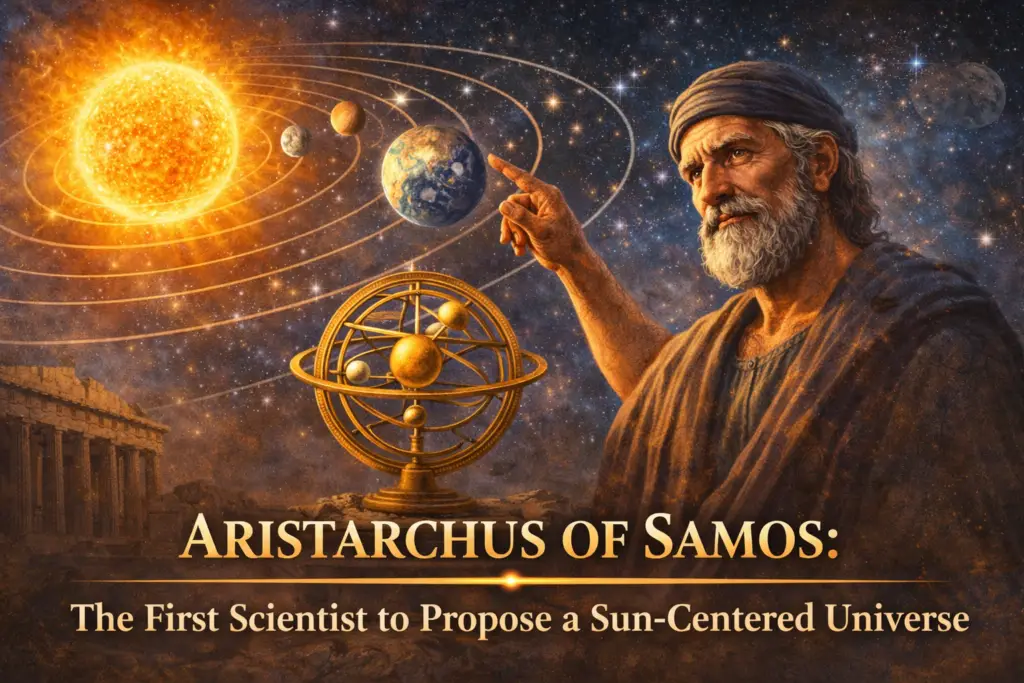
Aristarchus of Samos was a visionary astronomer of ancient Greece, born around 310 BC. Centuries before Copernicus or Galileo, he dared to propose a revolutionary idea: the Sun, not the Earth, is at the center of the universe. His pioneering thoughts challenged centuries of geocentric thinking and laid the foundation for modern astronomy.
Aristarchus’ work represents a pivotal moment in the history of science, demonstrating how observation, mathematics, and logical reasoning can revolutionize our understanding of the cosmos.
Early Life and Education
Aristarchus was born on the Greek island of Samos, a region known for producing intellectuals. He likely received rigorous training in mathematics, geometry, and astronomy. Historical accounts suggest he spent time studying in Alexandria, one of the most prominent learning centers of the ancient world, where he further honed his skills in observation and celestial calculations.
The Heliocentric Revolution
The most significant contribution of Aristarchus is his heliocentric model. He proposed that:
- The Sun is at the center of the universe
- The Earth rotates on its axis
- The Earth orbits the Sun
This revolutionary idea directly challenged the dominant geocentric worldview, which positioned Earth at the center. Although largely ignored at the time, his model would later inspire astronomers such as Copernicus, Galileo, and Kepler.
Contributions to Astronomy
Beyond his Sun-centered theory, Aristarchus made multiple contributions to the understanding of celestial bodies:
- Estimating the sizes and distances of the Sun and Moon using geometric calculations
- Observing lunar phases and eclipses to improve astronomical predictions
- Applying mathematical geometry to understand celestial mechanics
Influence on Later Scientists
Although Aristarchus’ heliocentric model was not widely accepted, it influenced later thinkers:
- Nicolaus Copernicus cited Aristarchus as a predecessor in proposing the Sun-centered universe
- Galileo Galilei used telescopic evidence to support a heliocentric system
- Johannes Kepler built on the concept of planetary motion around the Sun
His ideas highlight the power of bold thinking and the long-term impact of questioning established beliefs.
Observational Techniques and Methods
Aristarchus emphasized empirical observation and geometry in his work:
- He used triangles to measure angles between celestial bodies
- Calculated approximate distances of the Sun and Moon
- Predicted eclipses and lunar cycles through careful observation
His methods were precursors to the scientific method, demonstrating how mathematics and observation can explain natural phenomena.
Legacy of Aristarchus of Samos
Today, Aristarchus is remembered as one of the earliest pioneers to challenge Earth-centered thinking. His heliocentric theory and astronomical contributions inspired the scientific revolution centuries later. Modern astronomy, space exploration, and even our understanding of the solar system are indebted to his visionary work.
His legacy teaches that transformative ideas often begin with a single thinker willing to question the status quo.
Conclusion
Aristarchus of Samos was more than an ancient astronomer; he was a revolutionary mind whose bold vision of a Sun-centered universe laid the groundwork for modern science. By highlighting Aristarchus’ heliocentric theory and Aristarchus’ astronomical contributions, we acknowledge his enduring influence on astronomy, mathematics, and scientific inquiry.
The daring insights of Aristarchus continue to inspire scientists and learners, showing that curiosity, logic, and observation can forever change humanity’s understanding of the universe.