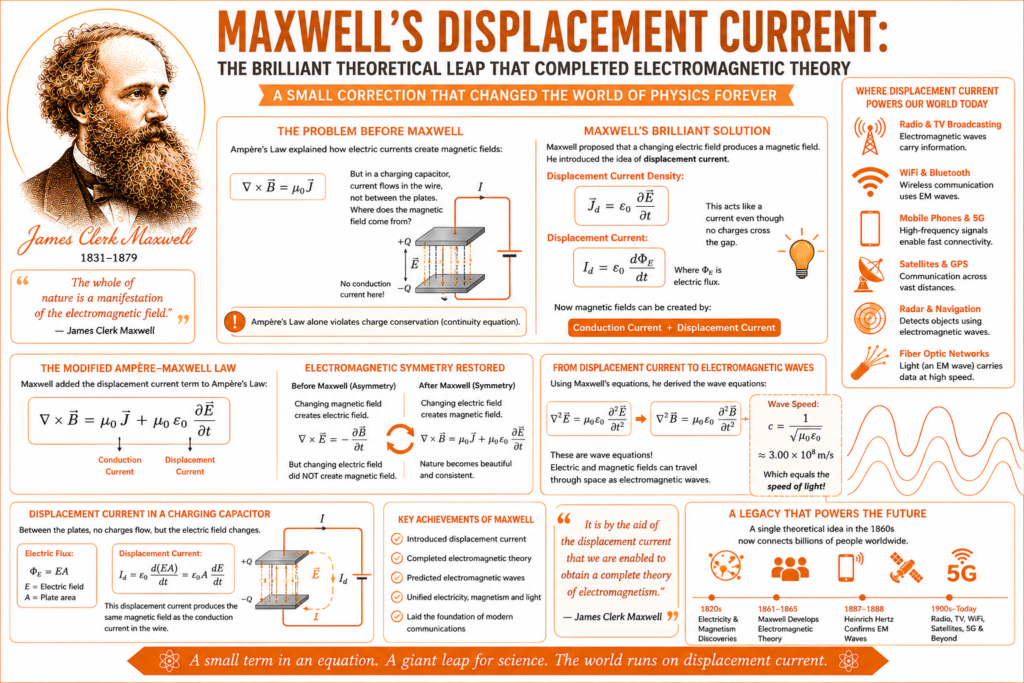
The story of displacement current is one of the most remarkable moments in the history of science. Sometimes a single mathematical idea changes everything. In the 1860s, James Clerk Maxwell introduced a concept so revolutionary that it completed electromagnetic theory and paved the way for radio, television, WiFi, satellites, and modern telecommunications.
At first glance, displacement current appears to be a small mathematical correction. However, it solved a major contradiction in physics and revealed the existence of electromagnetic waves long before they were experimentally discovered.
Many physicists consider displacement current one of the greatest theoretical insights ever achieved because it transformed separate observations about electricity and magnetism into a complete and elegant theory of nature.
The Scientific Problem Before Maxwell (1820 – 1860)
Before the discovery of displacement current, scientists had already learned many important facts about electricity and magnetism.
Researchers such as Ørsted, Ampère, and Faraday discovered:
- Electric currents create magnetic fields.
- Magnetic fields can induce electric currents.
- Electric and magnetic phenomena are connected.
The partnership of faraday and maxwell would ultimately explain these observations.
Faraday provided experimental evidence.
Maxwell supplied the mathematics.
However, a major problem remained hidden inside Ampère’s law.
Understanding Ampère’s Original Law
French physicist André Ampère developed a law describing how electric currents generate magnetic fields.
The differential form of Ampère’s law is:
∇ × B = μ₀J
Where:
- B = Magnetic field
- J = Current density vector
- μ₀ = Permeability of free space
This equation worked perfectly for many situations.
Whenever electric current flowed through a wire, a magnetic field appeared around it.
Scientists believed the problem had been solved.
Unfortunately, Maxwell discovered a serious inconsistency.
The Capacitor Problem
The contradiction appeared when studying a charging capacitor.
A capacitor consists of two conducting plates separated by a dielectric material.
When connected to a battery:
- Current flows through the wire.
- Electric charge accumulates on the plates.
- An electric field forms between the plates.
The situation appears simple.
However, Maxwell noticed something strange.
Current flows through the wire, but no physical current crosses the gap between the plates.
Yet magnetic fields still exist around the circuit.
How could Ampère’s law explain this?
It could not.
The mathematics broke down.
This became known as the capacitor charging displacement current problem.
The Continuity Equation Crisis
The deeper issue involved the continuity equation.
Charge conservation requires:
∇ · J = − ∂ρ/∂t
Where:
- J = Current density
- ρ = Charge density
This equation states that electric charge cannot simply disappear.
Ampère’s law predicted:
∇ · (∇ × B) = 0
Which implies:
∇ · J = 0
This directly conflicted with situations where charge density changes with time.
Physics faced a serious inconsistency.
A mathematical correction was required.
Maxwell’s Brilliant Insight (1861 – 1865)
Maxwell searched for a solution.
He realized that changing electric fields might behave similarly to electric currents.
Instead of requiring moving charges, perhaps a time varying electric field could generate a magnetic field.
This idea became the foundation of displacement current.
Maxwell introduced a new term:
J_d = ε₀(∂E/∂t)
Where:
- J_d = Displacement current density
- ε₀ = Vacuum permittivity
- E = Electric field
This simple addition solved the problem.
More importantly, it transformed electromagnetic theory forever.
The Modified Ampère Maxwell Law
After adding displacement current, Ampère’s law became:
∇ × B = μ₀J + μ₀ε₀(∂E/∂t)
This equation is now known as the Ampère Maxwell law.
The modification states that magnetic fields can be generated by:
- Electric currents
- Changing electric fields
This was an extraordinary leap in understanding.
Many historians regard it as the most important mathematical correction in nineteenth century physics.
Physical Meaning of Displacement Current
What exactly is displacement current?
Unlike ordinary current, it does not involve electrons physically moving through a conductor.
Instead, it arises from changing electric fields.
Consider a charging capacitor.
Between the plates:
- No electrons cross the gap.
- The electric field changes with time.
- A magnetic field still forms.
Displacement current explains this behavior perfectly.
It acts as the missing link connecting electric and magnetic phenomena.
Mathematical Derivation of Displacement Current
The electric flux density through a surface is:
Φ_E = ∫ E · dA
Maxwell proposed that a changing electric flux creates an effective current:
I_d = ε₀(dΦ_E/dt)
Where:
- I_d = Displacement current
- Φ_E = Electric flux
This equation completed the mathematics of electromagnetism.
For the first time, all known observations fit together consistently.
Electromagnetic Symmetry Emerges
One of the most beautiful consequences of displacement current was electromagnetic symmetry.
Before Maxwell:
- Changing magnetic fields created electric fields.
- Changing electric fields did not create magnetic fields.
This asymmetry seemed suspicious.
Maxwell corrected it.
Now:
Changing magnetic fields create electric fields.
Changing electric fields create magnetic fields.
Nature suddenly became balanced and elegant.
This electromagnetic symmetry became a cornerstone of modern physics.
From Displacement Current to Electromagnetic Waves
The true power of displacement current appeared when Maxwell combined it with the rest of electromagnetism.
Using the modified equations, he derived:
∇²E = μ₀ε₀ ∂²E/∂t²
and
∇²B = μ₀ε₀ ∂²B/∂t²
These equations describe waves.
Electric and magnetic fields could propagate through space together.
The wave speed is:
c = 1/√(μ₀ε₀)
Substituting known values:
c ≈ 3 × 10⁸ m/s
This matched the measured speed of light.
Maxwell immediately realized that light itself was an electromagnetic wave.
Without displacement current, this discovery would have been impossible.
The Birth of Electromagnetic Theory
The addition of displacement current transformed scattered observations into a complete framework.
This framework became known as maxwell electromagnetic theory.
The theory explained:
- Electricity
- Magnetism
- Light
- Electromagnetic waves
For the first time, multiple branches of physics became part of a single unified theory.
This achievement ranks among the greatest intellectual accomplishments in scientific history.
Maxwell’s Equations and the New Physics
The complete maxwell equations became:
∇ · E = ρ/ε₀
∇ · B = 0
∇ × E = −∂B/∂t
∇ × B = μ₀J + μ₀ε₀(∂E/∂t
The fourth equation contains Maxwell’s revolutionary correction.
Many physicists believe this single term changed civilization.
It ultimately enabled wireless communication, radio broadcasting, radar, WiFi, and mobile networks.
Experimental Confirmation (1887 – 1888)
Although Maxwell predicted electromagnetic waves mathematically, proof came later.
German physicist Heinrich Hertz performed famous experiments.
Hertz generated and detected radio waves.
His observations confirmed Maxwell’s predictions.
The existence of electromagnetic waves validated the concept of displacement current.
What began as a mathematical correction became an experimentally verified reality.
Why Displacement Current Matters Today
Modern technology depends on displacement current in countless ways.
Applications include:
- Radio communication
- Television broadcasting
- WiFi systems
- Mobile phones
- Satellite communication
- Radar technology
- Microwave engineering
- Fiber optic networks
Every electromagnetic signal moving through space relies on principles Maxwell uncovered.
Without displacement current, wireless communication would not exist.
James Clerk Maxwell Contributions Beyond Displacement Current
When discussing James Clerk Maxwell Contributions, displacement current is often considered his most profound theoretical achievement.
However, Maxwell also contributed to:
- Electromagnetic theory
- Statistical mechanics
- Color vision
- Gas theory
- Mathematical physics
His discoveries transformed both science and technology.
Few scientists have left such a powerful legacy.
From Maxwell to Einstein (1865 – 1905)
The influence of displacement current extended far beyond Maxwell’s lifetime.
Albert Einstein greatly admired Maxwell.
The connection between einstein hero maxwell remains famous in physics.
Einstein’s theory of relativity was partly inspired by Maxwell’s electromagnetic framework.
The intellectual journey from maxwell to einstein represents one of science’s greatest success stories.
Without Maxwell’s correction, modern physics might have evolved very differently.
Why Historians Call It a Theoretical Leap
Many scientific discoveries come from experiments.
Displacement current was different.
Maxwell introduced it because mathematics demanded it.
No experiment directly revealed its existence beforehand.
Instead, Maxwell trusted logical consistency.
That trust led to one of the greatest theoretical predictions ever made.
The discovery demonstrated the extraordinary power of mathematical reasoning.
The Scientific Legacy of Displacement Current
More than 150 years later, displacement current remains a central concept in electromagnetism.
Students learn it in universities around the world.
Engineers use it when designing communication systems.
Researchers apply it in advanced physics.
Its importance continues growing as technology advances.
What once appeared to be a small correction became one of the foundations of modern civilization.
Frequently Asked Questions (FAQs)
What is displacement current?
Displacement current is a term introduced by Maxwell that allows changing electric fields to generate magnetic fields.
Why did Maxwell invent displacement current?
He introduced it to resolve inconsistencies in Ampère’s law and maintain charge conservation.
Does displacement current involve moving electrons?
No. It results from changing electric fields rather than actual movement of electric charges.
How does displacement current relate to capacitors?
In a charging capacitor, displacement current explains how magnetic fields exist even though no electrons cross the gap between plates.
Why is displacement current important?
It completed electromagnetic theory and enabled the prediction of electromagnetic waves.
Conclusion
The discovery of displacement current stands among the greatest achievements in theoretical physics. What began as a mathematical correction ultimately completed electromagnetism, revealed electromagnetic symmetry, and led directly to the discovery of electromagnetic waves.
Maxwell’s insight transformed our understanding of nature and created the foundation for modern communication technology. From radio and television to WiFi and mobile phones, the connected world depends on principles made possible by displacement current.
More than a century later, Maxwell’s brilliant theoretical leap continues shaping science, engineering, and technology across the globe.