Introduction
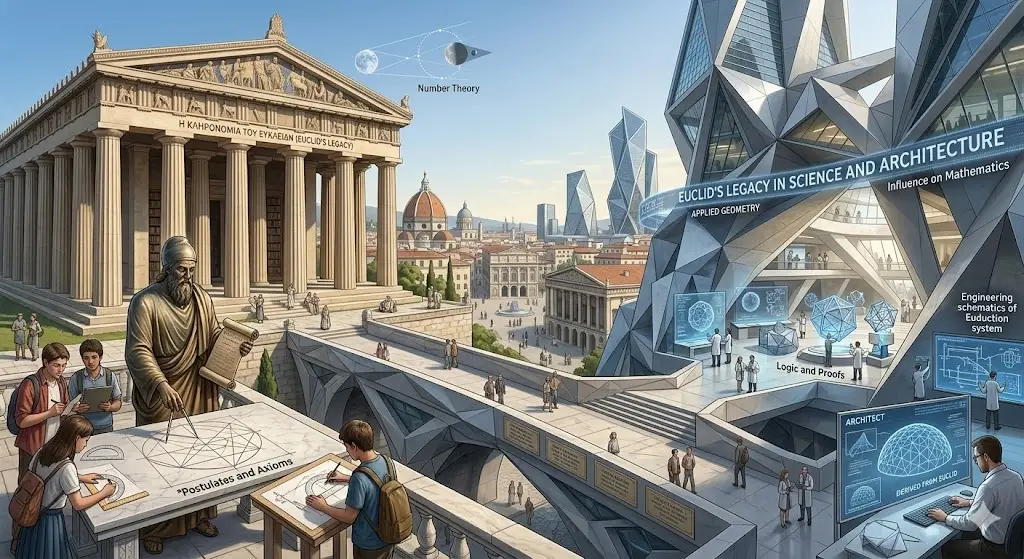
Euclid’s Legacy in Science and Architecture is one of the most remarkable stories in the history of knowledge. More than two thousand years ago, the Greek mathematician Euclid organized geometry into a logical system that became the foundation of mathematical thinking. His ideas did not remain limited to mathematics alone; they influenced science, engineering, architecture, and even philosophical reasoning.
Euclid is often known as “ Euclid: Father of Geometry ”, a title that reflects his enormous contribution to mathematical knowledge. His famous work, “ Elements of Geometry ”, established clear definitions, axioms, and logical proofs that guided generations of scholars.
Today, the impact of Euclid’s work can be seen everywhere—from modern buildings and city planning to engineering design and scientific theories. The euclidean geometry principles he introduced are still taught in schools and universities around the world.
Understanding Euclid’s legacy helps us see how ancient mathematical ideas continue to shape modern science and architecture.
Euclid and the Foundation of Geometry
To understand Euclid’s legacy, it is important to examine the structure of his mathematical work. Euclid lived around 300 BCE in Alexandria, Egypt, where he taught mathematics and compiled earlier Greek knowledge into a systematic framework.
His most influential book, Elements, organized geometry using logical steps. It began with definitions, followed by axioms and postulates, and then presented hundreds of theorems proven through reasoning.
These ideas became the foundation of euclid mathematical principles and influenced not only geometry but also the development of logical thinking in science.
Euclid also contributed to mathematical topics such as Number Theory, where he explored prime numbers and divisibility. His work showed how mathematics could be developed through structured reasoning rather than guesswork.
Because of this method, the history of euclidean geometry represents one of the earliest examples of rigorous scientific thinking.
Influence of Euclid on Scientific Thinking
Euclid’s influence goes far beyond mathematics. His logical system became a model for scientific reasoning. Many later scientists adopted Euclid’s method of starting with basic assumptions and building conclusions step by step.
One of the most important aspects of his work is Logic and Proofs, which emphasized that mathematical statements must be proven logically. This approach became the foundation for scientific methodology.
In fields like physics, astronomy, and engineering, scientists began using similar reasoning processes. Instead of relying on myths or tradition, they relied on observation and logical deduction.
For centuries, scholars studied Euclid’s geometry as part of their education. The euclid geometry rules helped scientists understand space, shapes, and measurement—concepts that are essential in many scientific disciplines.
Even modern mathematics continues to follow the logical structure introduced by Euclid. This demonstrates the powerful Influence on Mathematics that his work has maintained throughout history.
Euclid’s Impact on Architecture
Architecture is one of the fields where Euclid’s ideas are most visible. Buildings rely heavily on geometric principles such as symmetry, proportion, angles, and shapes.
Architects use euclidean geometry principles to design structures that are both functional and visually appealing. Concepts such as triangles, circles, and rectangles form the basic elements of architectural planning.
Ancient Greek and Roman architecture already reflected geometric harmony, but Euclid’s systematic approach made it easier to apply these ideas consistently.
For example, geometric principles are used to:
- Design stable structures
- Calculate angles and measurements
- Plan symmetrical building layouts
- Maintain proportional balance in design
The influence of euclid elements geometry can be seen in famous structures such as classical temples, Renaissance buildings, and even modern skyscrapers.
Without Euclid’s geometric framework, architectural design would be far more difficult and less precise.
Geometry in Engineering and Construction
Engineering relies heavily on geometry for planning and construction. Bridges, roads, tunnels, and buildings all require precise measurements and calculations.
Euclid’s geometry provides the mathematical tools needed to understand shapes, distances, and spatial relationships.
For example:
- Engineers use triangles to ensure structural stability.
- Circles and arcs are used in bridge and tunnel design.
- Angles help determine load distribution in structures.
These applications show how euclid geometry rules remain essential in modern engineering.
The ability to calculate space accurately allows engineers to design structures that are safe, efficient, and durable.
Because of this, Euclid’s work continues to influence technological development even in the modern world.
Euclidean Geometry in Modern Science
Although science has evolved dramatically since Euclid’s time, many scientific fields still rely on his geometric concepts.
Physics, astronomy, and computer graphics all use geometric principles derived from Euclid’s work.
For example:
- Astronomers use geometry to calculate distances between celestial bodies.
- Physicists analyze motion and spatial relationships using geometric models.
- Computer graphics rely on geometric calculations to create 3D images.
Even modern navigation systems and satellite technologies depend on geometric calculations rooted in Euclidean mathematics.
While newer mathematical systems such as non-Euclidean geometry exist, Euclid’s system remains the most widely used for everyday calculations and scientific applications.
This demonstrates the lasting power of Euclid’s ideas.
Geometry and Design in Art and Architecture
Euclid’s influence can also be seen in art and design. Artists have long used geometric patterns and proportions to create visually balanced compositions.
Many architectural masterpieces follow geometric patterns inspired by Euclid’s work.
Examples include:
- Renaissance architecture
- Islamic geometric art
- Classical European buildings
- Modern urban design
Geometric harmony creates a sense of order and beauty in visual design. These artistic principles are closely connected to euclid mathematical principles.
Because of this relationship, geometry has always played an important role in artistic creativity and architectural planning.
Frequently Asked Questions(FAQs)
Who was Euclid and why is he important?
Euclid was a Greek mathematician who lived around 300 BCE. He organized geometry into a logical system and wrote the famous book Elements, which shaped mathematics for centuries.
Why is Euclid called the Father of Geometry?
Euclid earned the title Euclid: Father of Geometry because he created the first systematic and logical framework for studying geometry.
What is Euclid’s Elements?
Elements of Geometry is a mathematical work consisting of thirteen books that explain geometric principles, proofs, and mathematical theories.
How does Euclid influence modern architecture?
Architects use euclidean geometry principles to design buildings with accurate measurements, symmetry, and structural stability.
Are Euclid’s ideas still used today?
Yes. Euclid’s geometry is still widely used in mathematics, engineering, architecture, and science around the world.
Conclusion
The impact of Euclid’s Legacy in Science and Architecture has lasted for more than two millennia. His logical system transformed geometry into a structured discipline and influenced many other fields of knowledge.
From scientific reasoning to architectural design, Euclid’s ideas continue to shape the modern world. His emphasis on logic, structure, and proof created a powerful model for intellectual inquiry.
Even today, students, engineers, architects, and scientists rely on euclid axioms in geometry and euclidean geometry principles to solve real-world problems.
Euclid’s work proves that knowledge developed thousands of years ago can still guide modern innovation and discovery. His contributions remain one of the greatest achievements in the history of mathematics and human thought.