Introduction
Before the 3rd century BCE, mathematical knowledge was a scattered collection of practical rules used for taxes, farming, and construction. It was Euclid’s Contributions to Logic and Proofs that transformed these disparate facts into a unified, rigorous science. By insisting that every mathematical statement be justified by a chain of reasoning starting from self-evident truths, Euclid invented the very concept of a “proof” as we know it today. His work didn’t just provide answers to geometric puzzles; it provided a methodology for discovering truth itself. This intellectual revolution ensured that mathematics would no longer be a matter of opinion or observation, but a domain of absolute certainty.
The Importance of Logical Reasoning in Mathematics
In the ancient world, many civilizations—including the Babylonians and Egyptians—knew that a triangle with sides of 3, 4, and 5 units formed a right angle. However, they lacked a formal system of logical reasoning in mathematics to explain why this was always true. Euclid realized that for mathematics to be a true science, it had to be detached from the physical measurement of objects.
Euclid’s great insight was that human intuition can be deceptive. A line might look straight, or two angles might appear equal, but appearances are not reliable. By establishing a formal Euclidean logic method, he shifted the focus from “what” we see to “how” we know it. This emphasis on logical rigor allowed mathematicians to explore complex concepts that the human eye could never perceive, such as the infinitude of primes or the properties of higher-dimensional solids.
The Structure of Euclidean Proofs
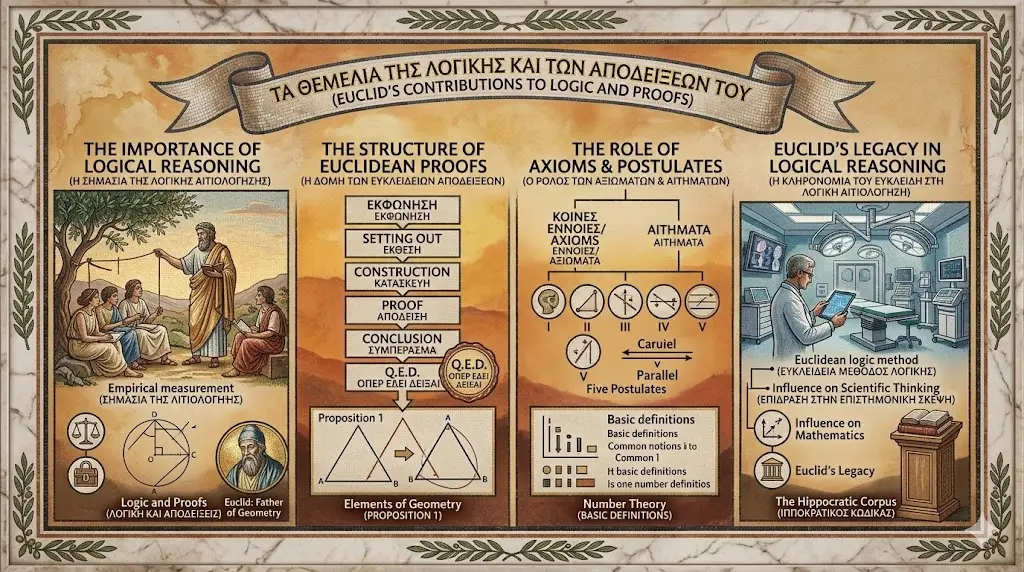
The brilliance of Euclid’s work lies in the architectural beauty of his arguments. Every one of the Euclid Elements geometry proofs follows a specific, repeatable structure that ensures no logical gaps are left open. This structure generally includes:
- Enunciation: Stating what is to be proved.
- Setting Out: Giving the specific points or lines to be used.
- Construction: Adding any necessary lines or circles to the diagram.
- Proof: The step-by-step logical deduction.
- Conclusion: Affirming that the original statement has been demonstrated.
This systematic approach is the reason Euclid: Father of Geometry is a title that encompasses more than just shapes. It represents the invention of the “Q.E.D.” (Quod Erat Demonstrandum)—the moment a mathematician can say, “That which was to be demonstrated has been shown.”
Logical Deduction in Euclid’s Elements
Within the pages of the Elements of Geometry, Euclid utilizes a “bottom-up” approach known as the Euclidean deduction system. He starts with the simplest possible ideas and uses them to build increasingly complex theorems. This is much like a ladder; you cannot reach the tenth rung without successfully stepping on the first nine.
For example, to prove that the interior angles of a triangle sum to two right angles, Euclid first had to prove the properties of parallel lines. This chain of causality is what makes his system so powerful. If you find a flaw in one link of the chain, the whole system might collapse. However, because Euclid’s Logic and Proofs were so meticulously constructed, his proofs have stood the test of time for over 2,000 years without being debunked.
The Role of Axioms and Postulates
At the base of any logical system, there must be a starting point—truths so simple they cannot be proven, only accepted. Euclid called these Postulates and Axioms. While “postulates” were specific to geometry (such as the ability to draw a line between any two points), “axioms” were general rules of logic applicable to all things (such as “the whole is greater than the part”).
The use of axioms and postulates in geometry allowed Euclid to avoid the trap of “infinite regress,” where you spend forever trying to prove your starting points. By clearly stating his assumptions at the beginning, he created a transparent and honest system. Anyone who agreed with his five basic postulates was logically bound to agree with all 465 of his subsequent theorems.
Influence on Scientific Thinking
The impact of Euclid’s Contributions to Logic and Proofs extends far beyond the classroom. It provided the template for the Scientific Revolution. When Isaac Newton wrote his Principia Mathematica, he modeled it directly after Euclid, using definitions and axioms to derive the laws of physics. Similarly, the philosopher Spinoza attempted to prove human ethics using a geometric style of deduction.
Even outside of the hard sciences, Euclid geometry reasoning influenced political thought. When Thomas Jefferson wrote the Declaration of Independence, he used Euclidean phrasing: “We hold these truths to be self-evident.” This is the language of an axiom. By framing political rights as self-evident truths from which all other laws are deduced, Jefferson was applying the same Influence on Mathematics and logic that Euclid pioneered in Alexandria.
Euclid’s Legacy in Logical Reasoning
The Euclid’s Legacy is essentially the legacy of Western rationalism. His method taught humanity that the world is intelligible and that human reason is capable of uncovering universal truths. Even when mathematicians discovered non-Euclidean geometries in the 19th century, they didn’t throw out Euclid’s method; they simply changed one of his postulates (the parallel postulate) and used his exact same logical system to see what new truths would emerge.
His work also reaches into the world of numbers. While many think of him only as a geometer, his work in Number Theory utilized the same rigorous proofs to explore prime numbers and divisibility. This proved that the laws of logic are universal across all branches of mathematics.
Why Euclid’s Logical System Was Revolutionary
Before Euclid, the history of mathematical proofs was a collection of “show-and-tell” demonstrations. A teacher might show a student a specific case and expect them to believe it applied to all cases. Euclid was revolutionary because he replaced “trust me” with “follow the logic.”
He introduced the idea of the “axiomatic system,” which is the gold standard for any intellectual discipline today. Whether you are studying law, computer science, or physics, you are looking for a set of core principles from which you can derive further knowledge. Euclid was the first to show that this was possible. He turned mathematics into a meritocracy of ideas; if your logic was sound, it didn’t matter if you were a king or a student—the truth was the same for everyone.
Frequently Asked Questions (FAQs)
What is the difference between a postulate and an axiom in Euclid’s system?
In Euclid’s time, an axiom was a “common notion” applicable to all sciences (like “if equals be added to equals, the wholes are equal”), while a postulate was a specific assumption required for geometry (like “all right angles are equal”).
Why is Euclid called the “Father of Geometry” if he didn’t discover all the theorems?
While many theorems were known before him, Euclid was the first to organize them into a single, logical system where every theorem was proven based on previous ones. He invented the “system,” not just the shapes.
How did Euclid’s logic influence modern computers?
Modern computer programming relies on “if-then” logic and algorithms. The Euclidean algorithm and his deductive method are early ancestors of the logical structures used in coding today.
Is Euclidean logic still used in schools?
Yes. High school geometry is often referred to as “Euclidean Geometry” because it still follows the basic postulates and deductive proofs laid out in the Elements.
Conclusion
Euclid’s Contributions to Logic and Proofs represent one of the greatest milestones in human history. He did not just give us a textbook; he gave us a way to think. By demonstrating that the human mind can reach across the void and grasp absolute, eternal truths through the power of deduction, he empowered every scientist and philosopher who followed him. From the construction of the Parthenon to the landing of the first man on the moon, the fingerprints of Euclid’s Legacy are everywhere. He taught us that the universe is not a place of chaos, but a place of order—an order that can be understood, step by logical step.