Introduction
While the name Euclid is synonymous with triangles and parallel lines, Euclid’s Work in Number Theory represents one of the most profound shifts in ancient Greek mathematics. Beyond the realm of physical shapes, Euclid sought to understand the hidden properties of integers—the “atoms” of mathematics. His exploration into divisibility, the nature of prime numbers, and the relationships between divisors laid a foundation that remains unshakable today. In his 13-book masterpiece, he demonstrated that the same Logic and Proofs used to solve geometric puzzles could be applied to the abstract world of numbers, forever changing how we perceive the numerical order of the universe.
Euclid and the Study of Numbers
To understand Euclid’s contributions, one must look toward Books VII, VIII, and IX of the Elements of Geometry. Despite the title, these books pivot away from points and planes to focus entirely on euclid number theory. During the era of ancient Greek mathematics, “number” referred strictly to positive integers greater than one. Euclid approached these numbers not as mere symbols for counting, but as lengths of line segments, allowing him to apply geometric intuition to arithmetic.
Euclid was not just a compiler; he was a rigorous logician. While he is famously known as Euclid: Father of Geometry, his work in Books VII–IX provided the first systematic treatment of divisibility theory and the properties of even and odd numbers. His goal was to move mathematics away from trial and error and toward a system where every property of a number could be proven through a chain of reasoning.
Euclid’s Definition of Prime Numbers
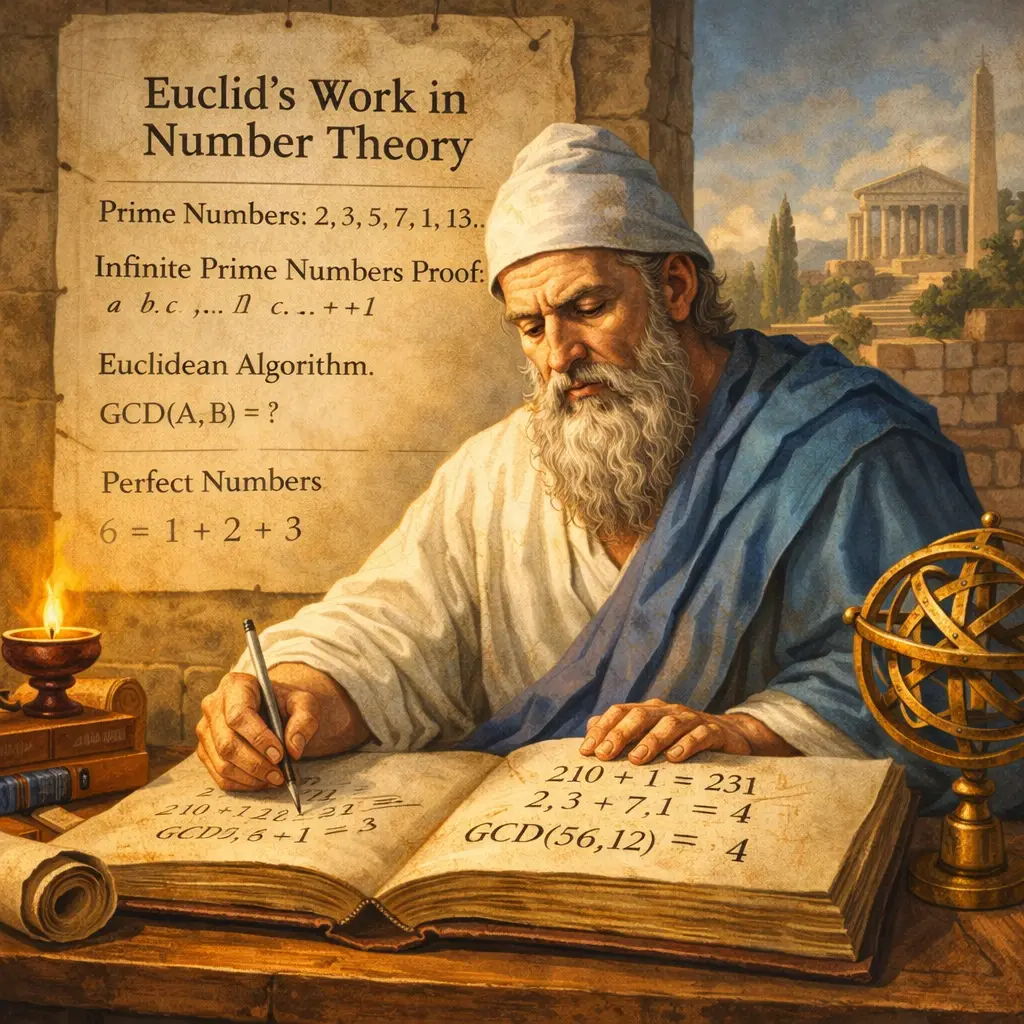
One of the most significant sections of Euclid’s Work in Number Theory involves his treatment of prime numbers. Euclid defined a prime number as that which is “measured by a unit alone.” In modern terms, a prime is a number greater than 1 that has no divisors other than 1 and itself. Within the prime numbers in euclid elements, he explored the concept of “relatively prime” numbers—sets of numbers that share no common factor other than 1.
His study of primes wasn’t just a matter of classification. He sought to understand how these numbers served as the building blocks for all other integers. This focus eventually led to what we now call the Fundamental Theorem of Arithmetic, which suggests that every composite number can be uniquely broken down into a product of primes.
Euclid’s Famous Proof: The Infinitude of Primes
Perhaps the crown jewel of euclid mathematics contributions is the euclid infinite primes proof found in Book IX, Proposition 20. Before Euclid, it was unclear if the sequence of prime numbers eventually ended. Using a brilliant “reductio ad absurdum” (proof by contradiction), Euclid demonstrated that no matter how large a list of primes you have, you can always find another.
The logic of the euclid prime numbers proof is elegant: suppose there is a finite list of primes. If you multiply them all together and add one, the resulting number is either prime itself or has a prime factor that was not on your original list. This simple yet undeniable logic proved that the “well” of prime numbers will never run dry. This proof is often cited as one of the most beautiful in the history of number theory.
Euclid’s Algorithm for the Greatest Common Divisor
Practicality meets theory in the famous Euclidean algorithm. Found in Book VII, this is the earliest known example of a step-by-step procedure—or algorithm—in mathematics. The euclidean algorithm explanation is centered on finding the Greatest Common Divisor (GCD) of two numbers.
Instead of listing every factor of both numbers, Euclid realized that the GCD of two numbers also divides their difference. By repeatedly replacing the larger number with the remainder of the smaller, one eventually reaches the largest possible common factor. This method is so efficient that it is still taught in computer science classes today to help encrypt data and secure the modern internet, proving that Euclid’s Legacy is alive in every digital transaction we make.
Perfect Numbers and Euclid’s Discoveries
Euclid also delved into the mystical and mathematical allure of “Perfect Numbers”—numbers whose proper divisors sum up to the number itself (such as 6, where 1+2+3=6). In Euclid’s Work in Number Theory, he discovered a specific formula for generating these rare gems.
He proved that if $2^n – 1$ is a prime number (what we now call a Mersenne prime), then $2^{n-1}(2^n – 1)$ is an even perfect number. This was a massive breakthrough in euclid mathematical discoveries, linking prime numbers to the concept of perfection. It took nearly two thousand years for Leonhard Euler to prove that this formula accounts for all even perfect numbers, showing just how far ahead of his time Euclid truly was.
Euclid’s Influence on Modern Mathematics
The Influence on Mathematics exerted by Euclid’s arithmetical books is nearly as vast as his geometry. His rigorous approach to divisibility and primality provided the tools for the giants of the 18th and 19th centuries, such as Fermat and Gauss. Today, euclid divisibility theory forms the backbone of cryptography.
When you enter your credit card information online, prime numbers—the very ones Euclid studied—are used to create secure keys. The same Postulates and Axioms that Euclid used to define the nature of numbers are the reasons our modern financial systems remain secure. He turned number theory from a hobby of philosophers into a powerful tool for civilization.
Frequently Asked Questions (FAQs)
What is Euclid’s most famous discovery in number theory?
His most famous contribution is the proof that there are infinitely many prime numbers, which remains one of the most elegant proofs in all of mathematics.
What is the Euclidean Algorithm used for?
It is a method used to find the Greatest Common Divisor (GCD) of two numbers. In modern times, it is essential for computer science and cryptography.
How does Euclid define a “prime number”?
In his “Elements,” he defines a prime number as a number measured only by a unit (the number 1).
What are “Perfect Numbers” in Euclid’s work?
Perfect numbers are integers equal to the sum of their divisors. Euclid discovered a formula to find even perfect numbers using Mersenne primes.
Conclusion
Euclid’s Work in Number Theory serves as a reminder that mathematics is a timeless language. Whether he was drawing lines in the sand or calculating the properties of primes, his commitment to absolute truth through logic remained the same. From the infinitude of primes to the efficiency of the Euclidean algorithm, his Euclid’s Legacy continues to shape how we understand the digital and physical worlds. He proved that numbers are not just symbols, but a structured reality that follows predictable, beautiful laws—laws that we are still uncovering more than two millennia later.