Introduction: The Dawn of AI Programming
The first AI programs marked the beginning of practical artificial intelligence. While Alan Turing artificial intelligence ideas and the Dartmouth Conference artificial intelligence set the theoretical stage, these early programs transformed imagination into executable experiments.
From solving mathematical problems to mimicking human conversation, the first AI programs paved the way for decades of AI research and innovation.
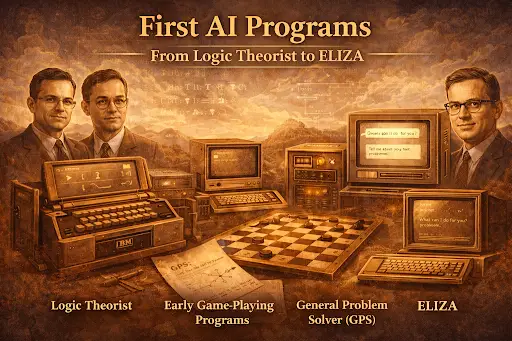
Logic Theorist: The First True AI Program
Developed in 1956 by Allen Newell and Herbert A. Simon, the Logic Theorist is widely regarded as the first AI program.
It was designed to prove mathematical theorems, simulating human problem-solving. This program demonstrated that machines could perform tasks requiring reasoning — an essential milestone in the history of artificial intelligence.
By applying formal logic, the Logic Theorist bridged the gap between theoretical AI concepts and practical programming.
Early Game-Playing Programs
Shortly after the Logic Theorist, researchers began experimenting with game-playing programs:
- Checkers programs (1951–1952): Christopher Strachey and Arthur Samuel developed programs that could play and improve at checkers.
- These programs introduced machine learning ideas by allowing machines to improve performance through repeated play.
Such experiments showed that AI could go beyond pure mathematics, engaging with real-world tasks.
General Problem Solver (GPS)
The General Problem Solver (GPS), created by Newell and Simon in 1957, aimed to simulate human problem-solving for a wide range of tasks.
- GPS was designed to solve problems using symbolic reasoning.
- It introduced structured AI approaches that influenced programming languages and machine intelligence development.
The GPS connected the theoretical ambitions of the Dartmouth Conference artificial intelligence with practical software experiments.
ELIZA: The First Conversational Program
In 1966, Joseph Weizenbaum developed ELIZA, an early chatbot capable of mimicking conversation:
- ELIZA used pattern matching to simulate human dialogue.
- The program demonstrated that computers could interact with humans in ways that seemed intelligent.
- Though not truly “thinking,” ELIZA inspired future work in natural language processing and conversational AI.
Impact of the First AI Programs
The first AI programs laid the foundation for modern artificial intelligence. Key impacts include:
- Moving AI from theory to practice
- Inspiring early AI experiments across mathematics, games, and language
- Influencing history of computers and programming languages development
- Establishing research patterns followed in later AI milestones
Without these programs, later breakthroughs in machine learning, neural networks, and robotics might have taken much longer to develop.
Frequently Asked Questions (FAQs)
1. What are considered the first AI programs?
The first AI programs include the Logic Theorist, early checkers programs, GPS, and ELIZA. They represent the earliest practical attempts at machine intelligence.
2. How did these programs influence AI research?
They demonstrated that machines could solve logical problems, play games, and simulate conversation, inspiring decades of AI research.
3. What is the connection between Turing and the first AI programs?
The programs built on Alan Turing artificial intelligence ideas, transforming theoretical concepts into executable experiments.
4. Were these programs truly intelligent?
No, they did not “think” like humans, but they simulated reasoning, problem-solving, and conversation — foundational steps in AI history.
5. How are the first AI programs linked to the Dartmouth Conference?
Many of these experiments were inspired by the 1956 Dartmouth Conference artificial intelligence, where AI research was formally launched.
Conclusion
The first AI programs represent the transition from imagination to reality. From the Logic Theorist to ELIZA, these pioneering AI projects set the stage for the modern AI systems we use today.
By understanding these early experiments, we see how early AI experiments, programming languages, and foundational research shaped the evolution of artificial intelligence.