Introduction
The History of Cloud Computing is a story of transformation—one that reshaped how organizations build, store, and access digital resources. What began as shared mainframe systems in the 1960s has evolved into global, on-demand infrastructure powering everything from mobile apps to artificial intelligence platforms.
Cloud computing did not appear overnight. It emerged gradually through advances in networking, virtualization, distributed systems, and internet expansion. To understand the evolution of cloud computing, we must trace its origins back to early computing models that emphasized resource sharing and centralized processing.
This chronological exploration follows the development of cloud computing from its earliest foundations to the modern multi-cloud and serverless era.
Early Foundations: Mainframes and Time-Sharing (1960s)
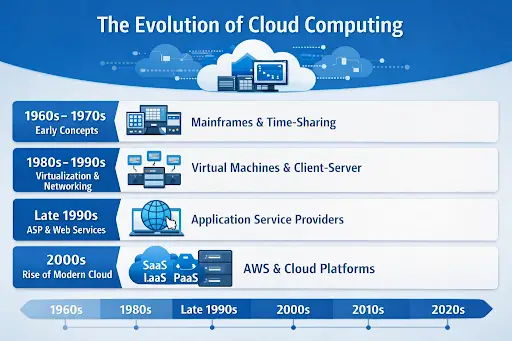
The roots of cloud computing can be traced to the 1960s, when computing resources were rare, expensive, and centralized. Organizations relied on massive mainframe computers housed in controlled environments. Access to these systems was limited, and users interacted through terminals.
One of the most important early concepts was time-sharing systems. Instead of dedicating a computer to one user at a time, time-sharing allowed multiple users to access a single machine simultaneously. Processing power was divided into small time slices, giving the illusion of individual access.
Computer scientist John McCarthy even suggested that computing could someday be organized as a public utility, similar to electricity or water. This early idea, often referred to as the utility computing model, laid philosophical groundwork for what would later become cloud computing.
These centralized systems established the first step toward shared computing infrastructure—an essential foundation in the history of cloud computing.
Virtualization Technology Emerges (1970s)
The 1970s introduced a technological breakthrough that would become central to cloud development: virtualization technology.
IBM pioneered the concept of virtual machines, enabling a single physical computer to run multiple isolated operating environments. Instead of dedicating hardware to one operating system, virtualization allowed better resource utilization and system efficiency.
This innovation solved a critical limitation of early computing—underused hardware. Virtualization allowed organizations to maximize computing resources, reducing costs and increasing flexibility.
Although virtualization remained largely enterprise-focused at this stage, it became one of the most significant milestones in the cloud computing timeline.
Distributed Computing and Networking Growth (1980s–1990s)
The 1980s and 1990s saw rapid development in networking and distributed computing systems. Client-server architecture became widespread, replacing purely centralized models.
As internet connectivity expanded, computing began to move beyond isolated data centers. Organizations connected machines across locations, creating distributed networks capable of sharing data and workloads.
During this era, concepts like grid computing and remote hosting services began to appear. Businesses experimented with outsourcing infrastructure management. The rise of web hosting services and application service providers (ASP) introduced early forms of hosted software delivery.
While these models were not yet “cloud computing” as we know it, they marked critical steps in the origins of cloud computing. The idea of remote infrastructure access was becoming normalized.
The Internet Revolution and ASP Model (Late 1990s)
The commercialization of the internet dramatically accelerated the development of cloud computing.
Application service providers began offering software hosted on external servers, accessible via web browsers. Instead of installing software locally, companies could subscribe to remotely managed applications.
This subscription-based model laid the groundwork for the later SaaS evolution. However, infrastructure at the time lacked scalability and elasticity. Data centers were still expensive to maintain, and automated provisioning was limited.
Nevertheless, the shift toward browser-based services signaled a fundamental change in how software could be delivered.
Birth of Modern Cloud Computing (2000–2006)
The early 2000s marked the true birth of modern cloud computing.
Salesforce, founded in 1999, popularized the software-as-a-service (SaaS) model by delivering CRM software entirely through the web. This proved that enterprise software could be managed remotely without on-premise installation.
The most transformative moment came in 2006 when Amazon launched Amazon Web Services (AWS). Initially developed to manage Amazon’s own infrastructure, AWS introduced Elastic Compute Cloud (EC2), allowing customers to rent virtual servers on demand.
This innovation revolutionized infrastructure access. Organizations no longer needed to purchase physical hardware. Instead, they could provision computing resources instantly and pay only for what they used.
The Amazon Web Services history is often considered the turning point in the history of cloud computing, as it formalized the infrastructure-as-a-service (IaaS) model.
The Rise of IaaS, PaaS, and SaaS
Following AWS, other technology giants entered the cloud space.
Microsoft launched Azure, and Google introduced Google Cloud Platform. These services expanded cloud offerings into three major service models:
- Infrastructure as a Service (IaaS)
- Platform as a Service (PaaS)
- Software as a Service (SaaS)
IaaS provided virtualized computing infrastructure.
PaaS offered development environments and tools for building applications.
SaaS delivered fully managed software applications.
This layered model defined the structure of modern cloud ecosystems. It also reshaped the development lifecycle, influencing practices later explored in the history of software engineering.
Cloud computing was no longer experimental—it became the standard approach for scalable infrastructure.
Enterprise Adoption and Data Center Evolution (2010s)
During the 2010s, enterprise cloud adoption accelerated rapidly.
Traditional data centers evolved into hyperscale environments capable of supporting millions of users worldwide. Businesses began migrating workloads from on-premise systems to cloud platforms for cost efficiency and scalability.
Virtualization matured, and containerization technologies like Docker and orchestration platforms such as Kubernetes enabled more flexible application deployment.
Cloud providers introduced advanced services including:
- Managed databases
- Machine learning platforms
- Content delivery networks
- Serverless computing
The development of cloud computing during this decade transformed IT operations. Companies embraced DevOps practices, automation, and continuous integration pipelines that relied heavily on cloud infrastructure.
The shift from capital expenditure to operational expenditure became a defining economic change in enterprise IT.
Hybrid and Multi-Cloud Era (Late 2010s–2020s)
As cloud adoption grew, organizations began adopting hybrid cloud models—combining on-premise systems with public cloud infrastructure.
Multi-cloud strategies also emerged, where businesses used services from multiple cloud providers to avoid vendor lock-in and improve resilience.
At the same time, edge computing gained importance, pushing processing closer to users to reduce latency.
Security and compliance became central concerns. Cloud security frameworks evolved to address new risks associated with distributed infrastructure.
Today, cloud computing powers streaming platforms, financial systems, healthcare applications, and global collaboration tools. It also provides the computational backbone for advances discussed in the history of artificial intelligence.
Modern Impact of Cloud Computing
The modern impact of cloud computing extends far beyond infrastructure management.
Cloud computing enables:
- Rapid application deployment
- Global scalability
- Cost-efficient startup ecosystems
- Remote collaboration
- AI and big data processing
- Disaster recovery and redundancy
It has fundamentally changed how organizations think about computing resources. Instead of purchasing hardware, companies now consume computing as a service.
The evolution of cloud computing also democratized innovation. Small startups can now access enterprise-grade infrastructure without massive upfront investment.
This transformation has influenced industries ranging from education to healthcare, finance, and entertainment.
Future Outlook of Cloud Computing
The future of cloud computing is closely tied to automation, artificial intelligence, and edge processing.
Emerging trends include:
- AI-driven infrastructure management
- Quantum cloud experimentation
- Increased serverless adoption
- Sustainable and energy-efficient data centers
- Enhanced zero-trust security models
Cloud computing will likely continue evolving toward greater decentralization and intelligent automation. As new technologies emerge, the foundational principles of shared infrastructure and on-demand scalability will remain central.
The history of cloud computing demonstrates that innovation in computing delivery models often builds upon earlier breakthroughs in networking, virtualization, and distributed systems.
FAQs
When did cloud computing start?
Cloud computing began conceptually in the 1960s with time-sharing systems and utility computing ideas, but modern cloud services emerged in the early 2000s.
Who invented cloud computing?
There is no single inventor. The concept evolved through contributions from researchers, IBM virtualization pioneers, and later companies like Amazon and Salesforce.
What was used before cloud computing?
Organizations relied on on-premise data centers, mainframes, and client-server models before adopting cloud infrastructure.
How did AWS change cloud computing?
AWS introduced scalable, on-demand infrastructure through EC2 in 2006, making cloud computing widely accessible and commercially viable.
What are the three main types of cloud computing?
The three main models are Infrastructure as a Service (IaaS), Platform as a Service (PaaS), and Software as a Service (SaaS).
Why is cloud computing important today?
It enables scalability, cost efficiency, remote collaboration, and supports modern technologies like AI and big data analytics.
Conclusion
The history of cloud computing reflects decades of innovation in shared infrastructure, virtualization, and internet-based services. From mainframes and time-sharing to hyperscale global platforms, cloud computing has reshaped the digital world. As technology continues to advance, cloud infrastructure will remain a central pillar of modern computing.