Introduction
The history of computer hardware is a fascinating journey of innovation, transformation, and technological progress. Computer hardware refers to the physical components of a computer system, including processors, memory devices, storage, and input/output equipment. These components work together to make modern computing possible.
Today, computers are small, fast, and powerful. However, this was not always the case. Early computers were extremely large, slow, and expensive. Over time, computer hardware evolved through several important stages, with each generation bringing major improvements in size, speed, efficiency, and reliability.
Understanding the evolution of computer hardware helps us appreciate modern technology and see how innovation has shaped the digital world we use today.
Early Mechanical Computing Devices
Before electronic computers existed, humans used mechanical devices to perform calculations. These early tools laid the foundation for modern computer hardware.
One of the earliest known computing devices was the Abacus, invented around 2500 years ago. It was used to perform basic arithmetic operations like addition and subtraction.
In the 17th century, mechanical calculators were developed. These machines used gears and wheels to perform mathematical calculations. For example, Blaise Pascal invented the Pascaline, which could add and subtract numbers automatically.
Although these devices were simple, they introduced the concept of automated calculation, which became essential for future computer hardware development.
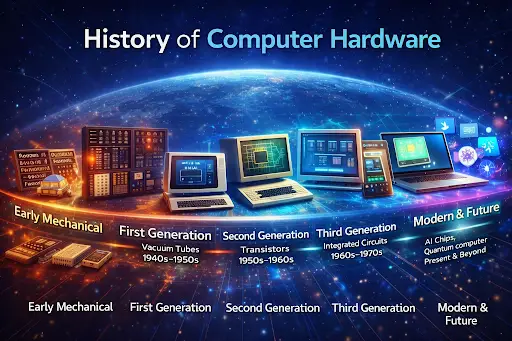
First Generation Computer Hardware (1940–1956)
The first generation of computer hardware marked the beginning of electronic computing. These computers used vacuum tubes as their main electronic components.
Vacuum tubes were large glass devices that controlled the flow of electricity. They allowed computers to perform calculations electronically instead of mechanically.
One of the most famous first-generation computers was ENIAC (Electronic Numerical Integrator and Computer), developed in 1945. It was extremely large, occupying an entire room and weighing several tons.
However, vacuum tube computers had many limitations:
- They generated excessive heat
- They consumed large amounts of electricity
- They were expensive to maintain
- They were unreliable and failed frequently
Despite these problems, vacuum tube computers played a crucial role in the history of computer hardware by proving that electronic computing was possible.
Second Generation Hardware: Transistors (1956–1963)
The invention of the transistor revolutionized computer hardware. Transistors replaced vacuum tubes and offered many advantages.
Transistors were:
- Smaller
- Faster
- More reliable
- More energy efficient
Because of their smaller size, computers became more compact and practical.
Second-generation computers were also faster and produced less heat. This made them more reliable and easier to maintain.
Transistors allowed computers to be used in businesses, universities, and government organizations. This marked an important step in making computers more widely available.
Third Generation Hardware: Integrated Circuits (1964–1971)
The next major advancement in computer hardware was the development of integrated circuits (ICs).
An integrated circuit is a small chip that contains multiple electronic components, such as transistors, on a single piece of silicon.
This innovation provided several major benefits:
- Increased proofreading speed
- Improved reliability
- Reduced size
- Lower cost
Computers became much smaller compared to previous generations. They were also more powerful and efficient.
Integrated circuits made it possible to develop more advanced computer systems and improved overall performance.
This generation played a key role in preparing the way for personal computers.
Fourth Generation Hardware: Microprocessors (1971–Present)
The invention of the microprocessor was one of the most important milestones in the evolution of computer hardware.
A microprocessor is a complete central processing unit (CPU) placed on a single chip.
This innovation allowed computers to become:
- Smaller
- Faster
- More affordable
- More powerful
Microprocessors made personal computers possible. Companies like Intel developed early microprocessors, which became the foundation of modern computing.
During this generation, personal computers became popular in homes, schools, and offices.
This period also saw the development of:
- Keyboards and monitors
- Hard drives
- Modern memory systems
Microprocessors continue to be the core component of modern computer hardware.
At the same time, computer hardware evolved alongside software innovations, including the development of programming systems, as explained in the history of programming languages.
Modern Computer Hardware
Today, computer hardware is more advanced than ever before.
Modern computers are:
- Extremely fast
- Compact
- Reliable
- Energy efficient
Examples of modern computer hardware include:
Personal Computers and Laptops
Modern laptops are lightweight and powerful. They can perform complex tasks such as video editing, programming, and gaming.
Smartphones
Smartphones are small but powerful computers that fit in your pocket. They include processors, memory, and storage similar to traditional computers.
Solid State Drives (SSD)
SSDs provide faster storage compared to traditional hard drives. They improve computer performance and reliability.
Graphics Processing Units (GPU)
GPUs help computers process images and videos quickly. They are essential for gaming, artificial intelligence, and video editing.
Artificial Intelligence Hardware
Special hardware is now designed specifically for artificial intelligence and machine learning tasks.
These components allow computers to process large amounts of data efficiently.
Fifth Generation and Future of Computer Hardware
The future of computer hardware is focused on advanced and intelligent technologies.
Some important future developments include:
Quantum Computing
Quantum computers use advanced technology to solve complex problems faster than traditional computers.
They have the potential to revolutionize computing.
Artificial Intelligence Chips
AI chips are designed to process artificial intelligence tasks more efficiently.
They are used in modern devices like smartphones and smart assistants.
Smaller and Faster Devices
Future computers will become even smaller, faster, and more powerful.
Technology continues to evolve rapidly.
Importance of Computer Hardware Evolution
The evolution of computer hardware has had a major impact on society.
It has made possible:
- Internet access
- Modern communication
- Online education
- Artificial intelligence
- Software development
Without hardware advancements, modern computing would not exist.
Each generation of hardware improved performance and made computers more accessible.
FAQs: History of Computer Hardware
What is computer hardware?
Computer hardware refers to the physical parts of a computer, such as the processor, memory, storage devices, keyboard, and monitor. These components work together to run software and perform tasks.
What was the first computer hardware?
The earliest computer hardware includes mechanical devices like the Abacus. However, the first electronic computer hardware was developed in the 1940s using vacuum tubes, such as the ENIAC computer.
What are the five generations of computer hardware?
The five generations are:
- First Generation: Vacuum tubes
- Second Generation: Transistors
- Third Generation: Integrated circuits
- Fourth Generation: Microprocessors
- Fifth Generation: Modern and AI-based hardware
Each generation improved speed, size, and performance.
Why are microprocessors important in computer hardware?
Microprocessors made computers smaller, faster, and more affordable. They allowed the development of personal computers, laptops, and modern digital devices.
What is the latest development in computer hardware?
The latest developments include AI chips, quantum computing, and advanced processors. These technologies are making computers more powerful and efficient.
Conclusion
The history of computer hardware shows how technology has evolved from simple mechanical devices to powerful modern machines.
Early computers used vacuum tubes and were large and inefficient. The invention of transistors made computers smaller and more reliable. Integrated circuits improved performance and reduced size. Microprocessors made personal computers possible.
Today, modern computer hardware is fast, compact, and powerful. Future innovations such as quantum computing and AI hardware will continue to transform technology.
Understanding the evolution of computer hardware helps us see how far computing has come and how it will continue to shape our future.