Introduction
The history of computer networking is a remarkable story of innovation, collaboration, and technological evolution. Networks allow computers to communicate, share data, and access resources across the globe. Today, networking powers the Internet, cloud computing, smart devices, and even artificial intelligence systems.
However, computer networking didn’t happen overnight. Its roots go back decades, beginning with simple experiments, then evolving into the ARPANET, and eventually becoming the modern Internet and global networks we use today. Understanding this history helps us appreciate the technologies that shape our connected world.
What is Computer Networking?
At its core, computer networking refers to the practice of connecting computers and other devices to share information. Networks can be as simple as two computers linked together or as vast as the global Internet. Networks rely on hardware, software, and standardized protocols like TCP/IP, allowing devices to communicate reliably.
Networking is essential for modern computing, enabling everything from email and online education to digital communication and smart home devices.
Early Precursors: Communication Before Networks
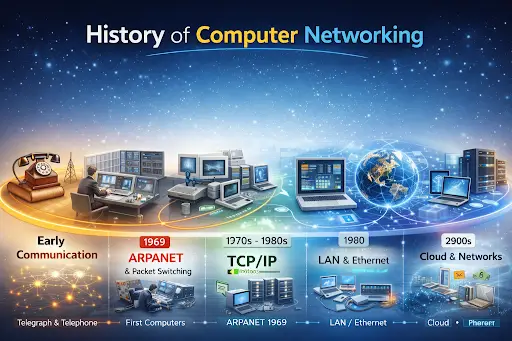
Before computers were networked, humans relied on communication technologies such as the telegraph, telephone, and radio systems. These innovations laid the conceptual groundwork for computer networking:
- Telegraph (1830s): Allowed messages to travel long distances using electrical signals.
- Telephone (1870s): Made real-time voice communication possible, inspiring data transfer ideas.
- Early Computer Experiments (1950s): Systems like SAGE (Semi-Automatic Ground Environment) used computers to process data from radar and military equipment, hinting at the potential of networked machines.
These early tools demonstrated that sharing information electronically was possible — a key idea for computer networking.
First Computer Networks
The first attempts at networking computers began in the late 1950s and 1960s. Researchers sought ways to connect computers to exchange data efficiently:
- SAGE Network: Connected multiple computers for military defense applications.
- ARPANET Predecessors: Universities and research labs experimented with connecting machines to share computing power.
These early networks were small and limited but proved that computers could communicate across distances, setting the stage for more sophisticated systems.
ARPANET and Packet Switching (1969)
The ARPANET is considered the true beginning of modern computer networking. Developed by the U.S. Department of Defense in 1969, ARPANET connected four universities in the United States. Its design introduced a revolutionary concept: packet switching.
What is Packet Switching?
Packet switching breaks down messages into small packets, sends them across multiple paths, and reassembles them at the destination. This method was more efficient than older circuit-switched communication and became the backbone of modern networks.
ARPANET demonstrated that computers could reliably communicate over long distances, and it became the foundation for the Internet.
The development of networking closely relates to the History of the Internet, which expanded ARPANET into the global system we use today.
Network Protocols: TCP/IP (1970s–1980s)
A critical milestone in networking history was the development of TCP/IP protocols. Introduced in the 1970s and adopted broadly in 1983:
- TCP (Transmission Control Protocol): Ensures reliable transmission of data.
- IP (Internet Protocol): Directs data packets to their correct destination.
TCP/IP allowed networks of different types and technologies to connect seamlessly. It is the standard protocol of the Internet today and remains fundamental to all modern computer networks.
Expansion: LAN, Ethernet, and Wireless Networks
As technology progressed, networks expanded beyond research labs:
Local Area Networks (LANs)
- Developed in the late 1970s and early 1980s.
- Connected computers within offices, schools, and universities.
- Allowed file sharing, printing, and centralized storage.
Ethernet
- Invented by Robert Metcalfe in 1973.
- Became the standard technology for LANs.
- Provided faster data transfer and reliability.
Wireless Networking
- Wi-Fi (1990s onward) enabled devices to connect without cables.
- Smartphones, laptops, and smart home devices benefit from wireless networking.
Hardware developments like History of Computer Hardware played a vital role in supporting these networks.
Modern Networking and the Internet
Modern computer networks are more complex and interconnected than ever:
- Global Internet: Connects billions of devices worldwide.
- Cloud Computing: Networks enable remote access to storage and computing power.
- Data Centers: Support large-scale applications and services.
- AI and IoT Devices: Rely on networked systems for real-time processing.
From early research experiments to today’s global networks, computer networking continues to evolve, enabling communication, business, education, and entertainment at an unprecedented scale.
FAQs: History of Computer Networking
1. What is computer networking?
Computer networking is the practice of connecting computers and devices to share information, resources, and data across networks such as LAN, WAN, or the Internet.
2. What was the first computer network?
The first operational computer network was ARPANET, developed in 1969. It introduced packet switching, connecting research universities in the United States.
3. What is packet switching?
Packet switching is a method of sending data in small packets through a network, allowing efficient and reliable communication. It is the foundation of the Internet.
4. Why is TCP/IP important?
TCP/IP protocols standardize data transmission and addressing, allowing different networks to communicate seamlessly. They are essential for the Internet.
5. How did computer networking evolve into the Internet?
Networking grew from ARPANET to academic and government networks, then adopted TCP/IP. LANs, Ethernet, and wireless networking expanded connectivity, eventually forming today’s global Internet.
Conclusion
The history of computer networking shows how innovation, collaboration, and technology transformed the way computers communicate. Early experiments with communication devices laid the groundwork, while ARPANET and TCP/IP established modern networking principles.
Networking expanded from local office connections to global Internet infrastructure, powering modern computing, cloud services, and AI systems. Understanding this history provides insight into the importance of networks and their impact on daily life.