Databases are essential to modern computing, helping organize, store, and retrieve information efficiently. They power applications, websites, artificial intelligence, and cloud computing. Understanding the history of databases gives insight into how these systems evolved from simple storage to modern, complex solutions.
Early Data Storage: Before Databases
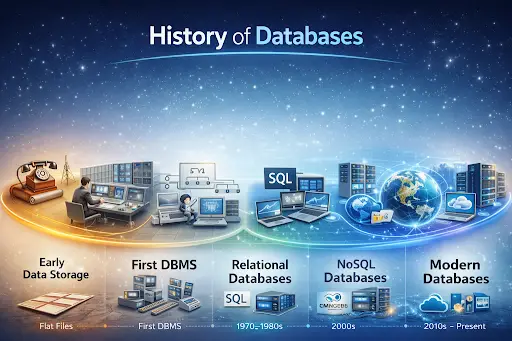
Before formal databases existed, computers stored information in flat files. These files lacked structure, making data retrieval slow and prone to errors. Organizations struggled with redundancy and inefficiency, which highlighted the need for better systems.
By the 1960s, innovators began creating database management systems (DBMS) to organize and manage data more systematically, paving the way for future technological advancements.
The First Database Management Systems (1960s–1970s)
Early DBMS aimed to improve data organization and efficiency. Two main models emerged:
- Hierarchical Databases: Data stored in tree-like structures. IBM’s IMS (Information Management System) was a key example.
- Network Databases: Allowed multiple relationships between data, enabling complex queries. Systems like IDMS became popular in large enterprises.
These DBMS were used primarily in government and large organizations because they required mainframes and expert operators.
The Relational Revolution: SQL and Structured Data (1970s–1980s)
A major milestone in database history occurred in 1970 when Edgar F. Codd introduced the relational database model. Unlike hierarchical systems, relational databases store data in tables, making it easier to retrieve and manage information efficiently.
SQL (Structured Query Language) was developed to interact with these databases. Commercial RDBMS like Oracle, IBM DB2, and Microsoft SQL Server transformed business operations, making database management more accessible and scalable.
Natural anchor text: The relational database model also closely complements the evolution of programming languages, enabling developers to build more complex software applications.
The Rise of NoSQL Databases (2000s)
As the internet expanded, relational databases faced limitations with unstructured and large-scale data. This led to the emergence of NoSQL databases, designed for flexibility, scalability, and performance.
Popular NoSQL systems like MongoDB, Cassandra, and Redis allow businesses to manage massive datasets, cloud applications, and distributed systems effectively.
Another anchor: Companies leveraging computer networking often rely on NoSQL databases to store distributed data efficiently.
Modern Databases: Cloud, AI, and Real-Time Processing
Modern databases have evolved beyond servers to the cloud, allowing remote access, high scalability, and enhanced security. Key developments include:
- Cloud Databases: Amazon RDS, Google Cloud Spanner
- AI-Powered Databases: Automated optimization, predictive analytics
- Real-Time Databases: Firebase and other instant-access systems
These systems support everything from e-commerce platforms to AI applications, making databases central to technological advancement.
Impact of Databases on Technology
The evolution of databases has transformed technology by enabling:
- Faster, reliable data storage
- Efficient business operations
- Advanced analytics for AI and machine learning
- Cloud computing and distributed applications
Without databases, modern computing, networking, and AI systems would not function as efficiently.
FAQs: History of Databases
(Place after Modern Databases section)
Where did databases originate?
Databases evolved from simple file storage in the 1960s to structured hierarchical and network systems to improve data management.
Who proposed the relational database model?
Edgar F. Codd proposed the relational model in 1970, revolutionizing how data was stored and accessed using SQL.
What is the difference between SQL and NoSQL?
SQL databases are structured and use tables with fixed schemas, while NoSQL databases are flexible, scalable, and handle unstructured or large-scale data.
Why are modern databases cloud-based?
Cloud databases provide scalability, remote access, high availability, and cost efficiency, which traditional on-premise systems cannot easily offer.
How have databases impacted AI and analytics?
Modern databases enable AI systems to process massive datasets efficiently, powering predictive analytics, recommendation engines, and automation.
Conclusion
The history of databases reflects a journey from primitive storage to modern, cloud-powered, AI-ready systems. Each milestone—hierarchical and network DBMS, relational databases, NoSQL solutions, and modern cloud databases—has reshaped how technology stores and processes data. Understanding this evolution highlights the central role databases play in software, AI, and cloud systems today.