
Introduction
The History of DevOps represents one of the most significant shifts in modern software development and IT operations. DevOps emerged as a response to growing challenges in software delivery, where development teams and operations teams often worked in isolation. This separation created delays, inefficiencies, and frequent system failures when new software was deployed.
As digital systems became more complex and organizations began relying heavily on online services, businesses needed faster and more reliable ways to deliver software updates. DevOps introduced a new culture that emphasized collaboration, automation, and continuous improvement across the entire software lifecycle.
Today, DevOps practices support rapid innovation across industries. From small startups to global enterprises, organizations rely on DevOps to deliver applications faster while maintaining system stability and security. Understanding the history of DevOps helps explain how modern software delivery evolved from traditional development practices.
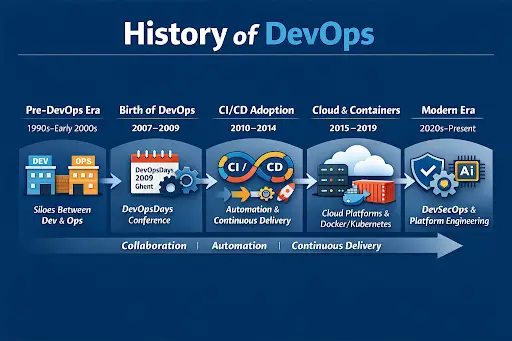
The Pre-DevOps Era: Development and Operations Divide (1990s–Early 2000s)
Before DevOps existed, software development and IT operations functioned as separate departments with very different priorities. Development teams focused on creating new features and releasing software quickly. Operations teams, on the other hand, were responsible for maintaining system stability and minimizing disruptions.
This separation often created what engineers described as the “wall of confusion.” Developers would write code and hand it off to operations teams for deployment, but operations teams often lacked insight into how the software worked. As a result, deployments frequently caused unexpected issues.
The rapid growth of the internet and distributed systems made these challenges even more complicated. Applications began running across multiple servers and networks, requiring careful coordination between development and infrastructure management.
These early challenges were closely related to broader infrastructure changes discussed in the history of computer networking, where interconnected systems introduced both opportunities and complexity for software deployment.
During this period, organizations began searching for better ways to integrate development and operations responsibilities.
Agile Development and the Foundations of DevOps (Early 2000s)
One of the most important influences on DevOps was the Agile software development movement, which emerged in the early 2000s. Agile encouraged teams to deliver software in small, iterative improvements rather than long development cycles.
Agile methodologies promoted collaboration, flexibility, and continuous feedback between team members. However, while Agile improved the development process, many organizations still struggled with slow and risky software deployments.
Even when development teams produced working code quickly, releasing that code into production environments often took weeks or months. The gap between development speed and deployment capability highlighted the need for a more integrated approach.
This challenge led engineers and IT professionals to explore automation tools, configuration management systems, and continuous integration practices that could streamline software delivery.
These ideas eventually formed the foundation of the DevOps movement.
The Birth of the DevOps Movement (2007–2009)
The modern DevOps movement began gaining momentum around 2007 when software engineers began publicly discussing the need to bridge the gap between development and operations.
A key turning point occurred in 2009 during the Velocity Conference, where engineers from Flickr presented a case study describing how they were deploying software more than ten times per day. Their success demonstrated that rapid deployments could be both safe and efficient when supported by automation and collaboration.
That same year, the first DevOpsDays conference was organized in Ghent, Belgium by Patrick Debois. The event brought together developers and operations professionals to discuss shared challenges and solutions.
The term “DevOps” quickly gained popularity as a way to describe this new collaborative approach to software delivery. Instead of treating development and operations as separate responsibilities, DevOps encouraged teams to work together throughout the entire software lifecycle.
This cultural shift was as important as the technology behind it. DevOps emphasized shared responsibility, open communication, and continuous learning.
Continuous Integration and Continuous Delivery (2010–2014)
After the DevOps movement gained visibility, organizations began adopting new technical practices to support faster and more reliable deployments.
One of the most influential practices was continuous integration (CI). CI allows developers to merge code changes into a shared repository frequently, where automated tests verify that the new code works correctly.
Continuous integration helped teams detect problems earlier in the development process. Instead of discovering issues during large releases, teams could identify and fix problems immediately.
Another key practice was continuous delivery (CD). Continuous delivery extends CI by automatically preparing software for release, ensuring that applications can be deployed to production environments at any time.
These practices allowed teams to deliver smaller updates more frequently while reducing the risk of large system failures. Automation tools, testing frameworks, and configuration management systems became essential components of DevOps workflows.
Cloud Computing and DevOps Expansion (2015–2019)
The rise of cloud computing significantly accelerated the adoption of DevOps practices. Cloud platforms allowed organizations to provision infrastructure instantly, eliminating many of the delays associated with traditional hardware management.
Instead of manually configuring servers, engineers could automate infrastructure using code. This concept, known as Infrastructure as Code (IaC), allowed teams to create and manage entire environments through automated scripts.
Cloud platforms also introduced scalable deployment pipelines that supported continuous integration and continuous delivery.
The relationship between cloud platforms and DevOps practices became increasingly strong, particularly as organizations adopted technologies described in the history of cloud computing.
During this period, containerization technologies such as Docker and orchestration platforms like Kubernetes transformed how applications were deployed. Containers allowed applications to run consistently across different environments, making automated deployments easier and more reliable.
These innovations helped DevOps become a mainstream approach to software development and IT operations.
Modern DevOps and Platform Engineering (2020s)
By the 2020s, DevOps had evolved into a mature discipline used by organizations worldwide. Many companies built specialized DevOps teams responsible for designing deployment pipelines, monitoring systems, and automation frameworks.
Another emerging concept during this era is platform engineering, which focuses on creating internal developer platforms that simplify software deployment for engineering teams.
At the same time, security considerations became more integrated into DevOps practices. This approach, often called DevSecOps, emphasizes building security into every stage of the development process rather than treating it as a separate step.
Automation, monitoring, and observability tools now allow teams to track application performance and detect issues in real time. These systems provide valuable insights that help organizations maintain reliable services while continuing to innovate rapidly.
Modern Impact of DevOps
DevOps has dramatically transformed how organizations develop and operate software systems. By breaking down barriers between development and operations teams, DevOps enables faster software releases while maintaining system reliability.
Key benefits of DevOps include:
- faster application delivery
- improved collaboration between teams
- automated testing and deployment
- increased system reliability
- faster response to incidents
Many companies now release software updates multiple times per day, a practice that would have been nearly impossible before DevOps practices became widespread.
DevOps also supports innovation by allowing organizations to experiment with new features and improvements without risking system stability.
As digital services continue expanding across industries, DevOps will remain a critical component of modern technology infrastructure.
Future Outlook of DevOps
The future of DevOps will likely focus on further automation, artificial intelligence, and improved developer productivity.
AI-powered monitoring tools are already helping teams detect system anomalies and predict potential failures before they occur. Machine learning systems can analyze vast amounts of operational data to identify patterns and recommend improvements.
Another growing trend is the use of GitOps, where infrastructure and application configurations are managed through version-controlled repositories. This approach increases transparency and simplifies system management.
Security integration will also continue to evolve through DevSecOps practices, ensuring that security testing becomes a natural part of automated deployment pipelines.
As organizations continue adopting cloud-native architectures and distributed systems, DevOps will remain essential for managing complex digital environments.
Frequently Asked Questions (FAQs)
What is the history of DevOps?
The history of DevOps began in the late 2000s when engineers sought better collaboration between software development and IT operations teams. The movement gained momentum after the first DevOpsDays conference in 2009.
Who created DevOps?
The DevOps movement was popularized by Patrick Debois, who organized the first DevOpsDays conference in 2009. However, the concept evolved through contributions from many engineers and organizations.
Why was DevOps created?
DevOps was created to solve communication and efficiency problems between development and operations teams, allowing organizations to deliver software faster and more reliably.
How is DevOps different from Agile?
Agile focuses mainly on improving software development practices, while DevOps extends collaboration to include operations, deployment, and infrastructure management.
What technologies support DevOps?
Common DevOps technologies include continuous integration tools, automated deployment pipelines, containerization platforms like Docker, orchestration systems such as Kubernetes, and infrastructure automation tools.
Conclusion
The History of DevOps illustrates how software delivery evolved from slow, isolated development processes into collaborative and automated workflows. By integrating development, operations, and automation, DevOps has enabled organizations to release software faster while maintaining reliability and stability. As technology continues advancing and digital services expand, DevOps will remain a central practice shaping the future of software engineering and IT infrastructure.