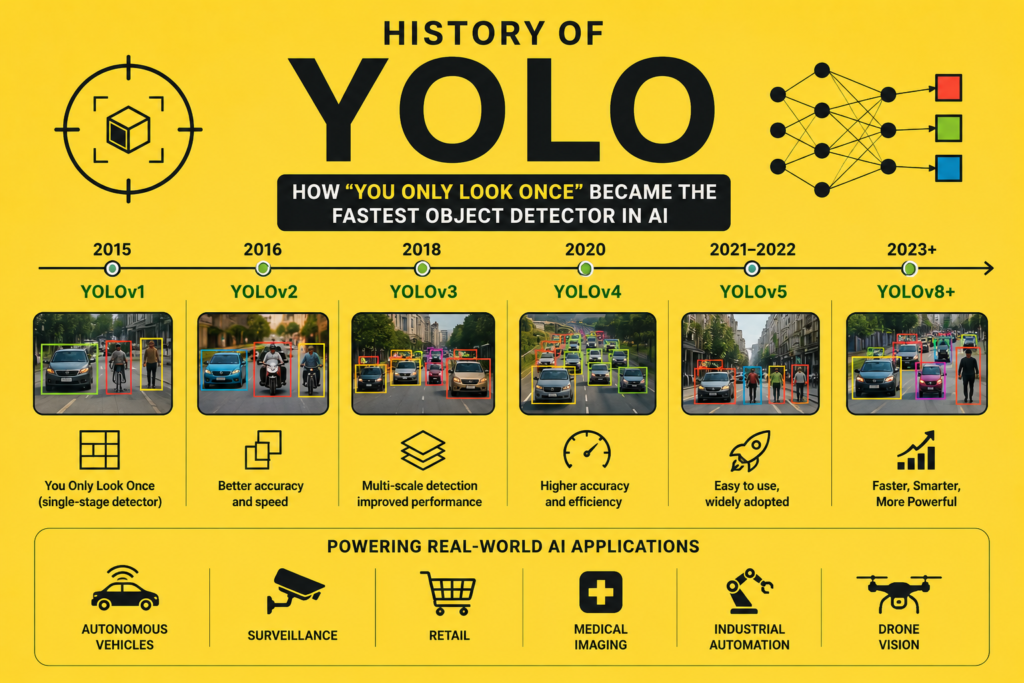
Few algorithms in the history of artificial intelligence have had a name as memorable as their impact. The history of yolo is the story of how a simple idea, look at the entire image only once, turned object detection from a slow, multi-stage process into something that could run in real time on ordinary hardware. From its first appearance in 2015 to the latest versions maintained today, YOLO has remained one of the most widely used, most actively developed, and most influential object detection architectures ever created. This article covers that entire journey, including the people behind it, the technical ideas that made it work, and the long line of versions that followed.
The Problem YOLO Was Designed to Solve
Before YOLO, the dominant approach to object detection involved multiple separate stages. A system would first propose regions of an image that might contain objects, then run a classifier on each of those regions separately to decide what, if anything, was there. The history of R-CNN, which began in 2013, exemplified this approach, and while it produced accurate results, it was slow, often taking seconds to process a single image.
This multi-stage design made real-time object detection essentially impossible for most applications. Robotics, video analysis, and any application that needed to process live camera feeds at usable frame rates were largely out of reach for these region-proposal-based systems. The field needed a fundamentally different approach, one that did not treat detection as a sequence of separate steps applied to many candidate regions.
Joseph Redmon and the Birth of YOLO (2015)
The history of yolo begins with Joseph Redmon You Only Look Once history, when Redmon, then a graduate student, along with collaborators including Santosh Divvala, Ross Girshick, and Ali Farhadi, published the original YOLO paper in 2015. The YOLO architecture development paper 2015 proposed something radical for its time: treat object detection as a single regression problem, predicting bounding boxes and class probabilities directly from the full image in one pass.
This single-pass inference approach was the defining innovation of YOLO. Rather than generating thousands of candidate regions and classifying each one separately, YOLO divided the input image into a grid and had the network predict, for each grid cell, whether an object’s center fell within that cell, what the bounding box for that object looked like, and what class the object belonged to, all in a single forward pass through the network.
Grid cell prediction meant that the entire image was processed simultaneously, with each cell responsible for detecting objects whose center fell within it. This design allowed YOLO to run dramatically faster than region-proposal-based methods, often achieving real-time frame rates (FPS) that made it practical for video applications for the first time.
How the Original YOLO Worked
The original YOLO architecture divided an input image into a grid, commonly 7 by 7 cells. For each cell, the network predicted a fixed number of bounding boxes, along with confidence score thresholds indicating how likely it was that a given box actually contained an object and how accurate the box’s location was likely to be. Each cell also predicted class probabilities, indicating what type of object was most likely present.
Because multiple grid cells and multiple predicted boxes could end up detecting the same object, Non-Maximum Suppression (NMS) was applied as a post-processing step. NMS worked by keeping only the highest-confidence bounding box for each detected object and removing other boxes that overlapped significantly with it, ensuring that each object was reported only once in the final output.
The network was trained using a joint optimization loss function that combined errors related to bounding box location, object confidence, and class prediction into a single value that the network could be trained to minimize through standard backpropagation. This unified loss function reflected the core philosophy of YOLO: rather than training separate components for separate subtasks, train one network to do everything at once.
The original YOLO was significantly faster than the history of R-CNN family of detectors, though it initially traded some accuracy for this speed, particularly struggling with small objects and objects that appeared close together.
YOLOv2 and YOLOv3: Closing the Accuracy Gap (2016 – 2018)
The Evolution of YOLO object detection models continued quickly after the initial release. YOLOv2, released in 2016, introduced anchor boxes in object detection, a concept that had also been used in the history of Faster R-CNN, allowing the network to predict bounding boxes relative to a set of predefined box shapes rather than predicting box dimensions from scratch. This made it easier for the network to learn to detect objects of varying shapes and sizes.
YOLOv2 also introduced batch normalization throughout the network and used a more efficient backbone architecture, improving both accuracy and training stability. The Darknet framework historical background is closely tied to this period, as Darknet, an open source neural network framework written by Redmon, served as the foundation for training and running the early YOLO versions, giving researchers and developers a lightweight, dependency-free way to experiment with the architecture.
YOLOv3, released in 2018, made further improvements, including predictions at multiple scales, allowing the network to detect both large and small objects more effectively, and a more powerful backbone network. By this point, the YOLO vs R-CNN vs SSD comparison had become a standard topic in computer vision discussions, with YOLO consistently representing the fastest option, the Single Shot Detector (SSD) offering a middle ground, and R-CNN variants like Faster R-CNN representing the more accurate but slower end of the spectrum.
A Turning Point: New Maintainers and Rapid Iteration (2018 – 2021)
The Transition of YOLO maintainers history marks an important shift in how YOLO development proceeded. After YOLOv3, Joseph Redmon stepped away from active development of the project, citing concerns about potential military and surveillance applications of the technology, a notable moment reflecting the broader facial recognition and privacy and surveillance technology debates affecting computer vision as a whole.
Despite this, the YOLO name and architecture continued to evolve rapidly, with multiple independent teams and companies releasing their own versions. YOLOv4, released in 2020 by a different team of researchers, incorporated numerous architectural improvements and training techniques that had been developed across the broader object detection research community, including mosaic data augmentation, a technique that combines multiple training images into a single composite image, helping the network learn to detect objects in varied contexts and at different scales.
YOLOv5, released shortly after by Ultralytics, represented a significant moment in Ultralytics development history. Implemented in PyTorch rather than the original Darknet framework, YOLOv5 made the architecture significantly more accessible to the broader machine learning community, who were increasingly standardized around PyTorch for research and deployment. YOLOv5 quickly became one of the most widely deployed object detection models in the world, used across industries including computer vision in manufacturing, computer vision in sports, and drones and computer vision.
YOLOv6 Through YOLOv8: Refinement and Expansion (2022 – 2023)
The Timeline of YOLO speed and accuracy breakthroughs continued through YOLOv6, YOLOv7, and YOLOv8, each released within a relatively short span and each incorporating refinements to the network architecture, training procedures, and loss functions.
Complete Intersection over Union (CIOU), an improved metric for measuring how well a predicted bounding box matches the actual location of an object, became standard in the loss functions used by these later versions, providing more precise training signals than earlier overlap metrics. Decoupled heads profile, an architectural change separating the network components responsible for classification from those responsible for bounding box regression, also became common, reflecting research findings that these two subtasks benefited from somewhat different network structures.
YOLOv8, released by Ultralytics in 2023, introduced support not just for object detection but also for image segmentation and pose estimation tasks within the same framework, reflecting a broader trend in the history of image segmentation and the history of pose estimation toward unified architectures capable of handling multiple related visual tasks.
YOLOv9, YOLOv10, and YOLOv11: The Anchor Free Era (2023 – 2025)
History of anchor free YOLO variants represents one of the most significant architectural shifts in the recent history of yolo. While early versions of YOLO relied heavily on anchor boxes in object detection to predict bounding boxes relative to predefined shapes, later versions moved toward anchor free designs, where the network directly predicts object locations without relying on a predefined set of box shapes.
This shift simplified the architecture in some respects while improving performance on objects with unusual aspect ratios that did not fit well with predefined anchor shapes. YOLOv9 and YOLOv10 continued this trend, along with further improvements to training efficiency and inference speed, often achieving real time frame rates (FPS) on increasingly resource-constrained devices, including smartphones and embedded systems.
YOLOv11, released in 2024, continued the pattern of incremental architectural refinement combined with improved training techniques, maintaining YOLO’s position as one of the fastest and most widely used object detection architectures, particularly for applications requiring deployment on edge devices rather than powerful cloud servers.
YOLO’s Role in the Broader History of Object Detection
The history of yolo cannot be fully understood in isolation from the broader history of object detection. While the R-CNN family of architectures, including the history of Faster R-CNN, prioritized accuracy and influenced how the field thought about region proposals and feature extraction, YOLO prioritized speed and influenced how the field thought about end-to-end, single-pass architectures.
This influence extended well beyond YOLO itself. The single shot detector (SSD), developed around the same time as early YOLO versions, shared the core philosophy of single-pass prediction, and the broader YOLO vs R-CNN vs SSD comparison became a standard framework for understanding the tradeoffs between speed and accuracy in object detection research.
YOLO’s emphasis on real-time performance also made it the architecture of choice for applications where speed was non-negotiable. Self-driving cars and computer vision systems, drones and computer vision applications, and computer vision in sports analysis all benefited enormously from an object detection architecture fast enough to process video streams in real time rather than analyzing frames after the fact.
Frequently Asked Questions
Who created YOLO?
YOLO was created by Joseph Redmon, along with collaborators including Santosh Divvala, Ross Girshick, and Ali Farhadi, who published the original YOLO paper in 2015. After the third version, Redmon stepped away from active development, and subsequent versions were developed by various research teams and companies, most notably Ultralytics.
What does YOLO stand for and what does it mean?
YOLO stands for “You Only Look Once,” referring to its core innovation of processing an entire image in a single pass to predict all bounding boxes and class labels at once, rather than examining many candidate regions separately as earlier object detection methods did.
How has YOLO changed since the original version?
YOLO has gone through many versions, from YOLOv1 in 2015 to YOLOv11 and beyond. Major changes include the introduction and later removal of anchor boxes, improved loss functions like CIOU, multi-scale predictions for detecting objects of different sizes, support for additional tasks like segmentation and pose estimation, and a transition from the original Darknet framework to PyTorch-based implementations under Ultralytics.
Is YOLO faster than R-CNN and SSD?
Generally, yes. In the YOLO vs R-CNN vs SSD comparison, YOLO has consistently been among the fastest object detection architectures, often achieving real time frame rates on standard hardware. R-CNN and its variants, including Faster R-CNN, tend to be more accurate in certain scenarios but significantly slower, while SSD occupies a middle ground between the two.
What applications commonly use YOLO?
YOLO is widely used in applications requiring real-time object detection, including self-driving cars and computer vision systems, video surveillance and surveillance technology, drones and computer vision for agriculture and inspection, computer vision in manufacturing for quality control, and computer vision in sports for tracking players and equipment during live broadcasts.
Conclusion
The history of yolo is a story about how a single architectural idea, processing an entire image in one pass rather than many, reshaped an entire subfield of computer vision. From Joseph Redmon’s original 2015 paper through more than a decade of rapid iteration by multiple teams, YOLO has remained at the forefront of real-time object detection, continually balancing speed and accuracy in ways that have made it practical for an enormous range of real-world applications.
Every modern system relying on computer vision technology for real-time detection, from autonomous vehicles to smart cameras to industrial inspection systems, has likely been influenced, directly or indirectly, by the architecture YOLO pioneered. Understanding the history of yolo is understanding how speed became just as important as accuracy in the evolution of computer vision.