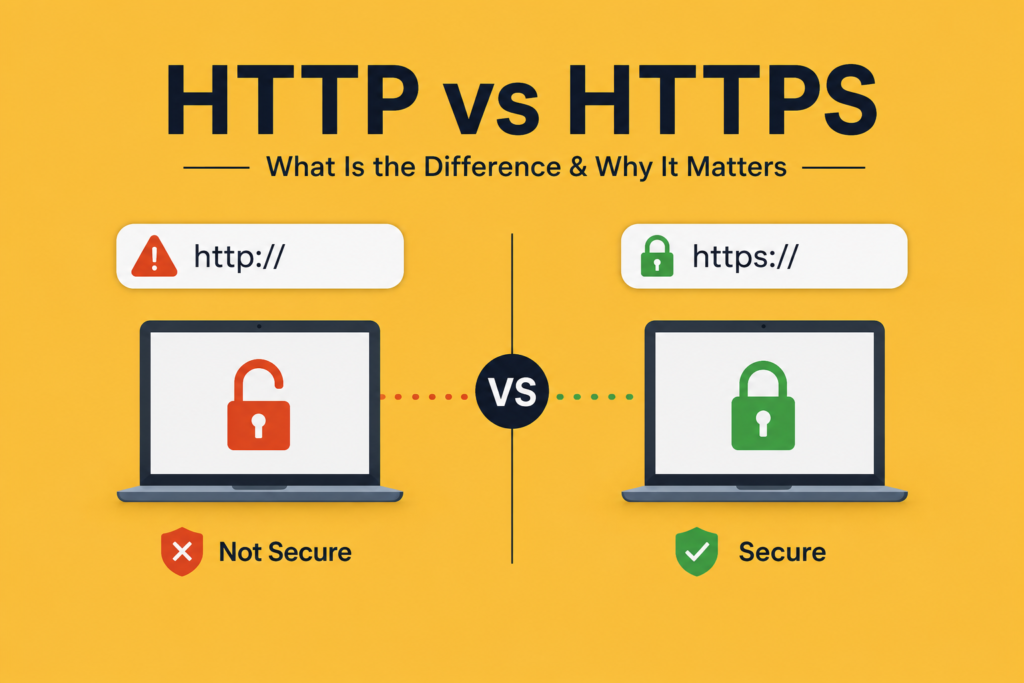
Whenever you visit a website, a small but powerful detail in your browser’s address bar reveals a great deal about your security, and understanding http vs https helps explain exactly why. Many users notice the small padlock icon appearing next to certain web addresses, yet few understand what it truly represents or why it matters so much for everyday internet safety.
Understanding http vs https is essential in today’s digital world, where data privacy and secure browsing have become increasingly important. This article breaks down http vs https clearly, covering how each protocol works, their key differences and why HTTPS has become the standard for modern websites.
What Is HTTP in Simple Terms
To properly understand http vs https, it helps to start with HTTP itself. Hyper Text Transfer Protocol, commonly known as HTTP, is the foundational protocol used to transfer data between a web browser and a server. When you visit a website using HTTP, your browser sends a request, and the server responds with the requested content.
However, HTTP transmits data in cleartext transmission, meaning information travels across the network without any encryption. This makes HTTP connections vulnerable to interception, since anyone monitoring network traffic could potentially view sensitive information being exchanged between your browser and the website.
What Is HTTPS and How It Improves Security
The key difference within http vs https comes down to one critical addition. Hyper text transfer protocol secure, or HTTPS, includes an extra layer of encryption that protects data as it travels between your browser and a website’s server. This encryption transforms readable information into ciphertext, making it extremely difficult for unauthorized parties to intercept or read your data.
Understanding how HTTPS works reveals why it has become the preferred standard for nearly all modern websites, particularly those handling sensitive information like passwords, payment details or personal data across today’s internet infrastructure.
The Role of SSL and TLS Certificates
At the heart of http vs https differences lies SSL TLS certificate technology. SSL, or Secure Sockets Layer, was the original encryption protocol used to secure web traffic, though it has largely been replaced by its more secure successor, TLS, or Transport Layer Security.
A digital certificate, issued by a trusted Certificate Authority, verifies that a website is legitimate and enables secure, encrypted communication. When your browser connects to a website using HTTPS, it performs a TLS handshake, a process that establishes trust and creates a secure connection before any data actually transfers.
Public Key Cryptography Explained Simply
Understanding http vs https also requires grasping the basics of public key cryptography, the encryption method that makes HTTPS possible. This system uses two mathematically linked keys, a public key and a private key, working together to encrypt and decrypt data securely.
When you connect to a secure website, your browser uses the site’s public key to encrypt information before sending it. Only the corresponding private keys, held securely by the website’s server, can properly decrypt and read that information, ensuring data remains protected throughout transmission.
Port 80 Versus Port 443
Another technical distinction within http vs https involves the specific network ports each protocol uses. Comparing port 80 vs 443 directly, standard HTTP traffic typically travels through port 80, while secure HTTPS traffic uses port 443 instead.
This distinction matters for network security configurations, since firewalls and other protective systems often manage traffic differently depending on which port is being used, helping distinguish between encrypted and unencrypted communication across a network.
Why HTTPS Matters for Everyday Browsing
Beyond technical specifications, understanding http vs https matters significantly for everyday secure web browsing. Websites using HTTPS protect users from potential eavesdropping, data theft and man in the middle attacks, where malicious actors attempt to intercept communication between a user and a website.
This protection becomes especially important when entering sensitive information, such as login credentials or payment details, since HTTPS ensures this data remains encrypted and protected from unauthorized access throughout the entire transmission process.
HTTP vs HTTPS and SEO Impact
Beyond security considerations, http vs https SEO impact has become an increasingly important factor for website owners. Major search engines now favor websites using HTTPS, often ranking secure sites higher than their unsecured HTTP counterparts within search results.
This shift reflects a broader industry wide push toward improving secure data transmission over web platforms, encouraging website owners to prioritize security as both a protective measure and a competitive advantage within search engine rankings.
The Transition From HTTP to HTTPS
Many website owners have made the transition from HTTP to HTTPS in recent years, driven by both security concerns and search engine ranking factor considerations. This transition typically involves obtaining and properly installing an SSL TLS certificate, then updating website configurations to redirect traffic securely.
Services like Let’s Encrypt free SSL have made this transition significantly easier and more affordable, providing free digital certificates that allow even small websites and personal blogs to implement proper encryption without substantial financial investment.
Why Is My Site Not Secure Warning
Website owners and visitors sometimes encounter a why is my site not secure warning when browsing certain websites. This warning typically appears when a website still uses HTTP instead of HTTPS, or when its SSL TLS certificate has expired or been improperly configured.
Seeing this warning should prompt caution, since it indicates that any information entered on that particular website may not be properly protected through encryption, potentially exposing sensitive data to unauthorized interception during transmission.
HTTPS Security Benefits Beyond Encryption
Beyond basic encryption, HTTPS security benefits extend to verifying website authenticity. Since HTTPS requires a legitimate digital certificate from a trusted Certificate Authority, users can feel more confident that they are communicating with the actual intended website rather than a fraudulent imitation designed to steal information.
This authentication process adds an important layer of trust to internet infrastructure, helping combat phishing attempts and other deceptive practices that rely on users mistakenly trusting fraudulent websites disguised as legitimate services.
How Encryption Protects Your Data During Transmission
Throughout any discussion of http vs https, understanding secure data transmission over web connections remains central. When using HTTPS, your data travels as ciphertext rather than readable cleartext transmission, making it exponentially more difficult for anyone intercepting network traffic to extract meaningful information.
This protection extends across various online activities, from simple browsing to more sensitive transactions like online banking or shopping, where robust vpn explained technology sometimes provides additional encryption layers alongside standard HTTPS protection.
Frequently Asked Questions (FAQs)
What is the main difference between HTTP and HTTPS?
The main difference is encryption. HTTPS encrypts data between your browser and a website using SSL TLS certificates, while HTTP transmits information without any encryption protection.
Why do some websites still use HTTP instead of HTTPS?
Some smaller or outdated websites still use HTTP due to lack of updates, though this is increasingly rare since free SSL certificates have made HTTPS accessible to nearly everyone.
Does HTTPS actually improve my website’s search engine ranking?
Yes, major search engines consider HTTPS a ranking factor, often favoring secure websites over unsecured HTTP sites within search results, making HTTPS beneficial for SEO purposes.
Is HTTPS completely foolproof against all cyber threats?
No, while HTTPS significantly improves security through encryption, it does not protect against every possible threat, so combining it with other security practices remains important.
Conclusion
Understanding http vs https reveals why that small padlock icon in your browser matters so much for everyday internet safety. From encryption and SSL TLS certificates to authentication and SEO benefits, HTTPS has become the clear standard for protecting modern web communication.
As cyber threats continue evolving, understanding http vs https remains essential for anyone browsing, building or maintaining websites within today’s increasingly security conscious internet infrastructure.