The rebirth of human knowledge known as the Renaissance was not merely about art and literature; it was a period of seismic shifts in how we perceived our place in the universe. At the center of this intellectual storm was the influence on renaissance astronomy, a movement that dismantled the ancient belief that the Earth sat immobile at the center of all things. When Nicolaus Copernicus published his radical findings, he didn’t just provide a new map of the sky—he unleashed a influence on renaissance astronomy that would eventually topple the philosophical foundations of the Middle Ages and pave the way for the age of reason.
Introduction to Renaissance Astronomy
Renaissance astronomy history is a fascinating tale of transition. For over a millennium, the Western world had relied on the geocentric model, which viewed the heavens as a series of perfect, unchanging spheres. However, as the 15th and 16th centuries progressed, the need for more accurate calendars and better navigation tools grew. This era of early modern astronomy was ripe for change. The influence on renaissance astronomy began as a quiet mathematical whisper but soon grew into a roar that challenged every authority, from university professors to the highest levels of the Church.
The Scientific Climate of the Renaissance
Before the nicolaus copernicus heliocentric theory took hold, the scientific climate was dominated by Scholasticism—a method of learning that prioritized ancient texts over direct observation. To understand this era, one must look at how ancient greek scientists changed modern science; while their logic provided the initial tools for inquiry, their geocentric errors had become a cage for the human mind. The influence on renaissance astronomy was fueled by the “humanist” movement, which encouraged scholars to return to original sources and, more importantly, to observe the natural world with their own eyes.
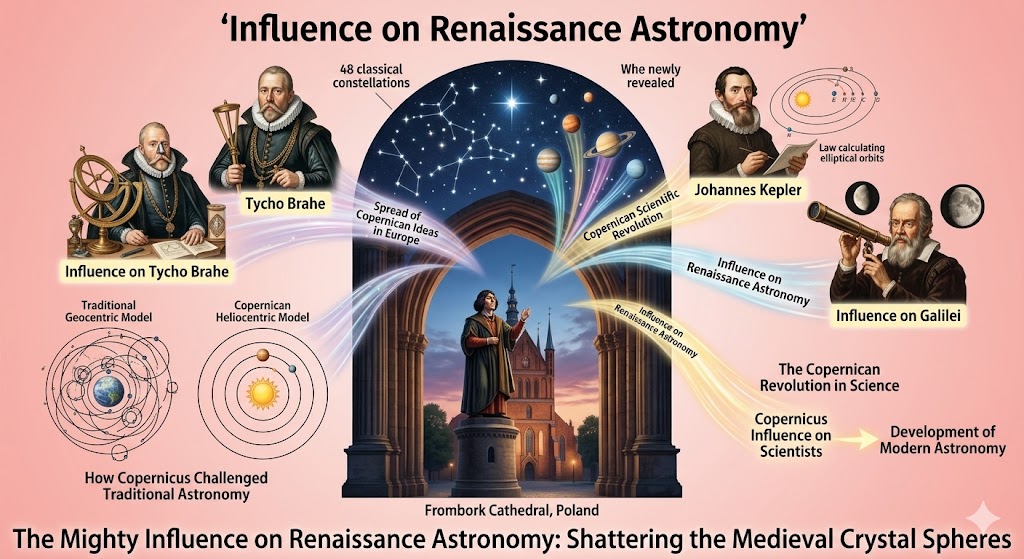
How Copernicus Challenged Traditional Astronomy
The primary influence on renaissance astronomy came from the audacity of one man to suggest the Earth was a “wanderer” (a planet). By presenting copernicus’ heliocentric model, he solved the “irregularities” of the planets that had bothered astronomers for centuries.
He didn’t just offer a new theory; he provided a superior tool for calculation. By utilizing the mathematical methods of copernicus, astronomers could suddenly predict planetary positions with a clarity that the old system lacked. This practical superiority was the wedge that allowed the Copernican revolution to begin splitting the old guard apart.
Influence on Tycho Brahe
One of the most direct examples of the influence on renaissance astronomy can be seen in the work of the Danish nobleman Tycho Brahe. While Tycho famously could not accept that the Earth moved, he was so moved by the astronomical observations of his time that he realized the old Ptolemaic system was dead.
Tycho built the most advanced observatory of the pre-telescope era to test the Copernican system. His data was the most precise in history, and while he tried to create a “hybrid” model where the Sun circled the Earth while the planets circled the Sun, he was operating entirely within the world of questions that Copernicus had opened. This transition from medieval to modern science was messy, but it was headed in only one direction.
Influence on Johannes Kepler
If Copernicus provided the spark, Johannes Kepler provided the fuel. Kepler was a true “Copernican” who felt the full weight of the influence on renaissance astronomy. By inheriting Tycho’s data and applying his own genius, Kepler realized that Copernicus was right about the Sun being the center, but wrong about the orbits being perfect circles.
By refining the nicolaus copernicus heliocentric theory into his Three Laws of Planetary Motion, Kepler turned a radical hypothesis into an undeniable law of nature. This was the moment when the heliocentric revolution moved from being a mathematical trick to being a physical reality.
Influence on Galileo Galilei
The most famous victim—and champion—of the influence on renaissance astronomy was Galileo Galilei. When Galileo turned his telescope toward the sky in 1609, he saw the physical proof that Copernicus had only dreamt of. He saw the phases of Venus and the moons of Jupiter—sights that proved not everything revolved around the Earth.
Galileo’s defense of the books of copernicus (de revolutionibus) brought him into direct conflict with the Inquisition. However, his work ensured that the Copernican system astronomy was no longer just for mathematicians; it was for everyone. His struggle highlighted the intense social and religious pressure that accompanied the development of modern astronomy.
Spread of Copernican Ideas in Europe
The influence on renaissance astronomy was not confined to Italy or Germany; it spread like wildfire across the European continent. Thanks to the printing press, Copernican ideas reached England, France, and the Netherlands. Renaissance scientific discoveries were becoming a point of pride for nations.
As more scholars adopted the influence on renaissance astronomy, the old geocentric model was relegated to the status of a historical curiosity. The Copernican scientific revolution was winning the battle for the minds of the next generation of thinkers.
The Copernican Revolution in Science
The ultimate influence on renaissance astronomy was the total restructuring of the human worldview. This was more than just a change in stars; it was the birth of the Scientific Revolution. It taught humanity that the universe is governed by laws that can be understood through reason and measurement.
This shift is the core of copernicus’ legacy in modern science. It established the “Copernican Principle”—the idea that we do not occupy a privileged or central position in the universe. This humility before the facts of nature is the hallmark of the modern scientific mind.
Frequently Asked Questions (FAQs)
How did the influence on renaissance astronomy change the world?
It shifted the human perspective from a small, Earth-centered universe to a vast, Sun-centered one, sparking the Scientific Revolution and the birth of modern physics.
Who were the key scientists influenced by Copernicus?
The most notable were Tycho Brahe, Johannes Kepler, Galileo Galilei, and eventually Isaac Newton.
Was the influence on renaissance astronomy immediate?
No. It took over 150 years for the heliocentric model to be fully accepted by the scientific community due to religious and traditional resistance.
What role did the printing press play?
It allowed the books of copernicus (de revolutionibus) and subsequent works by Galileo and Kepler to be distributed widely, preventing the ideas from being suppressed.
Why is it called the Copernican Revolution?
Because it represents a “revolution” or a complete turn in human thought—a total reversal of the previous 2,000 years of astronomical belief.
Conclusion
The influence on renaissance astronomy was the catalyst that dragged the world out of the Middle Ages. By daring to move the Earth, Nicolaus Copernicus moved the human spirit toward a new horizon of discovery. His work did more than explain the heavens; it taught us how to think, how to observe, and how to question. Today, every satellite we launch and every distant galaxy we photograph is a testament to the influence on renaissance astronomy that began with a single, bold idea. We are no longer at the center of the universe, but because of Copernicus, we finally know where we truly stand.