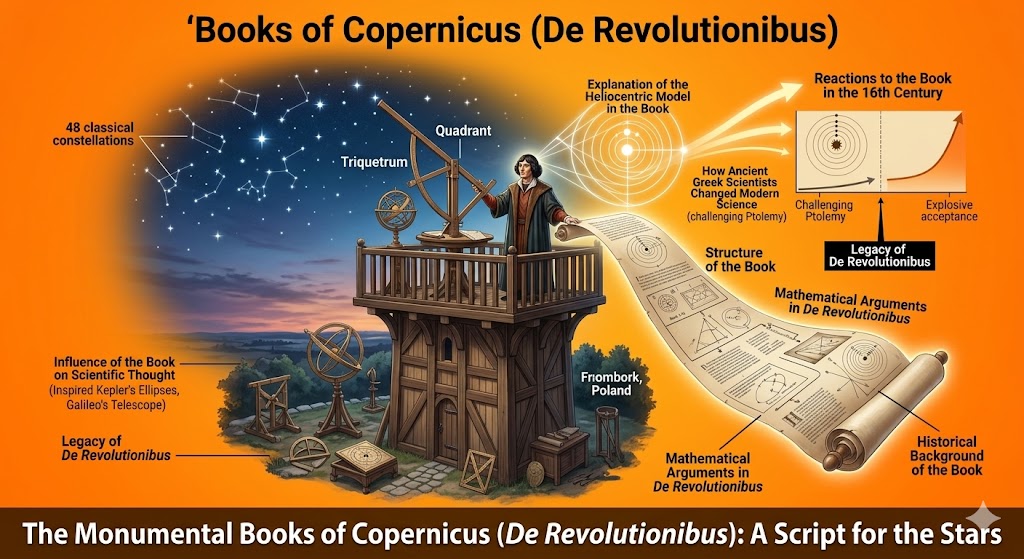
History is rarely changed by a single object, but in the case of modern science, a solitary manuscript holds that honor. The books of copernicus (de revolutionibus), specifically De revolutionibus orbium coelestium (On the Revolutions of the Heavenly Spheres), stand as the most defiant and transformative works in the history of human thought. Published in 1543, this heliocentric theory book did not just suggest a change in the calendar; it demanded a total relocation of humanity. By moving the Earth from the center of the universe, the books of copernicus (de revolutionibus) effectively ended the medieval era and authored the beginning of the modern world.
Introduction to De Revolutionibus
The books of copernicus (de revolutionibus) are often cited as the starting point of the Scientific Revolution. Written in Latin, the language of the scholars, this Copernicus famous book was the culmination of over thirty years of research. Nicolaus Copernicus was hesitant to publish, fearing the controversy his Sun-centered universe would spark. However, the final product provided the first comprehensive mathematical description of the nicolaus copernicus heliocentric theory. It wasn’t just a collection of ideas; it was a technical manual that redefined the cosmos, proving that the books of copernicus (de revolutionibus) were designed for the most elite minds of the 16th century.
Historical Background of the Book
To understand the significance of this Copernican astronomy text, one must look at the world into which it was born. For centuries, the Church and academia had relied on the geocentric views of Ptolemy and Aristotle. While we often discuss how ancient greek scientists changed modern science, it is important to remember that their authority was so absolute that questioning it was seen as both scientific and religious heresy.
Copernicus began working on his manuscript around 1510. He circulated a short hand-written summary called the Commentariolus among friends, but the full books of copernicus (de revolutionibus) remained hidden in his study for decades. It was only through the persistent urging of a young mathematician named Rheticus that the elderly Copernicus finally sent his life’s work to the printer in Nuremberg.
Structure of the Book
The books of copernicus (de revolutionibus) are divided into six distinct volumes, following a structure very similar to Ptolemy’s Almagest. This was a deliberate choice to show that he was playing by the same rules as the masters he sought to replace.
- Book I: Provides a general vision of the heliocentric model and the order of the planets.
- Book II: Explains the principles of spherical astronomy and a star catalogue.
- Book III: Focuses on the apparent motion of the Sun and the Earth’s orbit.
- Book IV: Details the motion of the Moon and its various eclipses.
- Books V & VI: Focus on the movement of the other planets in longitude and latitude.
By structuring the books of copernicus (de revolutionibus) this way, he provided a complete alternative to the existing astronomical system, ensuring that his work could not be easily dismissed as mere speculation.
Explanation of the Heliocentric Model in the Book
In the opening of the books of copernicus (de revolutionibus), Copernicus makes his radical claim: the Sun sits at the center, and the Earth is a planet that rotates daily and revolves annually. This heliocentric model explanation was revolutionary because it simplified the heavens. In the copernicus’ heliocentric model, the apparent “wandering” of planets was no longer a mystery of physics but a natural consequence of the Earth’s own motion.
The books of copernicus (de revolutionibus) argued that the universe possessed a “wonderful commensurability” when the Sun was at the center. This aesthetic and logical harmony was a key selling point of the text, attracting Renaissance scholars who valued beauty and order in nature.
Mathematical Arguments in De Revolutionibus
While the concept was philosophical, the evidence was mathematical. The books of copernicus (de revolutionibus) are dense with geometry and trigonometry. Copernicus knew that to be taken seriously, he had to provide better predictions for planetary positions than the Greeks had.
He applied the mathematical methods of copernicus to centuries of data, including his own astronomical observations. By using a moving Earth as a reference point, he was able to calculate the relative distances of the planets from the Sun with incredible accuracy. These Copernican scientific writings proved that the heliocentric theory was not just a “guess,” but a mathematically sound reality that outperformed the geocentric alternative.
Reactions to the Book in the 16th Century
The immediate reaction to the books of copernicus (de revolutionibus) was surprisingly quiet. Because the book was so complex, very few people could actually read and understand it. It was initially seen by the Church as a clever mathematical tool rather than a literal description of reality.
However, as the implications of the books of copernicus (de revolutionibus) began to sink in, opposition grew. Martin Luther famously dismissed Copernicus as an “upstart astrologer,” and eventually, the Catholic Church placed the work on the Index of Prohibited Books. Despite this, the influence on renaissance astronomy was already unstoppable. The book had crossed borders, reaching the desks of the most brilliant minds in Europe.
Influence of the Book on Scientific Thought
The books of copernicus (de revolutionibus) served as the foundational text for the next century of discovery. It provided the framework that allowed Tycho Brahe to map the stars and Johannes Kepler to discover the laws of planetary motion. Every copy of the books of copernicus (de revolutionibus) that was smuggled into a university or shared between scholars was a seed for the Scientific Revolution.
This Renaissance astronomy literature changed the goal of science from simply “predicting” what we see to “understanding” what truly exists. It established the idea that the universe has a physical structure that can be deciphered through study and logic, a concept that is the bedrock of copernicus’ legacy in modern science.
Legacy of De Revolutionibus
Today, the books of copernicus (de revolutionibus) are regarded as some of the most valuable historical astronomy publications in existence. They represent the moment humanity grew up—the moment we realized we were not the center of the world.
The legacy of the books of copernicus (de revolutionibus) is found in every physics textbook and every space mission. By daring to put his thoughts on paper, Copernicus ensured that his ideas would outlive him. The “Copernican Revolution” is not just a chapter in history; it is the very foundation of how we view our place in the cosmos today.
Frequently Asked Questions (FAQs)
What is the main theme of the books of copernicus (de revolutionibus)?
The main theme is the proposal of a heliocentric (Sun-centered) universe, where the Earth and other planets revolve around the Sun, replacing the traditional Earth-centered model.
Why did Copernicus wait until his death to publish the book?
He was a perfectionist who wanted to ensure the math was flawless, and he also feared the potential backlash from religious and academic authorities.
Is De Revolutionibus difficult to read?
Yes, it is highly technical. It was written in Latin and contains extensive geometric proofs and tables that require a strong background in Renaissance mathematics to understand.
How many copies of the first edition exist today?
It is estimated that around 270 copies of the first edition of the books of copernicus (de revolutionibus) still exist, making them extremely rare and valuable.
Did the book immediately prove the Earth moves?
No. While it provided a better mathematical model, physical proof of the Earth’s motion (like stellar parallax) was not available until the 19th century.
Conclusion
The books of copernicus (de revolutionibus) remain a testament to the power of the written word. In an age of absolute certainty, Nicolaus Copernicus had the courage to publish a work that questioned everything. Through his rigorous math and bold vision, he turned the universe inside out. These books of copernicus (de revolutionibus) did more than move the Sun; they moved the human mind toward a future defined by evidence, logic, and infinite curiosity. As we continue to explore the stars, we are merely reading the chapters of a story that began with a single book published five centuries ago.