Introduction
The story behind moore’s law is one of the most fascinating chapters in the history of computing and semiconductor technology. In 1965, engineer Gordon Moore made a prediction that would shape the entire technology industry for decades. His observation suggested that the number of transistors on integrated circuits would double roughly every year, leading to exponential growth in computing power.
At the time, few people realized how powerful this idea would become. Yet over the next half century, the story behind moore’s law proved remarkably accurate. From early integrated circuits to today’s advanced processors, semiconductor manufacturers followed this trend to create smaller, faster, and cheaper chips.
Understanding the story behind moore’s law also reveals how innovation in lithography, chip design, and advanced packaging transformed the world. Modern smartphones, laptops, and data centers all exist because of this remarkable prediction.
Many technologies discussed in the story behind moore’s law also connect to developments in bold history of computer processors, history of computer hardware, and the broader history of computers.
A. 1965 – 1975: The Famous Observation
The earliest chapter in the story behind moore’s law began when Gordon Moore analyzed transistor density trends in early integrated circuits.
Gordon Moore’s 1965 Paper: A Forecast for Electronics
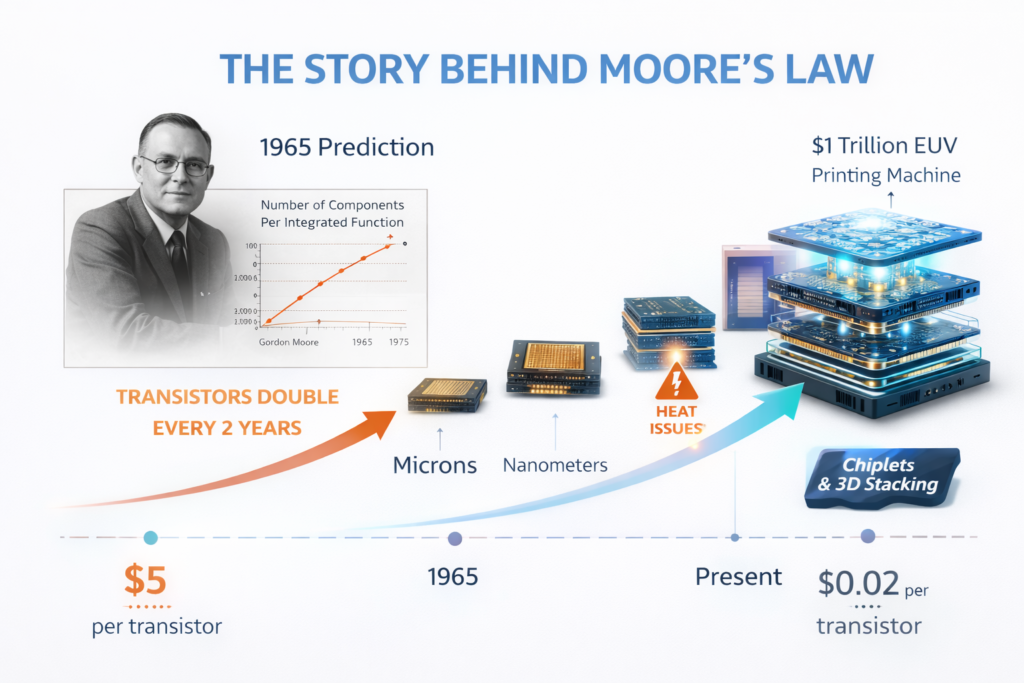
In 1965, Gordon Moore published a paper predicting that the number of transistor count per chip would double every year. His prediction was based on early integrated circuits (IC) manufacturing trends.
This simple observation quickly became the foundation of the story behind moore’s law and shaped the semiconductor roadmap for decades.
The rapid improvement in transistor scaling fueled breakthroughs across computing technologies and helped accelerate the history of computer processors.
Adjusting the Timeline: From 12 Months to 24 Months
In 1975 Moore revised his prediction. Instead of doubling every 12 months, transistor density would double approximately every two years.
Despite this adjustment, the story behind moore’s law continued to represent exponential growth in computing power and semiconductor innovation.
B. 1975 – 1990: Doubling Density as an Economic Driver
By the late 1970s, the story behind moore’s law had become more than a technical observation—it became an economic strategy for the semiconductor industry.
Moore’s Law as a Self-Fulfilling Prophecy for Intel
Companies such as Intel used Moore’s prediction as a roadmap for product development. Engineers pushed semiconductor roadmap (ITRS) goals to ensure transistor density kept increasing.
As a result, the story behind moore’s law became a self-fulfilling prophecy, guiding chip manufacturers toward aggressive innovation.
This period also influenced the growth of computing infrastructure and developments in history of data centers.
The Shrinking Transistor: Making Tech Cheaper and Faster
As transistor sizes decreased, power density improved and chips became faster and more energy efficient.
This phase of the story behind moore’s law dramatically reduced computing costs, making personal computers accessible to consumers.
These improvements also supported developments across the history of programming languages and software ecosystems.
C. 1990 – 2005: The Story Behind Moore’s Law and the PC Boom
During the 1990s, the story behind moore’s law reached its most visible impact as personal computers became mainstream.
Rapid Scaling: From Microns to Nanometers
Semiconductor fabrication moved from micron-scale lithography to nanometer-scale manufacturing.
Advanced photolithography techniques allowed engineers to pack millions and eventually billions of transistors onto chips.
This rapid scaling represented the most dramatic phase of the story behind moore’s law.
How Moore’s Law Fueled the Internet Revolution
The explosion of internet technologies required massive computing power. The improvements predicted in the story behind moore’s law enabled servers, routers, and networking equipment to process large amounts of data efficiently.
This transformation directly supported the development of history of internet technologies and global digital infrastructure.
D. 2005 – 2015: The Challenges of Heat and Power
By the mid-2000s, the semiconductor industry began encountering physical limitations that threatened the story behind moore’s law.
The Failure of Dennard Scaling
For decades, Dennard Scaling ensured that smaller transistors consumed less power. However, as transistor sizes approached nanometer dimensions, this rule stopped working.
As a result, power consumption and heat became major challenges in maintaining the trends predicted in the story behind moore’s law.
Shifting Focus: Performance Per Watt Over Raw Clock Speed
Instead of increasing clock speed, chip manufacturers shifted toward multi-core processors and energy-efficient architectures.
This shift reshaped the story behind moore’s law and encouraged new approaches to semiconductor innovation.
These improvements also enabled the rise of bold Modern Artificial Intelligence Applications that require efficient parallel processing.
E. 2015 – 2026: The “More-Than-Moore” Era
Even as transistor scaling slowed, the story behind moore’s law continued through new technologies and architectural innovations.
EUV Lithography: The Trillion-Dollar Printing Machine
Extreme ultraviolet EUV lithography allows chip manufacturers to create extremely small transistor features.
This technology represents one of the most advanced steps in continuing the story behind moore’s law despite the physical limits of silicon.
Chiplets and 3D Stacking: Keeping the Law Alive
Instead of relying solely on smaller transistors, engineers now use chiplets and advanced packaging techniques.
These methods combine multiple smaller chips into powerful computing systems while maintaining the spirit of the story behind moore’s law.
Such innovations also support future technologies connected to the history of quantum computing.
Frequently Asked Questions (FAQs)
What is Moore’s Law?
Moore’s Law states that the number of transistors on a microchip doubles approximately every two years, leading to exponential growth in computing power.
Who proposed Moore’s Law?
Gordon Moore, co-founder of Intel, proposed the observation in 1965.
Is Moore’s Law still valid today?
While traditional transistor scaling has slowed, innovations such as chiplets and advanced packaging continue the spirit of Moore’s Law.
Why was Moore’s Law important?
It guided semiconductor industry development and enabled rapid advances in computing technology.
What technologies are replacing traditional Moore’s Law scaling?
Modern solutions include 3D stacking, chiplet architectures, and advanced lithography techniques.
Conclusion
The story behind moore’s law demonstrates how a simple prediction can transform an entire industry. For more than fifty years, this principle guided semiconductor innovation, enabling exponential growth in computing performance.
Although physical limits are challenging traditional scaling methods, the semiconductor industry continues to innovate through chiplets, advanced packaging, and new materials.
Ultimately, the story behind moore’s law is not just about transistors—it represents humanity’s relentless drive to push the boundaries of technology.