Introduction
The question who invented computer graphics is one of the most exciting topics in modern computing history. Computer graphics have transformed how humans interact with machines by enabling visual communication, design, animation, and immersive digital experiences. From simple pixel displays to advanced 3D rendering, computer graphics power everything from video games to scientific simulations.
Understanding who invented computer graphics requires exploring the early days of computing when machines could only display text and basic symbols. Early computers lacked the ability to generate images, making user interaction limited and difficult.
As technology advanced, researchers began developing ways to represent images digitally using pixels and vectors. These innovations laid the foundation for modern graphics systems.
The evolution of graphics is closely tied to the history of computer graphics, which shows how visual computing became an essential part of modern technology.
The journey of who invented computer graphics reveals how powerful ideas turned computers into visual machines capable of rendering realistic images and animations.
Who Invented It
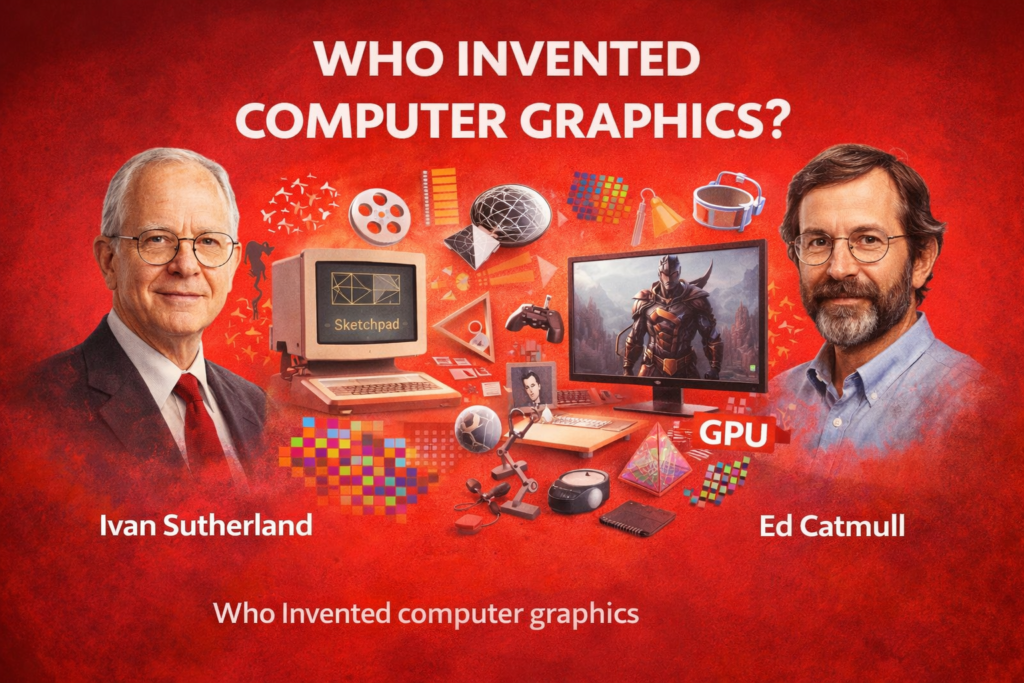
When discussing who invented computer graphics, the most important pioneer is Ivan Sutherland. He is widely recognized as the father of computer graphics.
In 1963 Ivan Sutherland developed Sketchpad, one of the first graphical computer programs. Sketchpad allowed users to draw shapes directly on a screen using a light pen. This was a revolutionary breakthrough because it introduced interactive graphics.
Sketchpad demonstrated key concepts such as graphical user interfaces, object manipulation, and constraints. These ideas are still used in modern graphics systems.
Another important figure in the story of who invented computer graphics is Ed Catmull, who contributed to the development of 3D graphics and later co founded Pixar.
The contributions of these pioneers are also connected to the history of computers, which shows how computing evolved to support graphical processing.
These innovations clearly answer the question who invented computer graphics and highlight the development of visual computing.
When It Was Invented
The origins of computer graphics can be traced back to 1963 when Ivan Sutherland created Sketchpad.
The year 1963 is a key milestone in understanding who invented computer graphics because it marked the first interactive graphical system.
During the nineteen seventies and eighties, computer graphics evolved with the development of rasterization and vector graphics techniques.
The introduction of computer generated imagery in films during the nineteen eighties further expanded the use of graphics.
The growth of video game graphics in the nineteen nineties introduced real time rendering and improved frame rates.
These milestones represent the timeline of who invented computer graphics and its evolution into a powerful technology.
How It Worked
To understand who invented computer graphics, it is important to understand how computer graphics work.
Computer graphics use pixels to represent images on a screen. Each pixel contains color information that contributes to the overall image.
Rasterization converts geometric shapes into pixels for display. This process is widely used in real time graphics such as video games.
Vector graphics use mathematical equations to represent shapes. This allows images to scale without losing quality.
Polygons are used to create 3D models. These models are rendered using techniques such as texture mapping and shading.
Ray tracing simulates the behavior of light to create realistic images.
Frames per second determine how smoothly animations are displayed.
Shaders are used to control how surfaces interact with light and color.
These processes demonstrate how the concept behind who invented computer graphics created powerful systems for visual representation.
Why It Was Important
Computer graphics revolutionized how humans interact with technology.
Before graphics existed computers were limited to text based interfaces. This made them difficult to use for many people.
Understanding who invented computer graphics highlights how visual interfaces improved usability and accessibility.
Computer graphics enabled the development of graphical user interfaces that are used in modern operating systems.
They also made it possible to create video games, animations, and virtual environments.
The importance of computer graphics extends to industries such as healthcare, engineering, and entertainment.
Computer graphics also play a key role in the who invented data science field by enabling data visualization and analysis.
Without computer graphics modern digital experiences would not be possible.
How It Evolved Today
Computer graphics have evolved into a highly advanced field.
Modern graphics systems use powerful GPUs to render complex images in real time.
The development of 3D modeling and animation has enabled realistic simulations and visual effects.
Technologies such as virtual reality and augmented reality provide immersive experiences.
The growth of high performance computing supported by the Evolution of GPUs has enabled advanced rendering techniques.
Modern graphics also use machine learning to improve rendering efficiency and image quality.
In the final stage of evolution improvements in hardware driven by the evolution of transistors and advancements in data handling through the rise of storage technology have made graphics systems more powerful and efficient.
The journey of who invented computer graphics continues to shape the future of digital experiences.
Frequently Asked Questions (FAQs)
Who invented computer graphics?
Ivan Sutherland is widely recognized as the father of computer graphics.
What was Sketchpad?
Sketchpad was one of the first graphical computer programs developed in 1963.
Why are computer graphics important?
Computer graphics enable visual interaction, design, and digital experiences.
What is rasterization?
Rasterization is the process of converting shapes into pixels for display.
How have computer graphics evolved?
Computer graphics evolved from simple images to advanced 3D rendering and virtual reality systems.
The Computer Graphics Revolution and Visual Computing Systems 1963 to Present
The story behind who invented computer graphics represents one of the most powerful transformations in computing history. From the creation of Sketchpad in 1963 to modern 3D rendering systems computer graphics have changed how we interact with technology.
The contributions of Ivan Sutherland and later innovators created a foundation for visual computing.
Computer graphics continue to evolve with advancements in hardware and software technologies.
The legacy of who invented computer graphics reminds us that visual innovation is essential for building the future of digital experiences.