Introduction
The question who invented the internet has fascinated technology historians, researchers, and curious readers for decades. The internet is one of the most powerful inventions in human history because it transformed how people communicate, learn, conduct business, and access information. Today billions of people rely on the internet every day to search for knowledge, connect with others, and build digital businesses.
Understanding who invented the internet requires exploring decades of technological innovation and scientific collaboration. Unlike many inventions that were created by a single person, the internet emerged from the combined work of multiple visionary scientists, engineers, and research institutions.
The early development of networking technology also relied on improvements in computing hardware and the evolution of transistors. As transistors became smaller and more powerful, computers became capable of communicating with each other across long distances.
Another critical technological factor was the rise of storage technology, which allowed computers to store and share large amounts of digital information. Without these advancements the modern internet would not exist.
The story of who invented the internet is not just a story about technology. It is a story about collaboration, innovation, and the desire to create a global communication system that connects the entire world.
Who Invented It
When people ask who invented the internet, the most accurate answer is that the internet was invented through collaboration rather than by a single individual. However several scientists played crucial roles in building the technology that powers the modern internet.
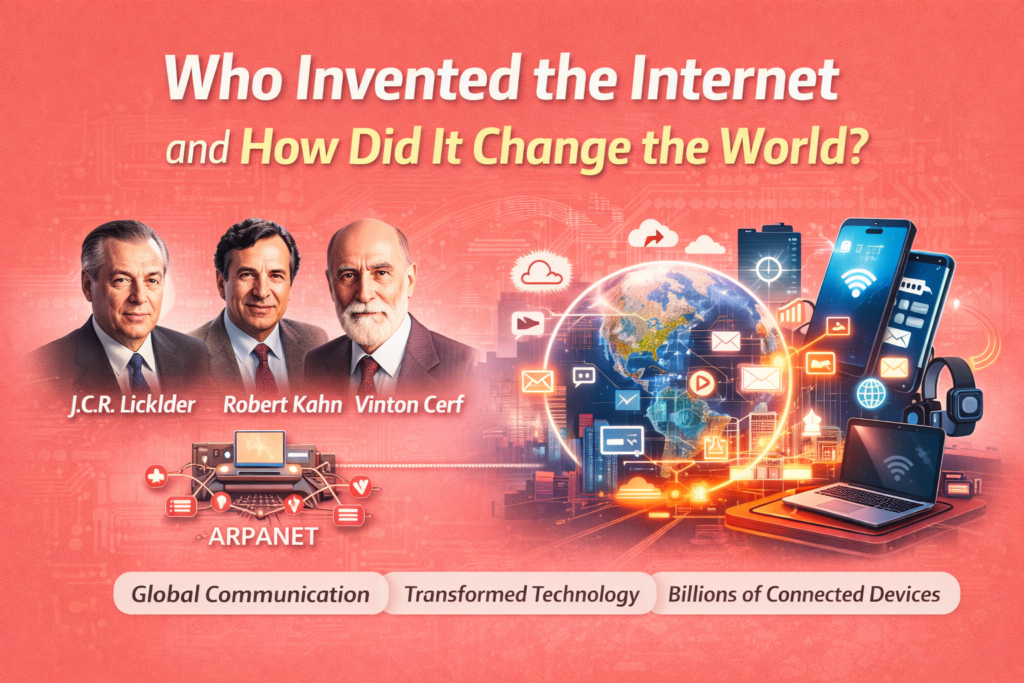
One of the earliest pioneers was J C R Licklider. In the early nineteen sixties he proposed the idea of a global network of interconnected computers. He imagined a future where people could share information instantly through connected machines. His vision later inspired the creation of the first networking research programs.
Another major contributor to who invented the internet was Vint Cerf. Along with Bob Kahn he developed the Transmission Control Protocol and Internet Protocol known as TCP and IP. These communication protocols allow computers to exchange data across networks regardless of hardware differences.
The research organization DARPA also played a vital role in the development of the internet. DARPA funded the creation of ARPANET which was the first packet switching network. ARPANET allowed universities and research centers to connect computers and exchange information digitally.
The contributions of these innovators are an important chapter in the history of internet and helped establish the digital infrastructure that supports modern communication.
Because of their work Vint Cerf and Bob Kahn are often referred to as the fathers of the internet. Their research answered the historic question of who invented the internet and provided the technical foundation that still powers global connectivity today.
When It Was Invented
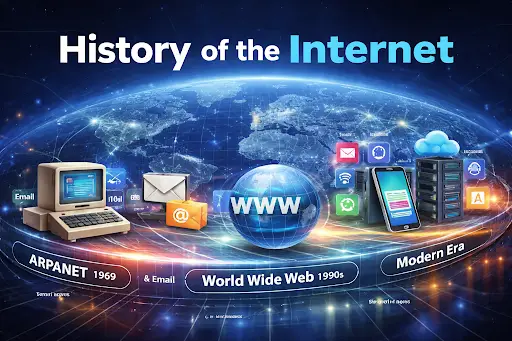
The development of the internet began during the late nineteen sixties. In nineteen sixty nine the first successful computer network connection occurred when ARPANET linked computers at several American universities.
This moment became a key milestone in the story of who invented the internet. Researchers successfully transmitted a message from UCLA to the Stanford Research Institute. Although the first attempt crashed the system after only two letters were sent, the experiment proved that computers could communicate across a network.
During the nineteen seventies researchers expanded ARPANET and developed more advanced networking technologies. Packet switching development allowed data to be divided into smaller pieces that could travel across different routes before being reassembled at the destination.
The invention of TCP and IP protocols during nineteen seventy four marked a revolutionary breakthrough in the story of who invented the internet. These protocols created a universal communication language that allowed different computer networks to connect together.
Another important step occurred in nineteen eighty three when ARPANET officially adopted TCP and IP. Many historians consider this moment the true birth of the modern internet.
Advances in processor technology and the evolution of transistors made it possible to build faster computers and networking hardware. These improvements allowed the internet to expand rapidly during the following decades.
How It Worked
Understanding who invented the internet also requires understanding how the internet works.
The internet is a global system of interconnected networks that communicate through standardized protocols. When a user sends data across the internet the information is divided into packets. Each packet travels through routers and network nodes until it reaches its destination.
The Transmission Control Protocol manages how data packets are sent and received while the Internet Protocol identifies the location of each device on the network. Together these protocols allow computers to communicate reliably across long distances.
Another important technology is the Domain Name System. DNS converts human readable website names into numerical IP addresses that computers use to locate servers.
Web pages are delivered through Hypertext Transfer Protocol which works together with HTML to display information in web browsers such as Mosaic and Netscape.
Modern networks rely heavily on advanced router technology and broadband expansion. Massive facilities known as data centers manage global internet traffic and store digital content. These infrastructures form an essential part of the history of data centers and support the rapid growth of online services.
As digital content increased the rise of storage technology became essential for storing massive databases, media libraries, and cloud services that power the internet today.
Why It Was Important
The invention of the internet represents one of the most transformative technological breakthroughs in human civilization. Before the internet communication across countries was slow and expensive. Letters and documents could take days or weeks to reach their destination.
Understanding who invented the internet highlights how revolutionary this technology became. Today messages can be delivered instantly through email, messaging apps, and social media platforms.
The internet also changed how businesses operate. Companies can now sell products globally through electronic commerce platforms. Entrepreneurs can launch digital services and reach customers across the world.
Education experienced a major transformation as well. Students can now access online courses, research databases, and digital libraries from anywhere with an internet connection.
The internet also accelerated innovation across many industries including artificial intelligence, cybersecurity, and cloud computing.
These technological advances are closely connected with the history of computer networking, which explains how computers evolved from isolated machines into globally connected systems.
Without the innovations that answered who invented the internet, modern society would not have access to global communication, online knowledge, or digital economies.
How It Evolved Today
Since its creation the internet has evolved dramatically. What began as a small research network connecting a handful of computers has become a global infrastructure connecting billions of devices.
The evolution of global connectivity has been driven by fiber optic networks, satellite communication systems, and wireless broadband technologies. These innovations allow users to access high speed internet from almost anywhere in the world.
The internet also supports emerging technologies such as the Internet of Things where everyday devices connect to networks and share data automatically.
Another important milestone in internet evolution was the creation of the World Wide Web by Tim Berners Lee in nineteen eighty nine. The web introduced web pages, hyperlinks, and browsers that made the internet accessible to ordinary users.
The impact of the internet on society has been enormous. It transformed communication, entertainment, education, and global commerce.
The continued expansion of the internet also depends on advancements in hardware technologies such as the evolution of transistors and improved data storage systems powered by the rise of storage technology.
Today the internet continues to evolve through technologies such as cloud computing, edge computing, and next generation networking systems.
The story of who invented the internet continues to influence modern innovation and digital transformation.
Frequently Aked Questions (FAQs)
Who invented the internet?
The internet was created by several scientists including Vint Cerf, Bob Kahn, and J C R Licklider. Their research led to the development of networking protocols and ARPANET.
When did the internet begin?
The first internet connection occurred in nineteen sixty nine when ARPANET linked computers at research universities.
What is the difference between the internet and the world wide web?
The internet is the global network infrastructure while the world wide web is a system of web pages and documents accessed through browsers.
Why is TCP and IP important?
TCP and IP enable computers to communicate across different networks by dividing data into packets and routing them across the internet.
How many devices use the internet today?
Today billions of devices including smartphones, computers, and smart home systems connect to the internet.
The Global Internet Revolution and Digital Connectivity (1969 to Present)
The question who invented the internet reveals one of the most inspiring stories in technological history. The internet did not emerge overnight but evolved through decades of collaboration, experimentation, and visionary thinking.
From the early experiments with ARPANET to the global networks that power modern digital communication the internet has transformed the world in extraordinary ways. It connected people, accelerated innovation, and created new opportunities for education, commerce, and scientific research.
The continued development of the internet depends on advances in networking technologies, computing hardware, and data storage systems. As the world moves toward an increasingly connected future the legacy of those who answered who invented the internet will remain one of the most powerful examples of human innovation.
The internet continues to evolve and reshape the world proving that the vision of early networking pioneers was not only ambitious but truly revolutionary.