Introduction
The question who invented virtual reality is one of the most fascinating topics in modern technology. Virtual reality has transformed how humans interact with digital environments by creating immersive experiences that feel almost real. From gaming to training simulations, virtual reality is shaping the future of interaction and entertainment.
Understanding who invented virtual reality requires exploring early experiments in immersive technology. In the beginning computers could only display simple text and images. There was no concept of immersion or presence.
As researchers explored ways to simulate environments, they began developing systems that could engage human senses. These innovations led to the creation of virtual environments that users could interact with.
The development of virtual reality is closely connected with the history of virtual reality, which explains how immersive technology evolved over time.
The journey of who invented virtual reality reveals how powerful ideas transformed digital interaction into a fully immersive experience.
Who Invented It
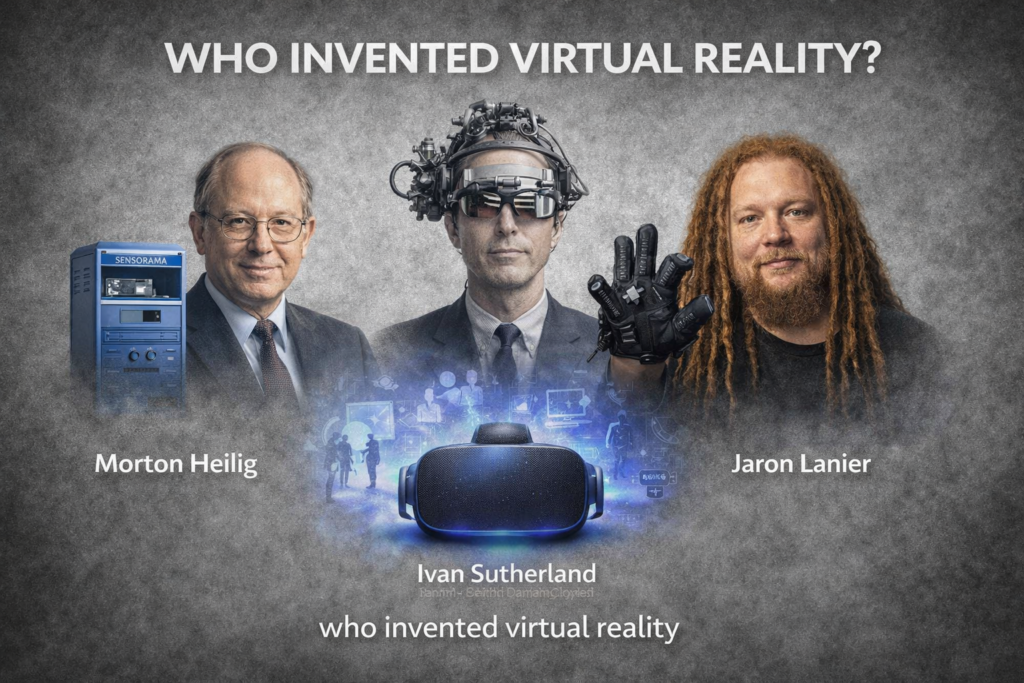
When discussing who invented virtual reality, one of the earliest pioneers is Morton Heilig. He created the Sensorama in the nineteen fifties, a machine designed to provide a multi sensory experience including visuals, sound, and even smell.
Morton Heilig vision was to create an immersive experience that could simulate real life environments. His work laid the foundation for modern virtual reality systems.
Another major contributor to who invented virtual reality is Ivan Sutherland, who developed the first head mounted display system known as the Sword of Damocles in 1968. This system introduced the concept of a virtual environment viewed through a headset.
Later innovations were led by Jaron Lanier, who popularized the term virtual reality and contributed to the development of commercial VR systems through VPL Research.
These pioneers played a crucial role in answering the question who invented virtual reality and shaping immersive technology.
Their contributions are also connected with the history of computer graphics, which enabled visual rendering in virtual environments.
When It Was Invented
The origins of virtual reality can be traced back to 1956 when Morton Heilig developed the Sensorama.
The year 1956 is a key milestone in understanding who invented virtual reality because it marked the first attempt to create an immersive experience.
The development of head mounted displays in 1968 by Ivan Sutherland further advanced the field.
During the nineteen eighties and nineties virtual reality gained attention with the work of Jaron Lanier and the development of VR systems.
The introduction of modern VR devices such as Oculus Rift in the twenty first century brought virtual reality into mainstream use.
These milestones represent the timeline of who invented virtual reality and its evolution into a powerful technology.
How It Worked
To understand who invented virtual reality, it is important to understand how virtual reality works.
Virtual reality creates a simulated environment that users can interact with. This environment is displayed through a headset that covers the user field of view.
Stereoscopy is used to create depth perception by displaying slightly different images to each eye.
Motion tracking sensors detect the movement of the user head and adjust the virtual environment accordingly.
Spatial audio enhances immersion by providing realistic sound effects.
Haptic feedback devices simulate touch and interaction within the virtual environment.
Virtual reality systems rely on real time rendering to generate images and maintain a smooth experience.
Presence is a key concept in virtual reality, referring to the feeling of being inside the virtual environment.
These processes demonstrate how the concept behind who invented virtual reality created immersive digital experiences.
Why It Was Important
Virtual reality revolutionized how humans interact with digital systems.
Before virtual reality digital interaction was limited to screens and input devices.
Understanding who invented virtual reality highlights how immersive technology created new possibilities.
Virtual reality is used in gaming, education, healthcare, and training simulations.
It allows users to experience environments that are difficult or impossible to access in real life.
Virtual reality also supports remote collaboration and telepresence.
The importance of virtual reality is closely connected with the who invented data science field, which uses immersive visualization for analysis.
Virtual reality also plays a key role in modern entertainment and design industries.
Without virtual reality many modern interactive experiences would not exist.
How It Evolved Today
Virtual reality has evolved into a highly advanced technology.
Modern VR systems use high resolution displays and advanced motion tracking.
Wireless headsets allow greater mobility and convenience.
The development of immersive technologies such as augmented reality and mixed reality has expanded the possibilities of virtual environments.
The growth of high performance computing supported by the Evolution of GPUs has enabled realistic rendering and simulations.
Modern VR systems are used in gaming, training, healthcare, and virtual tourism.
In the final stage of evolution improvements in hardware driven by the evolution of transistors and advancements in data handling through the rise of storage technology have made virtual reality systems more powerful and efficient.
The journey of who invented virtual reality continues to shape the future of immersive technology.
Frequently Asked Questions (FAQs)
Who invented virtual reality?
Morton Heilig is considered an early pioneer while Ivan Sutherland and Jaron Lanier advanced the field.
What is virtual reality?
Virtual reality is a technology that creates immersive digital environments.
When was virtual reality invented?
Virtual reality began in 1956 with the Sensorama and advanced in 1968 with head mounted displays.
How does virtual reality work?
It uses headsets, motion tracking, and stereoscopic displays to create immersive experiences.
Why is virtual reality important?
It enables immersive interaction and has applications in many industries.
The Virtual Reality Revolution and Immersive Technology Systems 1956 to Present
The story behind who invented virtual reality represents one of the most powerful transformations in computing history. From the Sensorama in 1956 to modern VR headsets virtual reality has changed how humans interact with digital environments.
The contributions of Morton Heilig, Ivan Sutherland, and Jaron Lanier created a foundation for immersive technology.
Virtual reality continues to evolve with advancements in hardware and software.
The legacy of who invented virtual reality reminds us that immersive experiences are shaping the future of digital interaction.