Introduction
The Sieve of Eratosthenes explained is one of the most famous methods in mathematics used to find prime numbers. Developed more than 2,000 years ago, this elegant algorithm remains a foundational concept in number theory and computer science today. The method was introduced by Eratosthenes, a Greek mathematician, geographer, and scholar who made remarkable contributions to science and mathematics during the Hellenistic period.
Eratosthenes was not only known for mathematical discoveries but also for his groundbreaking work in geography and astronomy. His achievements include calculating the Earth’s Circumference, helping establish the Birth of Geography, and making significant Mathematics Contributions that continue to influence modern learning. As the chief librarian of the Library of Alexandria, he had access to vast knowledge, which helped him develop ideas that were far Ahead of His Time.
Among all his discoveries, the Sieve of Eratosthenes remains one of the most practical and widely taught mathematical techniques.
Who Was Eratosthenes?
Before understanding the sieve method, it is important to know about Eratosthenes, the brilliant scholar behind it. Born around 276 BCE in Cyrene (modern-day Libya), Eratosthenes became one of the most respected intellectuals of the ancient Greek world.
He studied philosophy, mathematics, astronomy, and geography. His broad knowledge allowed him to combine different disciplines to make groundbreaking discoveries. His work on measuring the Earth’s Circumference demonstrated his ability to apply geometry to real-world problems.
Eratosthenes also played a key role in the Birth of Geography, introducing systematic mapping and geographic measurements. These achievements were part of his wider Mathematics Contributions, which influenced generations of scientists and scholars.
His appointment as chief librarian of the Library of Alexandria allowed him to study and organize one of the largest collections of knowledge in the ancient world. Because of his advanced thinking and scientific reasoning, historians often describe him as a thinker Ahead of His Time.
What Is the Sieve of Eratosthenes?
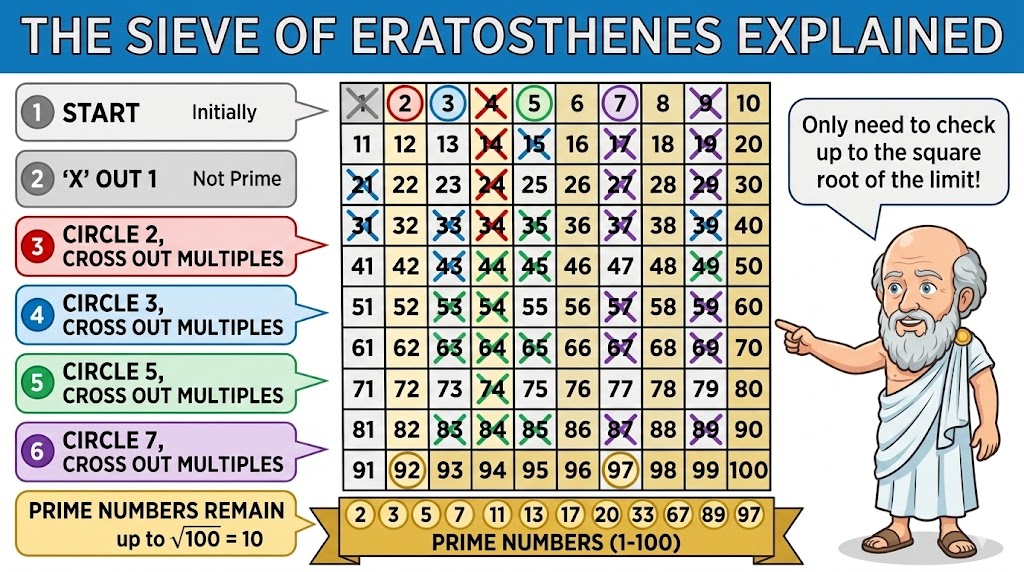
The Sieve of Eratosthenes explained in simple terms is a systematic way to identify all prime numbers up to a given limit.
A prime number is a number greater than 1 that can only be divided by 1 and itself. Examples include:
2, 3, 5, 7, 11, 13, 17, and 19.
The sieve method works by eliminating multiples of each number, leaving only prime numbers behind.
The word “sieve” refers to a tool used to separate fine particles from larger ones. Similarly, this mathematical method filters out composite numbers and leaves only prime numbers.
Why the Sieve of Eratosthenes Is Important
The sieve algorithm is important because it provides a simple and efficient way to find prime numbers. Prime numbers are fundamental to many areas of mathematics, including number theory, cryptography, and computer algorithms.
Even today, the concept behind the sieve is taught in schools and universities around the world. Computer scientists also use variations of this method when designing programs that require prime number calculations.
The brilliance of the algorithm shows the depth of Eratosthenes’ thinking and highlights his lasting Mathematics Contributions to the field.
Step-by-Step Explanation of the Sieve of Eratosthenes
Understanding the sieve becomes easier when we walk through a simple example.
Let’s find all prime numbers up to 30.
Step 1: Write the Numbers
Write down all numbers from 2 to 30.
2, 3, 4, 5, 6, 7, 8, 9, 10, 11, 12, 13, 14, 15, 16, 17, 18, 19, 20, 21, 22, 23, 24, 25, 26, 27, 28, 29, 30.
Step 2: Start with the First Prime Number
The first prime number is 2.
Circle 2 because it is prime.
Now eliminate all multiples of 2:
4, 6, 8, 10, 12, 14, 16, 18, 20, 22, 24, 26, 28, 30.
Step 3: Move to the Next Remaining Number
The next number that has not been removed is 3.
Circle 3 as a prime number.
Now eliminate all multiples of 3:
6, 9, 12, 15, 18, 21, 24, 27, 30.
(Some of these numbers were already removed.)
Step 4: Continue the Process
Next remaining number is 5.
Circle 5 and eliminate its multiples:
10, 15, 20, 25, 30.
Step 5: Continue Until the Limit
Repeat the process with 7 and continue until all numbers are processed.
The remaining circled numbers are:
2, 3, 5, 7, 11, 13, 17, 19, 23, 29.
These are the prime numbers up to 30.
Why the Algorithm Works
The algorithm works because every composite number has a smallest prime factor. By removing multiples of each prime number starting from 2, the sieve systematically eliminates all composite numbers.
This logical process reflects the mathematical thinking of Eratosthenes, whose analytical methods helped shape the development of mathematics.
The simplicity and efficiency of this technique highlight why his work continues to influence modern mathematical education.
Applications of the Sieve of Eratosthenes
The sieve is not just a historical concept. It is still used in several modern fields.
1. Computer Science
Prime numbers are essential in cryptography and encryption systems used to protect digital data.
2. Mathematical Research
Number theorists study prime number patterns and use sieve methods to analyze them.
3. Education
The sieve is commonly used in classrooms to teach students about prime numbers and logical algorithms.
These applications show how the Mathematics Contributions of Eratosthenes remain relevant today.
Eratosthenes’ Wider Contributions
Although the sieve is famous, it was only one part of his remarkable career.
His calculation of the Earth’s Circumference demonstrated how mathematics could be used to measure the real world with impressive accuracy.
He also helped establish the Birth of Geography by creating one of the earliest systems for mapping the Earth.
During his time at the Library of Alexandria, he studied literature, astronomy, and mathematics, organizing knowledge for scholars across the ancient world.
These achievements demonstrate why historians consider him a thinker Ahead of His Time.
Frequently Asked Questions (FAQs)
What is the Sieve of Eratosthenes?
The Sieve of Eratosthenes is a mathematical algorithm used to find all prime numbers up to a certain number by eliminating multiples of each prime.
Who invented the Sieve of Eratosthenes?
The method was created by Eratosthenes, a Greek mathematician and scholar who lived in the 3rd century BCE.
Why is the sieve called a “sieve”?
The method filters out composite numbers in the same way a sieve filters unwanted particles, leaving only prime numbers behind.
Why are prime numbers important?
Prime numbers are the building blocks of number theory and are essential in modern cryptography and computing.
Is the Sieve of Eratosthenes still used today?
Yes. The algorithm is widely used in mathematics education and computer science to generate prime numbers efficiently.
What other achievements did Eratosthenes have?
Besides creating the sieve, Eratosthenes calculated the Earth’s Circumference, helped establish the Birth of Geography, made important Mathematics Contributions, and served as a scholar at the Library of Alexandria, demonstrating ideas far Ahead of His Time.